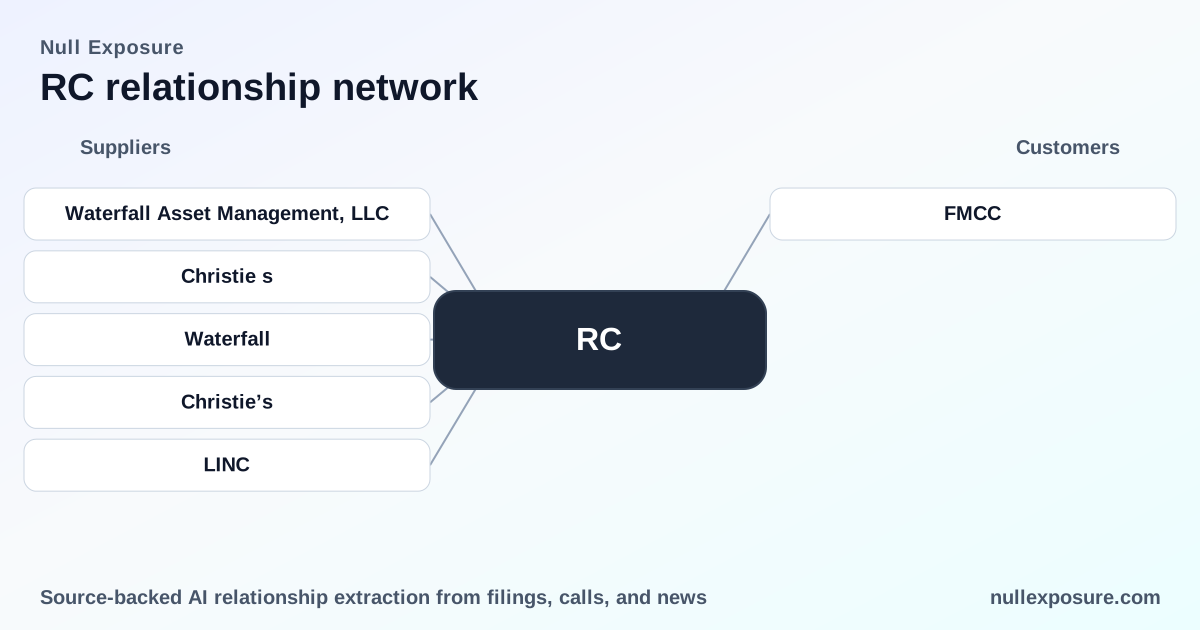
Ready Capital Corp (RC): Supplier Relationships and Strategic Dependencies
Ready Capital is a publicly traded mortgage REIT that originates, acquires and services small-balance commercial real estate loans and small-business lending products, and monetizes through interest income, loan sales, servicing fees and securitizations. The firm operates with a significant degree of externalization—using an external manager, third‑party servicers and bank partners—so investors should value the company as a capital allocator and contract manager as much as a balance-sheet lender. For a concise supplier-risk view and deeper counterparty mappings, visit https://nullexposure.com/.
How Ready Capital’s supplier posture shapes cash flow and risk
Ready Capital’s operating model emphasizes external management and outsourced servicing, which reduces fixed overhead but raises dependency risk on a small set of counterparties. Public disclosures and earnings commentary flag several company-level characteristics that drive supplier risk and strategic flexibility:
- Short-term financing orientation: Borrowings that are collateralized by loans and held-for-sale frequently have maturities within two years, which creates roll and liquidity sensitivity for the company’s funding stack.
- Small-business client exposure: The company provides working-capital advances to small businesses and purchases future revenues, anchoring revenue generation to high-frequency, credit-sensitive receivables.
- Government program participation: Ready Capital holds an SBA SBLC license and originates SBA Section 7(a) loans, positioning the firm to benefit from guaranteed lending but also to interface with the SBA’s program requirements and audit regime.
- Material bank counterparties: Named bank partners such as JPMorgan Chase and Morgan Stanley show up in disclosure tables and indicate important custodial and funding relationships that would be material to operational continuity.
- Dual economic roles: The firm acts both as a buyer of LMM (lower middle market) loans and as a service buyer—relying on external special servicers, property managers and ACH banks to execute collections and disbursements.
These dynamics create a business model that is capital-efficient but operationally concentrated, where execution quality at a few key suppliers directly affects net interest income and loss mitigation outcomes.
Relationship-by-relationship review (source-by-source)
Below are the supplier relationships surfaced in recent public coverage and transcripts, presented one result at a time with concise, investor‑oriented context.
Waterfall Asset Management, LLC — CityBiz (reported 2026)
Ready Capital is externally managed and advised by Waterfall Asset Management, LLC, which controls investment and portfolio management functions under contract. (CityBiz article reporting the appointment of a chief credit officer noted the firm is externally managed by Waterfall; March 2026) — https://www.citybiz.co/article/103022/ready-capital-corp-appoints-adam-zausmer-as-chief-credit-officer/
Christie s — InsiderMonkey (Q4 2025 earnings call transcript)
Management described adopting a phased sales strategy using a new sales agent, “Christie s,” to sell smaller units first and larger units later, indicating an active disposition program to manage asset realizations. (Q4 2025 earnings call transcript, InsiderMonkey) — https://www.insidermonkey.com/blog/ready-capital-corporation-nyserc-q4-2025-earnings-call-transcript-1706251/
Waterfall — InsiderMonkey (Q4 2025 earnings call transcript)
Management said it is increasing reliance on Waterfall to expand CRE investment capacity and reduce operating costs, explicitly shifting origination and underwriting muscle toward its external manager. (Q4 2025 earnings call transcript, InsiderMonkey) — https://www.insidermonkey.com/blog/ready-capital-corporation-nyserc-q4-2025-earnings-call-transcript-1706251/
Christie’s — The Globe and Mail / Motley (Q4 2025 earnings transcript)
A parallel transcript captured the same phased sales strategy with Christie’s as the sales agent, reinforcing that the company is outsourcing certain disposition functions to a third‑party auction/sales intermediary. (Q4 2025 earnings transcript, The Globe and Mail / Motley) — https://www.theglobeandmail.com/investing/markets/markets-news/motley/471712/ready-capital-rc-q4-2025-earnings-transcript/
Waterfall — The Globe and Mail / Motley (Q4 2025 earnings transcript)
The transcript reiterated the plan to streamline CRE origination into a lower‑cost structure with greater reliance on Waterfall’s CRE investment capacity, confirming the company-level shift toward external management. (Q4 2025 earnings transcript, The Globe and Mail / Motley) — https://www.theglobeandmail.com/investing/markets/markets-news/motley/471712/ready-capital-rc-q4-2025-earnings-transcript/
Lincoln (LINC) — InsiderMonkey (Q4 2025 earnings call transcript)
Management identified Lincoln as the property manager leading a strategy to drive higher occupancy in the Portland portfolio, signaling hands-on third‑party property management to boost cash flow from assets. (Q4 2025 earnings call transcript, InsiderMonkey) — https://www.insidermonkey.com/blog/ready-capital-corporation-nyserc-q4-2025-earnings-call-transcript-1706251/
Lincoln (LINC) — The Globe and Mail / Motley (Q4 2025 earnings transcript)
The same occupancy-focused approach led by Lincoln was echoed in the Globe and Mail transcript, underscoring that property management relationships are operationally relevant for portfolio performance. (Q4 2025 earnings transcript, The Globe and Mail / Motley) — https://www.theglobeandmail.com/investing/markets/markets-news/motley/471712/ready-capital-rc-q4-2025-earnings-transcript/
Explore a mapped view of these supplier exposures at https://nullexposure.com/ to quantify concentration and counterparty criticality.
What these supplier links mean for investors
- Concentration risk is elevated: Waterfall functions as both external manager and a source of CRE investment capacity; losing or changing that relationship would be operationally disruptive. Waterfall is a single point of strategic execution.
- Operational outsourcing reduces fixed cost but raises vendor-operational risk: Reliance on Lincoln for property management and on external sales agents like Christie’s means that execution quality at third parties will directly affect occupancy and realization timing.
- Funding and maturity profile is sensitive: Short-term, collateralized borrowings and reliance on bank counterparties for ACH and custodial services create liquidity and counterparty dependency that require active treasury management.
- Diversified revenue channels, concentrated execution: Ready Capital’s model blends SBA-guaranteed loans, LMM CRE lending and small-business revenue-purchase products—diverse revenue but concentrated supplier execution.
What to watch next and recommended investor actions
- Monitor the contract terms and renewal cadence with Waterfall and other named service providers; material fee resets or termination clauses would change economics quickly.
- Track borrowings maturities and bank exposures in quarterly filings to assess refinancing risk given short-term collateralized debt.
- Watch performance metrics tied to outsourced partners—occupancy trends in Lincoln-managed assets, pace and pricing of Christie’s sales, and loss mitigation outcomes tied to special servicers.
For an actionable supplier-risk report and counterparty scoring on Ready Capital, go to https://nullexposure.com/ and request the supplier map.
Bottom line
Ready Capital’s value lies in capital deployment and asset disposition governed through a narrow set of supplier relationships—not in a broad, vertically integrated operating engine. Investors should balance the upside of outsourced cost efficiency against the concentration and liquidity risks embedded in short-term funding and a small cohort of critical service providers. For a concise, investor-ready counterparty dossier and exposure scoring, visit https://nullexposure.com/.