RCAX supplier relationships: what investors need to know
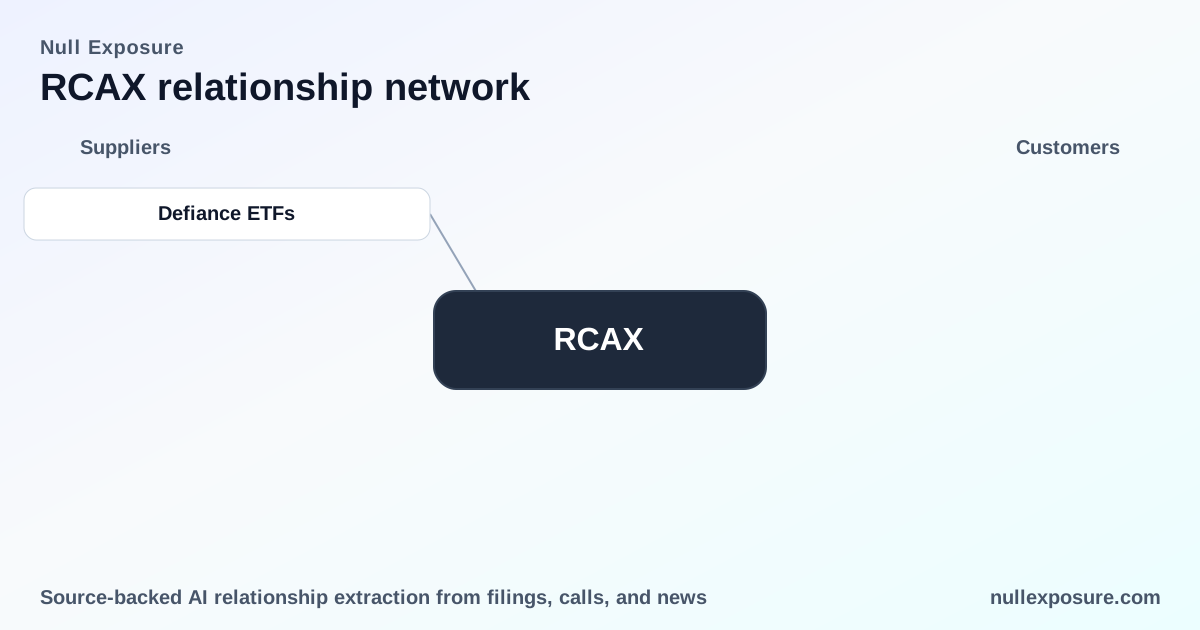
RCAX is the ticker for a newly launched leveraged ETF product issued by Defiance ETFs; the product generates revenue for its issuer through management and servicing fees, spreads and trading activity tied to short-term leveraged exposure, and typical issuer-level revenue streams such as securities lending and creation/redemption fees. For investors assessing counterparty and operational risk, the single visible supplier relationship driving RCAX’s market presence today is the ETF issuer itself — Defiance ETFs — which controls product design, distribution and the economic terms that monetize this vehicle. Understanding that issuer relationship is the primary determinant of commercial and operational risk for RCAX.
Explore issuer and supplier intelligence at https://nullexposure.com/
The quick read: what this relationship means for investors
Defiance ETFs launched the Defiance Daily Target 2X Long RCAT ETF under the ticker RCAX, positioning the product for active traders seeking amplified exposure. The economic model is issuer-centric: Defiance ETFs captures management fees and related ETF revenue streams while market participants provide liquidity through trading and authorized participant activity. That alignment concentrates supplier risk at the issuer level rather than across a broad supply chain.
The single listed relationship: Defiance ETFs
Defiance ETFs launched the fund described as the Defiance Daily Target 2X Long RCAT ETF (RCAX). According to a press release carried by The Globe and Mail on March 10, 2026, Defiance expanded its lineup with this single-stock leveraged ETF aimed at traders seeking amplified exposure to a chosen underlying (RCAT). The press release confirms the launch and places RCAX firmly as an issuer-created product rather than a third-party white-label vehicle (The Globe and Mail, March 10, 2026).
- Defiance ETFs is the issuer and commercial supplier for RCAX, responsible for product governance, fee schedule and distribution (The Globe and Mail, March 10, 2026).
- The launch was positioned to attract active traders who require intraday leveraged exposures rather than a buy-and-hold retail audience (The Globe and Mail, March 10, 2026).
How the operating model reads to an investor
The available records show a concentrated supplier posture: a single, clearly identified issuer relationship that controls creation, governance and monetization. That concentration translates into predictable commercial exposure and equally direct single-counterparty risk.
Key operating-model signals:
- Contracting posture: The issuer model indicates standard ETF contracting with authorized participants, custodians and market makers supplying liquidity and settlement, but those counterparty relationships are managed by the issuer rather than embedded across a complex supplier network.
- Concentration: RCAX’s supplier footprint is concentrated at Defiance ETFs; this is a single-point supplier structure that centralizes both operational control and counterparty dependency.
- Criticality: Defiance ETFs is critical to RCAX’s existence — product decisions, fees and distribution channels flow from the issuer’s governance and commercial choices.
- Maturity: The relationship is nascent and product-level; the March 2026 launch implies early-stage operational maturity for RCAX specifically, while Defiance as an issuer has an established market presence.
These signals combine into a clear investor implication: monitor issuer governance and fee structure closely, because changes at Defiance ETFs will have immediate and full effect on RCAX economics and positioning.
Explore product-level intelligence and issuer risk at https://nullexposure.com/
Constraint profile and what’s not on the record
The records provide no explicit contractual constraints tied to supplier relationships for RCAX; there are no disclosed supplier-specific limitations or restrictive covenants in the available results. This absence is a company-level signal: no published constraints suggests standard ETF issuance mechanics without additional named supplier bindings disclosed in the public launch notice. For due diligence, investors should treat the lack of disclosed constraints as neutral-to-positive for operational flexibility but require deeper review of issuer filings for fee schedules, authorized participant agreements and custodian arrangements that are typically documented elsewhere.
Risk considerations that flow from the supplier relationship
Given the concentrated supplier structure, the primary operational and market risks are:
- Issuer governance risk: Any change in Defiance ETFs’ product strategy, fee policy or compliance posture directly alters RCAX’s commercial profile.
- Liquidity and market structure risk: Leveraged single-stock ETFs depend on active market makers and authorized participant support; although those roles are standard, they operate at arm’s length to the issuer and are not listed in the launch notice.
- Early-stage product risk: As a newly launched fund in March 2026, RCAX will have limited trading history and adoption metrics until market participants establish a track record.
Investors should prioritize issuer disclosures (prospectus, fee table and authorized participant lists) and intra-day liquidity metrics as the next step in supplier-focused diligence.
Relationship-level summary (concise)
Defiance ETFs — Defiance launched the Defiance Daily Target 2X Long RCAT ETF (RCAX) and serves as the issuer and principal supplier for the product; the launch was announced in a press release published via The Globe and Mail on March 10, 2026. This single relationship defines the commercial and operational posture of RCAX and is the primary counterparty investors should monitor.
Source: The Globe and Mail press release reporting the Defiance ETF launch (March 10, 2026).
Final assessment and recommended actions
RCAX’s supplier footprint is simple and concentrated: Defiance ETFs is the controlling supplier and revenue recipient for the fund. For investors and operators evaluating exposure to RCAX, immediate next steps are:
- Review the RCAX prospectus and fee schedule filed with regulators to quantify issuer-level fees and operational mechanics.
- Track initial liquidity and spreads once trading commences to assess market-maker engagement.
- Monitor Defiance ETFs’ governance disclosures for any changes that could alter RCAX’s positioning.
For structured issuer intelligence and on-demand supplier relationship monitoring, visit https://nullexposure.com/ — the best place to centralize diligence on ETF issuer relationships and product launches.
This supplier snapshot establishes the core fact investors need: RCAX’s operational and commercial life is driven by Defiance ETFs, and active monitoring of that issuer is the most direct way to manage supplier risk.