RCEL (Avita Medical): Supplier and financing counterparties that shape operational runway
Avita Medical monetizes by commercializing regenerative-tissue products and wound-care matrices through a mix of direct sales and exclusive distributor partnerships, and it supports that commercial footprint with secured credit facilities that finance working capital and product manufacturing. Revenue derives from product sales across the U.S., U.K., and Australia; balance-sheet flexibility depends on secured debt counterparties and multi‑year distribution/manufacturing arrangements. For deeper counterparty intelligence and supplier risk scoring, visit the NullExposure homepage: https://nullexposure.com/.
Why counterparties matter to an investor in Avita
Avita is a commercial-stage medical devices firm with material negative operating margins but positive gross profit, which makes the company’s supplier contracts and financing partners central to cash-flow stability. The company’s financing counterparties control covenant and collateral dynamics that determine runway, while exclusive distribution and manufacturing agreements determine route-to-market concentration and product availability.
- Financing counterparties determine covenant risk and collateral claims.
- Exclusive distributors and manufacturing partners determine market access and operational continuity.
If you need consolidated counterparty profiles for diligence, see the NullExposure homepage: https://nullexposure.com/.
Recent financing counterparties — the public record
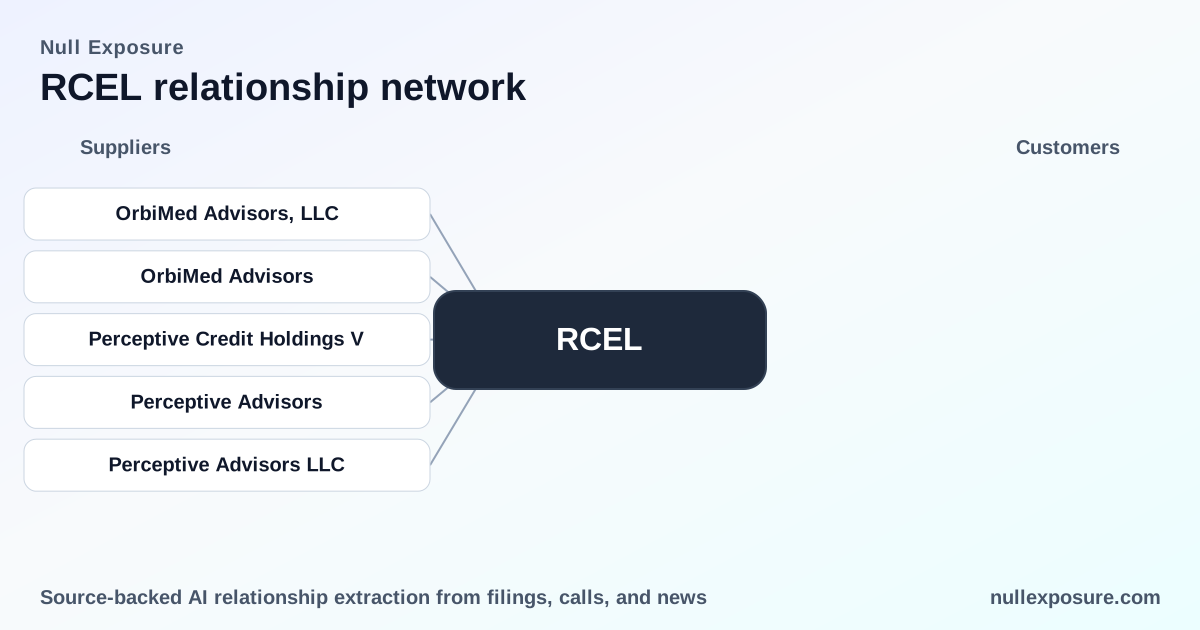
OrbiMed Advisors, LLC — FY2025 10‑K disclosure: Avita previously entered into a credit agreement with OrbiMed Advisors, LLC on October 18, 2023 (amended most recently November 5, 2025) that resulted in $40.0 million of indebtedness secured by substantially all of Avita’s assets, creating a secured creditor claim on operating assets. According to Avita’s FY2025 Form 10‑K, the OrbiMed facility was material collateralized debt. (FY2025 10‑K filing)
OrbiMed Advisors — TradingView report, March 10, 2026: TradingView recorded that Avita terminated its credit agreement with OrbiMed Advisors as part of a refinancing package, signaling a deliberate replacement of secured capital providers. (TradingView, March 10, 2026)
Perceptive Credit Holdings V — TradingView report, March 10, 2026: Avita secured a new five‑year senior secured credit facility of up to $60 million with Perceptive Credit Holdings V, replacing prior OrbiMed financing and increasing committed secured availability versus the prior $40 million indebtedness. (TradingView, March 10, 2026)
Perceptive Advisors — The Globe and Mail reporting on Avita’s earnings commentary: In January 2026 Avita refinanced its debt with a Perceptive Advisors facility that materially lowered covenant risk, improving near‑term financial headroom. (The Globe and Mail, March 2026)
Perceptive Advisors LLC — Motley Fool earnings transcript coverage: Company management told investors in the Q4‑2025 earnings call that in January they refinanced through a new credit facility with Perceptive Advisors LLC, underlining that the refinancing was a company-level strategic action discussed on the call. (Motley Fool/Motley Fool transcript coverage, Q4‑2025 earnings call, March 2026)
Perceptive Advisors LLC — Avita press release coverage: On January 13, 2026, Avita announced the closing of a five‑year credit facility providing up to $60 million in capital from Perceptive Advisors LLC, establishing a longer maturity profile for secured debt. (Company press release reported by The Globe and Mail, January 13, 2026)
Perceptive Advisors LLC — InsiderMonkey coverage of the Q4‑2025 call: Independent reporting reiterates that management refinanced debt through the Perceptive facility in January, confirming consistency between public statements and press coverage. (InsiderMonkey, March 2026)
What the contractual and supplier constraints tell investors
The public constraint excerpts give clarity on Avita’s operating model beyond financing: Avita runs long‑term, exclusive commercial agreements and outsources some manufacturing functions, which creates both strategic benefits and concentration risks.
- Avita has an exclusive multi‑year U.S. distribution and manufacturing agreement with Stedical Scientific, Inc. to market, sell and manufacture PermeaDerm, establishing a single-partner route-to-market for that product in the U.S. (Contract evidence: multi‑year distribution and later manufacturing agreement entered January 2024 and extended March 2025.)
- Avita entered a multi‑year exclusive development and distribution agreement with Collagen Matrix, LLC (doing business as Regenity Biosciences) to market Cohealyx and Regenity manufactures and supplies Cohealyx as an AVITA‑branded, FDA‑cleared dermal matrix, reflecting a supplier/manufacturer relationship rather than internal production. (Contract evidence: exclusivity and manufacturing role cited in corporate disclosures.)
These constraints form a company-level signal: Avita’s commercial model is dependent on a small number of exclusive partners for distribution and supply, while financing runs on multi‑year secured facilities. That mix drives both stability in go‑to‑market channels and concentration risk if a counterparty relationship deteriorates.
Investment implications: runway, concentration, and counterparty risk
- Improved covenant profile but still secured exposure. The move from OrbiMed to Perceptive increased committed capacity (up to $60M) and management states covenant risk declined; however, the facility remains senior secured and therefore limits asset flexibility for alternative financings. (Press release and earnings call, January–March 2026)
- Operational concentration is explicit. Multi‑year exclusive distribution and manufacturing agreements accelerate commercialization but concentrate execution risk in named partners (Stedical, Regenity). If either partner delays supply or distribution, revenue volatility will accelerate given Avita’s fixed-cost base and negative operating margins.
- Counterparty monitoring is essential. Track Perceptive’s covenant schedule and collateral enforcement language, and monitor renewal/extension timelines with Stedical and Regenity. Events to watch: covenant test dates, inventory‑supply notices from Regenity, and termination or assignment clauses in the Stedical agreement.
If you are building a diligence checklist or monitoring workflow around these counterparties, NullExposure aggregates these relationship proofs and surfacing triggers: https://nullexposure.com/.
Actionable next steps for investors and operators
- For investors: prioritize monitoring of the Perceptive facility’s covenant calendar and any standstill or waiver language that could affect liquidity ahead of clinical or commercial inflection points.
- For operators or procurement teams: secure secondary suppliers where possible or establish contingency logistics for PermeaDerm and Cohealyx to lower single‑partner dependency.
- For credit analysts: re‑price recovery assumptions to reflect that secured lenders hold claims on substantially all assets under the prior OrbiMed agreement and that the Perceptive facility is the successor secured lender.
For full counterparty profiles and automated alerting on material changes to these relationships, visit NullExposure: https://nullexposure.com/.
Bottom line
Avita operates a commercially oriented regenerative‑tissue business financed by secured credit facilities and driven by exclusive, multi‑year distribution and manufacturing partners. The Perceptive refinancing reduces covenant pressure compared with the prior OrbiMed facility, but secured creditor status and supplier concentration remain principal risk vectors for equity investors. Maintain active surveillance of Perceptive covenant outcomes and the performance of Stedical and Regenity as critical relationship nodes. For ongoing coverage and supplier risk scoring, see the NullExposure homepage: https://nullexposure.com/.