Rocket Pharmaceuticals (RCKT): licensing-first gene therapy platform with outsized supplier dependency
Rocket Pharmaceuticals builds value by in‑licensing academic and institutional gene therapy programs, advancing clinical development, and positioning for eventual product sales and royalties; the company currently generates no reported revenue and monetizes primarily through license-backed product launches and future net‑sales royalties. For supplier managers and buy‑side analysts, the immediate implication is a supplier profile dominated by academic licensors and contract manufacturers, with operating leverage driven by successful regulatory milestones. Learn more about supplier and counterparty exposure at https://nullexposure.com/.
Why the recent KRESLADI headlines matter to investors and operators
Rocket’s announcement about FDA acceptance related to KRESLADI highlights the company’s dependence on external academic inventors for core IP. KRESLADI was in‑licensed from Spanish research institutions, which makes these organizations strategic upstream suppliers for Rocket’s near‑term commercialization plan.
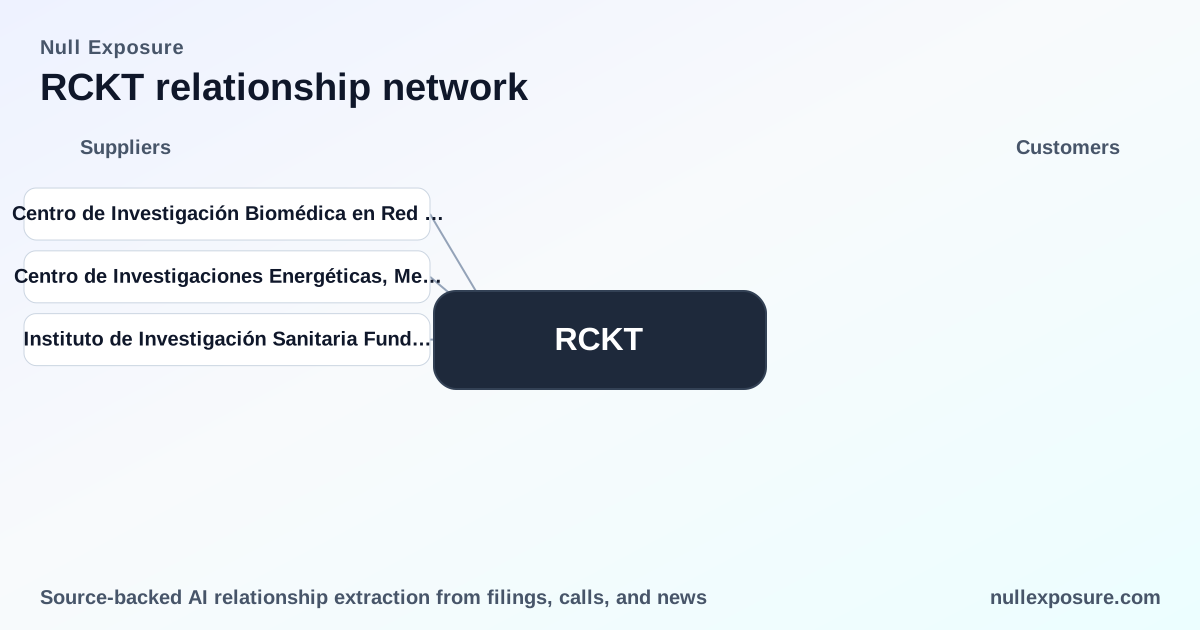
- Centro de Investigación Biomédica en Red de Enfermedades Raras (CIBERER): Rocket states that KRESLADI was in‑licensed from CIBERER, positioning the institute as a foundational IP source for this product candidate (Rocket press release on Yahoo Finance, March 10, 2026).
- Centro de Investigaciones Energéticas, Medioambientales y Tecnológicas (CIEMAT): CIEMAT is listed as a co‑licensor of KRESLADI, reinforcing Rocket’s pattern of acquiring exclusive rights from specialized public research centers (Rocket press release on Yahoo Finance, March 10, 2026).
- Instituto de Investigación Sanitaria Fundación Jiménez Díaz: The Foundation Jiménez Díaz is also named among licensors of KRESLADI, giving Rocket access to clinical and translational know‑how tied to the candidate (Rocket press release on Yahoo Finance, March 10, 2026).
PharmiWeb’s October 14, 2025 release similarly documents the same in‑license chain for KRESLADI, corroborating the institutional origins and the continuity of these relationships through Rocket’s development milestones.
A licensing-centric operating model — what that implies for contracting and concentration
Rocket’s operating model is structured around exclusive licenses and acquisition of academic IP, which creates a supplier stance where upstream research institutions function as strategic, high‑criticality licensors rather than commodity vendors. Company disclosures consistently list numerous exclusive, worldwide licenses (CIEMAT, UCSD, Temple University and others), and Rocket’s contracts typically include sublicensing rights and royalty obligations—royalties are explicit in certain deals (for example, low‑single digit royalties to Temple University).
At the company level, the disclosures also show a mixed contracting posture:
- Long‑term commitments exist in operational leases (an NJ lease with an initial term running to 2034 and renewal options), signaling facility stability for manufacturing or lab operations.
- Short‑term engagements are used for flexibility, including an Empire State Building office lease expiring July 2027 and the routine use of independent contractors and consultants for project‑specific expertise.
- Licensing relationships are frequent and central (multiple license agreements across vector platforms and gene targets), indicating concentrated dependence on a small set of academic licensors and IP owners.
These are company‑level signals derived from Rocket’s filings and disclosures; they describe the firm’s contracting posture, supplier maturity, and concentration without assigning a specific constraint to any single licensor.
Manufacturing and service provider exposure: critical but outsourced
Rocket discloses development, manufacturing, and testing agreements with third parties to produce supplies of product candidates, which means manufacturing is a critical outsourced skillset for the company. Because the firm reports no revenue through the latest quarter and runs a negative operating profile (market cap roughly $528.7M; EBITDA negative as of the latest reporting period ending 2025‑12‑31), successful third‑party manufacturing scale‑up is essential to convert licenses into commercial sales.
The company also states it continuously enhances vendor oversight—vendor qualification and ongoing monitoring are active parts of its supplier governance, which reduces but does not eliminate operational dependency on external manufacturing partners.
Relationship snapshots (plain English, source-backed)
Centro de Investigación Biomédica en Red de Enfermedades Raras — Named as a co‑licensor of KRESLADI, CIBERER supplies intellectual property and disease‑specific research that underpins Rocket’s candidate (Rocket press release on Yahoo Finance, March 10, 2026; PharmiWeb, Oct 14, 2025).
Centro de Investigaciones Energéticas, Medioambientales y Tecnológicas (CIEMAT) — CIEMAT is cited as a rights holder for the KRESLADI program and has been the source of prior vector and LV licenses to Rocket, making it a recurring academic supplier of core gene therapy IP (Rocket press release on Yahoo Finance, March 10, 2026; PharmiWeb, Oct 14, 2025).
Instituto de Investigación Sanitaria Fundación Jiménez Díaz — The Foundation Jiménez Díaz is listed among the institutions that transferred rights for KRESLADI; its clinical assets and translational data are part of Rocket’s regulatory dossier (Rocket press release on Yahoo Finance, March 10, 2026; PharmiWeb, Oct 14, 2025).
Practical takeaways for procurement, compliance, and the buy side
- Treat academic licensors as strategic counterparties: they supply exclusive IP and clinical data that materially affect valuation and timeline risk.
- Prioritize manufacturing vendor redundancy and qualification: Rocket’s reliance on third‑party manufacturers makes supplier continuity planning a core risk mitigant.
- Monitor contractual horizons: the firm maintains both long‑term facility leases and short‑term consultant arrangements, suggesting operational stability with tactical workforce flexibility. Learn more about supplier exposure and counterparty risk frameworks at https://nullexposure.com/.
The bottom line for investors
Rocket is a licensing‑driven biotech with no TTM revenue reported and a negative EBITDA, backed by a market capitalization in the mid‑hundreds of millions and an analyst consensus target near $8.20. The company’s value is concentrated in a small set of academic licensors and in outsourced manufacturing capacity, and its supplier posture mixes long‑term facility commitments with short‑term human capital engagements. For investors and operators, the focus should be on the integrity of license exclusivity, royalty obligations, third‑party manufacturing scale‑up, and the company’s active vendor oversight processes.
If you want a deeper supplier map and counterparty risk scorecard for RCKT, explore comprehensive relationship analytics at https://nullexposure.com/. For tailored supplier diligence or to monitor 계약 exposure over time, visit https://nullexposure.com/ to request a consultation.