Rocky Brands (RCKY): Supplier relationships, acquisition leverage, and what operators should watch
Rocky Brands designs, manufactures and markets premium footwear and apparel under owned and licensed labels (Rocky, Georgia Boot, Durango, Lehigh and licensed Michelin). The company monetizes through wholesale channels and direct-to-consumer sales, supplemented by strategic brand acquisitions that expand SKU breadth and industrial footwear exposure; profitability depends on manufacturing scale, inventory discipline and successful integration of acquired brands. The 2021 acquisition of Honeywell’s performance and lifestyle footwear business materially changed Rocky’s supplier, manufacturing and financing posture and remains the central lens for evaluating supplier risk and capital structure. For a consolidated view of supplier signals and deal counterparties, see https://nullexposure.com/.
How the acquisition reshaped supplier relationships and capital flows
Rocky’s acquisition of The Original Muck Boot Company and XTRATUF (and related brands) for roughly $230 million transformed the company from a niche domestic boot maker into a broader performance-footwear platform. The purchase was financed with a mix of asset-backed credit, a secured term loan and cash — a financing package that increased Rocky’s reliance on external lenders and elevated integration risk while giving the company immediate scale in outdoor and lifestyle categories. According to SGB Online’s coverage of the FY2021 transaction, the deal was funded with an $80 million senior secured asset-backed credit facility from Bank of America and a $130 million senior secured term loan from The Direct Lending Group of TCW, plus cash on hand.
Relationship map — who Rocky worked with (one-by-one)
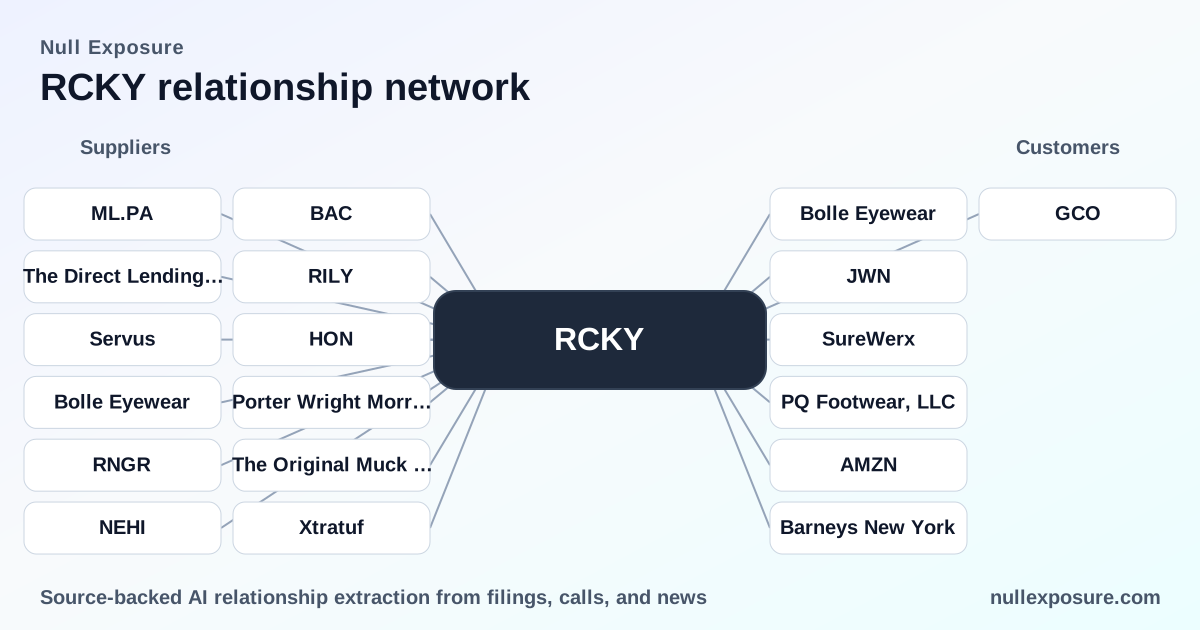
Below are plain-English summaries of every counterparty or supplier relationship identified in public coverage and news mentions. Each line cites the reporting used.
Bank of America, N.A.
Bank of America provided an $80 million senior secured asset-backed credit facility that helped fund Rocky’s acquisition of Honeywell’s performance and lifestyle footwear business; this financing was reported in connection with the FY2021 deal (SGB Online, reporting on the FY2021 transaction).
The Direct Lending Group (TCW Asset Management)
The Direct Lending Group of TCW supplied a $130 million senior secured term loan facility as part of the acquisition financing package, increasing Rocky’s term debt obligations tied to the FY2021 purchase (SGB Online, FY2021 coverage).
B. Riley Securities
B. Riley Securities acted as financial advisor to Rocky Brands and provided a fairness opinion on the Honeywell acquisition transaction, according to SGB Online’s report of the FY2021 deal.
Honeywell International, Inc. (Honeywell / Honeywell Inc.)
Honeywell divested its performance and lifestyle footwear business — including The Original Muck Boot Company, XTRATUF, NEOS, Servus and Ranger brands — in a transaction completed March 15, 2021 for approximately $230 million, transferring brand ownership and manufacturing assets to Rocky (CityBiz and SmartBusinessDealmakers reporting on FY2021).
The Original Muck Boot Company
The Original Muck Boot Company became an owned brand within Rocky’s portfolio through the March 2021 acquisition, representing a direct product and brand integration that substantially broadened Rocky’s outdoor and lifestyle offerings (CityBiz, March 2021 completion notice).
XTRATUF / Xtratuf / XTRATUF
XTRATUF fishing and deck footwear was part of the Honeywell divestiture purchased by Rocky, adding a specialty marine/outdoor SKU set to Rocky’s distribution and manufacturing plans (SmartBusinessDealmakers, FY2021 coverage).
NEOS / Neos Overshoe
NEOS overshoes were included in the Honeywell portfolio Rocky acquired in March 2021, and Rocky referenced NEOS as part of the acquired mix that augmented production throughput and inventory (Sourcing Journal and SmartBusinessDealmakers, FY2021).
Servus
Servus protective rubber boots were included in the divestiture and became part of Rocky’s product family, with Rocky highlighting the addition as expanding its Made‑in‑America and manufactured‑product capabilities (CityBiz and GlobeNewswire reporting, FY2021).
Ranger
Ranger was listed among the five brands divested by Honeywell and acquired by Rocky, contributing to the company’s stated goal of nearly doubling annual revenues through brand scale (SmartBusinessDealmakers and CityBiz, FY2021).
Porter Wright Morris & Arthur LLP
Porter Wright Morris & Arthur LLP served as legal counsel to Rocky Brands on the transaction, supporting the corporate and transactional work required to complete the FY2021 acquisition (SGB Online, FY2021 reporting).
Michelin (licensed brand)
Rocky markets products under the licensed Michelin brand, reflecting a licensing relationship that extends product reach and margin potential through brand recognition in select categories (SmartBusinessDealmakers, FY2021 company profile).
The Direct Lending Group of TCW Asset Management Company LLC
(See above; listed separately in source material) The Direct Lending Group’s term loan participation was a central lender role in the acquisition financing structure that increased secured leverage at closing (SGB Online, FY2021).
Bolle Eyewear
Bolle Eyewear is a commercial partner in Rocky’s PPE and prescription safety eyewear program, with management citing the partnership as a growth driver in safety eyewear during FY2026 earnings commentary (InsiderMonkey transcript, FY2026 earnings call).
Operating constraints and what they signal for sourcing and margin control
Rocky’s public disclosures and reporting produce a consistent set of company-level supplier signals:
- Short-term contracting posture: Rocky states it does not maintain long-term contracts with third‑party manufacturers, indicating a transactional supplier model that provides flexibility but exposes the company to price volatility and capacity scarcity (company excerpts).
- Geographic sourcing footprint: Rocky sources a significant portion of footwear, apparel and gloves from manufacturers in Asia (China, Vietnam, India) and operates owned manufacturing in the Dominican Republic, Puerto Rico and China, with supplier relationships extending into Latin America; this multi‑region manufacturing base reduces single-country concentration but raises logistics and tariff exposure (company sourcing disclosures).
- Manufacturer role and reliance: The company sources finished goods and components from third‑party manufacturers rather than relying exclusively on captive production, making supplier selection and quality control critical to maintaining margins and delivery performance.
These are company-level signals and should be treated as structural characteristics of Rocky’s operating model rather than attributes of any single supplier unless explicitly named.
Implications for investors and operators
- Credit and integration risk are now material: The FY2021 financing package increased secured leverage and introduced lender covenants that constrain capital allocation; investors should track covenant compliance and free cash flow conversion as the integration of multiple acquired brands completes. Reporting in SGB Online documents the $80m and $130m facilities used in the acquisition.
- Supply flexibility and cost volatility: Short-term manufacturing contracts provide nimbleness for SKU shifts but heighten exposure to input inflation and capacity squeezes across APAC and LATAM sourcing lanes; operators must prioritize supplier diversification and inventory discipline.
- Brand-driven margin potential: The Michelin license and acquisitions like Muck and XTRATUF materially expand Rocky’s addressable market and support pricing power in industrial and outdoor segments, but successful monetization depends on distribution execution and wholesale relationships.
For a concise strategic monitoring checklist and deeper counterparty profiles, visit https://nullexposure.com/.
Key takeaways and next actions
- Rocky Brands is now a consolidator in performance and lifestyle footwear with a financing structure tied to external lenders and a supplier model that is geographically diversified but contractually short-term. The FY2021 Honeywell deal and its financing are the single largest inflection in the company’s supplier and capital story (CityBiz and SGB Online coverage).
- Operational focus should be on integration, covenant headroom, and supplier risk mitigation. Investors should prioritize quarterly cash flow metrics and inventory trends; operators should prioritize supplier lead-time visibility and alternative sources in APAC and LATAM.
If you want a structured supplier risk brief and lender counterparty map for Rocky Brands, start here: https://nullexposure.com/. For ongoing alerts and curated reporting on RCKY counterparties, subscribe at https://nullexposure.com/.