Royal Caribbean Group (RCL): Supplier relationships and strategic constraints that shape the investment case
Royal Caribbean Group operates and monetizes by selling cruise experiences across multiple brands while capturing ancillary revenue (onboard spending, shore excursions, and premium experiences) and leveraging scale in fleet deployment; liquidity events such as bond offerings and secured financing underpin capital-intensive shipbuilding and terminal investments. The company earns margin from ticket sales and high-margin onboard services, finances fleet growth through a mix of unsecured and export-credit–backed debt, and externalizes operational complexity to a concentrated set of shipyards, port authorities, and financial underwriters.
If you evaluate supplier counterparty risk or procurement exposure for portfolio or operations diligence, start with this concise mapping of active financial underwriters and the corporate-level constraints that define contracting posture and spend concentration. For a quick primer on supplier exposure monitoring visit https://nullexposure.com/.
What the recent activity tells investors: debt placement as a financing lever
Royal Caribbean completed a sizable unsecured notes offering in March 2026 to fund operations and capital programs. The company uses the capital markets and bank syndicates as primary financing channels, which reduces near-term liquidity pressure compared with asset-backed or highly constrained export-credit structures, but preserves meaningful unsecured leverage on the balance sheet. That financing posture interacts directly with supplier and contractor risk because cash available for large capital projects (shipbuilding, terminal improvements) depends on access to these underwriters and bond market terms.
The named supply-side relationships you need to know
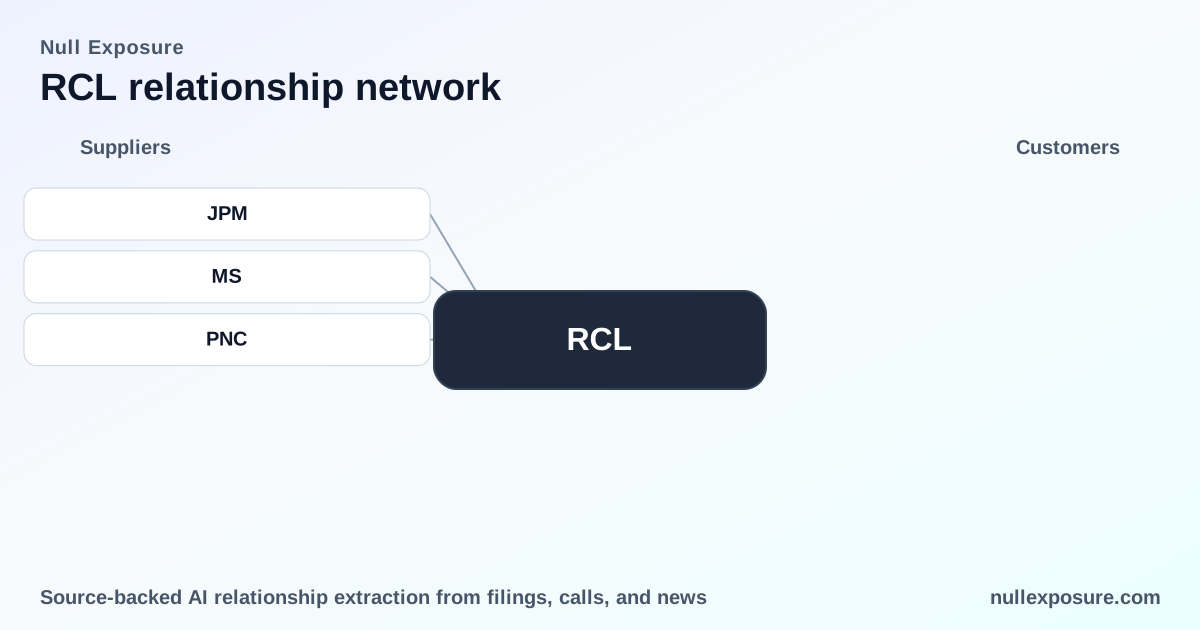
Below are every supplier/partner referenced in the disclosure set returned for RCL; each entry includes a plain-English summary and the primary source.
-
J.P. Morgan Securities LLC — J.P. Morgan acted as a lead book-running manager on Royal Caribbean’s March 2026 offering of $1.25 billion senior unsecured notes due 2033 and $1.25 billion due 2038, helping place long-dated unsecured debt with institutional investors. According to a PR Newswire release announcing the completion of the offering on March 10, 2026, J.P. Morgan was a lead manager for the transaction (PR Newswire, March 10, 2026; https://www.prnewswire.com/news-releases/royal-caribbean-group-announces-completion-of-offering-of-1-25-billion-senior-unsecured-notes-due-2033-and-1-25-billion-senior-unsecured-notes-due-2038--302699803.html).
-
Morgan Stanley & Co. LLC — Morgan Stanley joined the book-runners for the same unsecured notes offering, supporting syndication and distribution to buy-side accounts and helping Royal Caribbean secure fixed-rate long-term funding. The participation is documented in the same PR Newswire announcement of the offering (PR Newswire, March 10, 2026; https://www.prnewswire.com/news-releases/royal-caribbean-group-announces-completion-of-offering-of-1-25-billion-senior-unsecured-notes-due-2033-and-1-25-billion-senior-unsecured-notes-due-2038--302699803.html).
-
PNC Capital Markets LLC — PNC Capital Markets also acted as a lead book-running manager on the March 2026 unsecured notes offering, completing the syndicate alongside J.P. Morgan and Morgan Stanley to place the combined $2.5 billion issuance. The role is listed in the same press release (PR Newswire, March 10, 2026; https://www.prnewswire.com/news-releases/royal-caribbean-group-announces-completion-of-offering-of-1-25-billion-senior-unsecured-notes-due-2033-and-1-25-billion-senior-unsecured-notes-due-2038--302699803.html).
Each of these relationships is transactional and centered on capital markets execution; the bank syndicate provides distribution and underwriting services rather than operational inputs to the cruise business.
For operational supplier mapping and continuous monitoring tools, see https://nullexposure.com/ for a walkthrough of supplier coverage and exposure analytics.
Company-level constraints that shape supplier strategy and counterparty priority
Royal Caribbean’s public disclosures reveal a combination of long-term contracts, government-backed financing, concentrated manufacturing partners, substantial committed spend, and outsourcing to service providers. Those characteristics should be treated as company-level signals that influence procurement risk and supplier negotiation leverage:
-
Contracting posture: long-term, capital-intensive commitments. The company’s master lease for its Miami headquarters is treated as a finance lease through 2077 with extension options the company says it is reasonably certain to exercise, which indicates multidecade fixed commitments for real estate and related services.
-
Counterparty mix includes government guarantees. Export-credit agencies (such as Finnvera and Euler Hermes referenced in filings) guarantee a large portion of certain ship financings, revealing a financing stack that mixes private capital markets and government-supported loans—useful when evaluating recovery priority and political risk in shipbuilding programs.
-
Manufacturing concentration is material. Royal Caribbean explicitly names a limited set of shipyards (for example, Chantiers de l'Atlantique and Meyer Turku Oy) for multi-year build schedules; the company states shipyards are scarce in capability and capacity, making production timing and supplier reliability a critical single point of failure.
-
Service-provider outsourcing is broad and operationally critical. The company outsources key functions—onboard concessionaires, parts of call center operations, guest port services, logistics, and substantial IT operations—creating a distributed operational footprint that requires tight SLAs and contingency planning.
-
Spend and committed exposure are large and backloaded. Management reports aggregate future commitments of roughly $1.66 billion for port facilities, marine consumables, services, and maintenance across the medium and long term, with notable spikes in the nearer years (2026–2028). These commitments translate into high procurement sensitivity to cash flow and refinancing conditions.
These constraints collectively increase the strategic importance of a small number of suppliers and financial underwriters, and they also raise the bar for operational continuity if a shipyard or port partner experiences disruption.
Risk profile and concentration — what investors should watch
- High supplier concentration for shipbuilding and repairs creates execution risk; delays at a key shipyard directly delay revenue-generating newbuilds and increase drydock expense.
- Funding risk is mitigated but not eliminated because Royal Caribbean can access unsecured market channels (as the March 2026 bond shows), but rising rates or a stressed credit market would increase refinancing cost for capital projects.
- Contractual stickiness with port authorities (e.g., long-term lease and anticipated Terminal G milestones) locks in fixed payments and counterparty exposure to municipal construction timelines and political cycles.
Investment implications and actionable signals
- For credit-oriented investors: the successful $2.5 billion unsecured notes placement is a positive indicator of market access, yet monitor covenant drift and leverage metrics relative to EBITDA (RCL’s EV/EBITDA and leverage trends will be determinant).
- For equity or operations investors: manufacturing concentration and outsourced services are the dominant operational risks; active diligence on shipyard backlog, delivery schedules, and port construction milestones is essential.
- For procurement and vendor managers: prioritize contingency arrangements with alternate repair yards and diversified port service providers; insist on milestone-based payments and performance bonds where possible.
If you need a deeper supplier exposure map or continuous monitoring across underwriters, shipyards, and port commitments, consult our investor tools at https://nullexposure.com/ to translate these disclosures into operational risk metrics.
Bottom line and next steps
Royal Caribbean’s capital strategy leverages both unsecured market issuance and selective government-backed financing while relying on a small group of high-capability manufacturers and a broad roster of outsourced service providers. That combination creates durability in market access but concentration risk in operations; both factors are central when sizing downside scenarios and liquidity cushions.
For portfolio managers and operators assessing counterparty resilience, begin with syndicate relationships and shipyard schedules as leading indicators; for hands-on vendor risk mitigation, focus on alternate docking and spare-parts logistics. To get a structured supplier risk report tailored to your investment or operational horizon, visit https://nullexposure.com/ and request supplier coverage aligned to your diligence objectives.