R1 RCM Inc: The revenue engine for healthcare—what the supplier relationships reveal
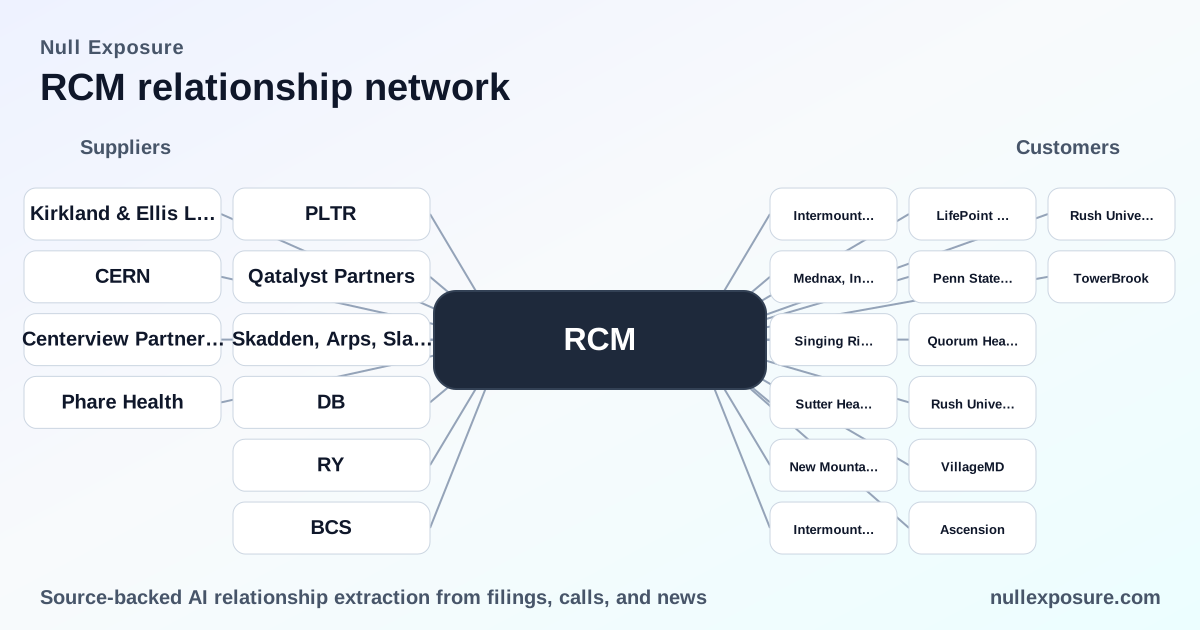
R1 RCM Inc operates as a technology-enabled revenue cycle manager for hospitals and outpatient providers, monetizing through outsourced billing contracts, platform fees and performance-linked incentives that capture retained savings and improved collections. Its economics combine recurring services revenue with margin upside from scale and AI-driven automation, a proposition that attracted a reported private-equity acquisition and a wave of strategic partnerships. For investors evaluating R1 as a counterparty or supplier, the health of its ecosystem—banks, advisors, legal counsel, technology partners and acquired capabilities—directly maps to deal structure, execution risk and upside from automation.
Explore supplier and advisor relationships that matter at https://nullexposure.com/ for deeper counterparty intelligence.
The operating model you need to understand up front
R1 trades on criticality: revenue cycle operations are mission-critical to hospital cash flow, creating high switching costs and multi-year contracting posture. Contracts tend to be concentrated around large health systems even as the company pursues scale; this creates meaningful client concentration risk offset by service stickiness. Financially, R1 generated about $2.46 billion of revenue (TTM) with EBITDA around $518 million, but the companywide profit margin was negative in the most recent period, indicating a sensitivity to operating leverage and integration costs. On the maturity axis, R1 is a scaled vendor that is actively retooling its platform through acquisitions and AI partnerships—an explicit strategic response to margin compression and client demand for automation.
Key company-level signals:
- Contracting posture: long-term, service-level contracts with performance components.
- Concentration: revenue depends on a set of large health-system clients.
- Criticality: high—billing and coding are essential hospital functions.
- Maturity: established public company transitioning under private-equity ownership and accelerating AI investments.
Who sits around the R1 table — the relationships that drive strategy and execution
Below I cover every relationship listed in the company-scope results, with a concise business takeaway and the source context.
-
Palantir Technologies (PLTR) — R1 built an enterprise AI capability called R37 in partnership with Palantir to develop agentic AI tools that automate revenue-cycle intelligence and decisioning. This is a strategic technology partnership intended to accelerate automation across R1’s client base (TechTarget, Mar 2026; GlobeNewswire/May 2025).
Sources: TechTarget report (Mar 10, 2026) and GlobeNewswire release (May 28, 2025). -
Palantir (alternate coverage) — media accounts also describe Palantir tooling being installed into R1’s data repository as part of the same AI initiative, reinforcing that the relationship is operational (Precedence Research coverage, 2026).
Source: PrecedenceResearch article (2026). -
Phare Health — R1 completed the acquisition of Phare Health to bring AI-native inpatient coding and clinical documentation improvement capabilities in-house, a bolt-on that feeds R1’s product roadmap for automated coding and capture. The acquisition was announced alongside product launches in early 2026.
Source: GlobeNewswire release announcing Phare integration and product launch (Jan 8, 2026). -
Cerner (CERN) — R1 acquired Cerner’s RevWorks business in 2020 and integrated its staff and platform elements, a move that extended R1’s service footprint and created integration workstreams between R1’s services and Cerner’s clinical systems. This is an example of R1 growing through targeted M&A to deepen EHR interoperability.
Source: HitConsultant coverage of the RevWorks acquisition (Jun 3, 2020). -
TowerBrook Capital Partners & Clayton, Dubilier & Rice (CD&R) — while not individually listed as relationships in the results array, the 2024 announcement that R1 would be acquired for $8.9 billion places private-equity ownership at the center of R1’s strategic and capital posture, shaping leverage, investment cadence and exit planning.
Source: GlobeNewswire release on the acquisition agreement (Aug 1, 2024). -
Qatalyst Partners — Qatalyst served as a financial advisor to R1’s Special Committee during the acquisition process, indicating external advisory bandwidth used to run the strategic sale process and validate valuation.
Source: GlobeNewswire release (Aug 1, 2024). -
Barclays — Barclays acted as a financial advisor to the R1 Special Committee alongside Qatalyst, signaling use of top-tier investment banking in the sale and capital-structure discussions.
Source: GlobeNewswire release (Aug 1, 2024). -
Deutsche Bank (DB) — Deutsche Bank is reported to be part of the committed debt financing for the leveraged buyout, an important signal about the debt syndication and the likely covenant and repayment profile post-transaction.
Source: MPAMag coverage of the financing package (reported in 2024/2025). -
Royal Bank of Canada (RBC/RY) — RBC participated alongside Deutsche Bank in arranging the approximately $4.5 billion debt financing package to support the acquisition, indicating cross-border syndication for the LBO.
Source: MPAMag article detailing the debt arrangement (2024). -
Skadden, Arps, Slate, Meagher & Flom LLP — Skadden was counsel to the Special Committee in the sale process, reflecting the use of top-tier M&A legal support for governance and regulatory navigation.
Source: GlobeNewswire release (Aug 1, 2024). -
Kirkland & Ellis LLP — Kirkland served as legal counsel to R1 in prior transactions and in the RevWorks integration, underscoring repeated use of large-cap corporate counsel through strategic M&A and financing events.
Source: GlobeNewswire (Aug 1, 2024) and HitConsultant (Jun 3, 2020). -
Centerview Partners LLC — Centerview acted as financial advisor to R1 for the 2020 RevWorks transaction, which demonstrates a history of partnering with senior advisors for tuck-ins and strategic acquisitions.
Source: HitConsultant summary of the RevWorks deal (Jun 3, 2020).
What these relationships imply for risk and upside
The network around R1 paints a clear strategic thesis: R1 is investing aggressively in AI (Palantir, Phare) while operating under a private-equity financing and advisory structure that emphasizes margin improvement and consolidation. That combination boosts potential operational leverage but also concentrates execution risk: successful integration of AI and acquired capabilities is necessary to justify leverage and to convert EBITDA to free cash flow.
- Upside: AI partnerships and acquisitions can raise throughput and capture previously lost revenue (higher collections per claim), directly boosting margins.
- Risk: LBO debt and integration costs create sensitivity to downside; client concentration or contract churn would stress covenant headroom.
- Operational constraint: R1’s contracting posture—long-term, operationally critical agreements—reduces churn risk but increases the cost of failure on automation projects.
If you evaluate counterparty exposure or supplier risk, track contract renewals, reported collections per adjusted discharge, and progress on agentic AI deployments; these are the levers that determine whether strategic investments convert into sustainable margin expansion.
For a structured, evidence-driven view of counterparties and their role in transactions, visit https://nullexposure.com/ to see how supplier intelligence maps to balance-sheet outcomes.
Bottom line and recommended next steps for investors and operators
R1’s ecosystem—top-tier banks and advisors for financing and sale execution, and strategic AI and coding acquisitions—aligns with an aggressive margin-recovery thesis under private-equity ownership. Investors should treat R1 as a case where technology partnerships and M&A execution are the primary drivers of value realization. Monitor the Palantir R37 rollout and the Phare integration as leading indicators of future cost and cash-flow improvement.
If you are underwriting exposure or negotiating with R1, insist on transparency around implementation timelines, SLA measures tied to revenue capture, and escalation governance for AI-driven coding changes. For more detailed counterparty profiles and ongoing monitoring, start with https://nullexposure.com/ — the supplier network tells the story behind the numbers.