RCM Technologies (RCMT): supplier relationships, lease commitments, and where operational risk lives
RCM Technologies operates as an engineering and technology services firm that monetizes through project-based engineering, construction-management services, staffing and equipment procurement on behalf of clients; the company typically invoices end-clients and passes cash to subcontractors or vendors, while retaining margin and contractual responsibility as the primary contractor. Investors should model RCM’s cash conversion and counterparty risk around long-term lease commitments and sizable pass-through working capital items rather than pure recurring subscription economics. For faster supplier-screening and relationship intelligence, see https://nullexposure.com/.
Why supplier relationships matter for RCMT investors
RCM’s commercial model creates two linked exposures for operators and investors: (1) working capital and payment timing risk from pass-through subcontractor/vendor payments, and (2) fixed-cost leverage from long-dated leases. These are company-level characteristics visible in filings and public coverage.
- According to RCM’s filing data for the period ending December 28, 2024, transit accounts show $7.3 million in receivables and $23.9 million in payables, producing a net payable of $16.6 million—a material working capital overlay that can compress cash flow when client collections lag.
- Lease schedules disclosed by the company show long-term maturities extending through 2029 and thereafter, with roughly $6.3 million in operating lease payments and $1.9 million in finance lease payments laid out across future years, indicating sustained fixed-cost obligations.
- The company’s contracting posture is dual: RCM acts as a buyer when it purchases equipment or hires subcontractors on behalf of customers and serves as the primary service provider, accepting performance risk and the obligation to pay subcontractors even if clients delay payment. These dynamics amplify short-term liquidity volatility and make supplier/payment flows a critical lens for credit and operational diligence.
What the public record shows about named relationships
Below are the relationships surfaced in public reporting and their immediate implications for diligence.
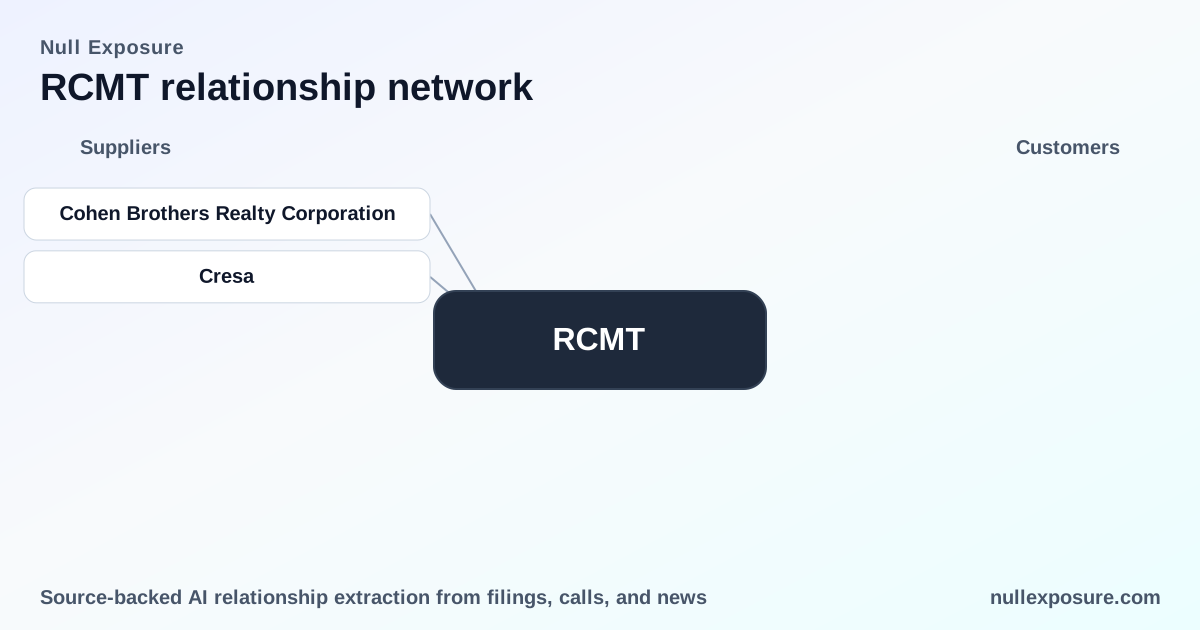
Cohen Brothers Realty Corporation
RCM’s move to a new facility was handled with Cohen Brothers as the landlord; a 2014 LoHud real-estate piece reported that Charles S. Cohen announced a lease signing for the tenant’s Westchester Avenue location, indicating Cohen Brothers acted as the property landlord in that transaction (https://www.lohud.com/story/lohud-real-estate/2014/04/08/tech-firm-plans-a-westchester-avenue-move/7470931/). This is evidence of RCM’s long-term real estate relationships and supports the company’s disclosed multiyear lease obligations.
Cresa
The same 2014 LoHud report noted that Cresa represented the tenant in the lease transaction (Stephanie Coleman acted for Cresa), showing RCM’s use of tenant-representation commercial brokers for occupancy negotiation (https://www.lohud.com/story/lohud-real-estate/2014/04/08/tech-firm-plans-a-westchester-avenue-move/7470931/). Broker involvement is consistent with structured, negotiated leases rather than ad hoc occupancy and aligns with the company’s longer-dated contractual commitments.
How these relationships map to operational constraints
Treat the constraints below as company-level signals that shape supplier risk and procurement strategy:
- Contracting posture — long-term commitments: Lease math in filings shows leases with multi-year maturities and a total future operating lease payment schedule in the low millions; this is not transient occupancy but a structural fixed-cost base that limits near-term flexibility. (Company filing excerpts for lease maturities, FY2024)
- Materiality — notable working capital pass-through: The net transit payable of $16.6 million (Dec 28, 2024) is economically meaningful relative to RCM’s balance sheet and can escalate short-term funding needs if client collections slow. (Company financial notes, FY2024)
- Role mix — buyer and service provider: RCM routinely purchases equipment or retains subcontractors on behalf of clients while retaining payment obligations to those subcontractors, creating counterparty and timing risk if clients delay payment. (Company contract disclosures)
- Relationship maturity and activity: Lease liabilities are recognized as current and long-term right-of-use liabilities, which signals active, ongoing commercial commitments with landlords and service vendors rather than one-off arrangements. (Lease liability balances in filing)
- Typical supplier spend band: Supplier and lease exposures often fall in the $1M–$10M band, suggesting that single-vendor relationships can be meaningful to cash flow without being large-scale industrial procurements.
If you are building an operational diligence plan for RCMT, start with the lease schedule and the transit accounts reconciliation documented in filings; for assisted analysis, visit https://nullexposure.com/ for structured supplier profiles.
Risk, timing and what operators should prioritize
For investors and procurement teams, the critical controls and monitoring items are straightforward:
- Cash collection speed vs. pass-through payables. Because RCM can be contractually obligated to pay subcontractors regardless of client payment timing, days-sales-outstanding and the age profile of transit receivables directly influence short-term liquidity risk. (See transit accounts receivable/payable disclosures, Dec 28, 2024)
- Lease renegotiation and occupancy flexibility. Long-dated lease schedules mean occupancy is a fixed cost; any market-driven shift in demand or need to consolidate will have a lag and expense. Monitor upcoming lease maturities and any sublease activity recorded in filings.
- Subcontractor performance and indemnities. As primary contractor, RCM is responsible for subcontractor nonperformance; ensure bonds and insurance requirements are enforced per contract terms cited in the company’s engineering segment disclosures.
- Concentration exposure in vendor spend. While exact vendor concentration is not itemized here, the typical spend band suggests single suppliers can move the needle—procurement should prioritize alternative sourcing and credit checks for mid-sized suppliers.
Bottom line: a supplier profile that amplifies cash-flow risk
RCM’s supplier picture is dominated by long-term occupancy commitments and a pass-through commercial model that places payment timing risk on the company. Together these factors make working capital trends and lease schedules the most direct levers for operational and credit assessment. For a deeper supplier and lease-maturity breakdown, or to incorporate these relationship signals into an investment thesis, start with the intelligence tools at https://nullexposure.com/.
Key takeaway: watch transit payables and receivables, monitor upcoming lease maturities, and treat subcontractor obligations as direct liquidity risk. For bespoke diligence or to access a consolidated supplier view tied to filings and public reporting, visit https://nullexposure.com/ and request a brief.