Recon Technology Ltd (RCON): supplier relationships and what they signal for investors
Recon Technology sells hardware, software and on-site services to oil and gas operators in China and monetizes through equipment sales, automation system contracts and field services, supplemented by agency arrangements for foreign-made components. The company generates revenue from product sales and service contracts, while relying on a small set of manufacturing and agency relationships to source critical components. Recon’s trailing revenue is modest relative to its operating losses and negative EBITDA, which amplifies supplier concentration and corporate-governance signals for investors. For more supplier-level intelligence and relationship mapping, visit https://nullexposure.com/.
Why supplier relationships matter for Recon’s commercial model
Recon’s operating model is manufacturing- and supply-chain dependent: it purchases automation products, furnaces and other production hardware and sells integrated systems with on-site services. The company’s own disclosures for FY2015–FY2016 show high supplier concentration, with one supplier accounting for 18% of purchases in FY2015 and two suppliers accounting for 49% in FY2016; that concentration elevates vendor risk and negotiating leverage for counterparties. Recon also states that “all materials and components we need can be purchased or manufactured by subcontractors,” which signals a flexible contracting posture—the firm can outsource production but is materially exposed to a small number of external manufacturers.
Operationally this translates into three business-model characteristics investors should weigh:
- Concentration risk: a small number of suppliers account for a near-majority of purchases in the periods disclosed, increasing procurement vulnerability.
- Sourcing flexibility paired with execution risk: the company can subcontract manufacture, but that flexibility does not eliminate supply chain dependency or single-vendor outsized share.
- Governance and continuity factors: continuity in auditing and board actions intersect with supplier arrangements and capital structure moves that affect minority shareholders.
Discover relationship-level intelligence and cross-reference corporate filings at https://nullexposure.com/.
Relationship-by-relationship: who Recon buys from and works with
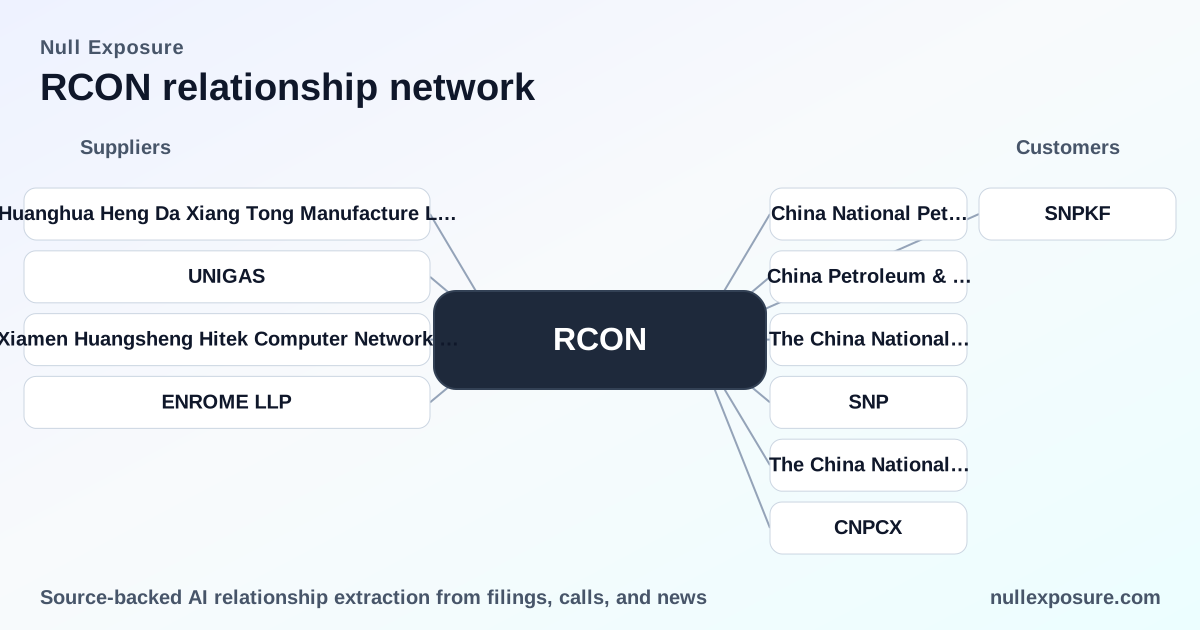
Huanghua Heng Da Xiang Tong Manufacture Ltd
Recon records purchases from Huanghua Heng Da Xiang Tong; for FY2016 the company disclosed purchases totaling RMB 338,862 (about $51,000). This relationship is included in the related‑party purchases section of Recon’s FY2016 filing, indicating transactional procurement from a named manufacturer. According to Recon’s 2016 Form 10‑K, those purchases were recorded as related‑party procurement for FY2016.
UNIGAS
Recon acts as an agent for the Unigas burner, which is designed and manufactured by UNIGAS, a European burning-equipment company; this establishes an agency-supplier channel for imported components that Recon resells or integrates into larger systems. The UNIGAS agent arrangement is described in Recon’s 2016 Form 10‑K.
Xiamen Huangsheng Hitek Computer Network Co. Ltd.
Recon purchased automation products and heating furnaces from Xiamen Huangsheng Hitek Computer Network Co. Ltd., and disclosed that accounts payable to Huangsheng Hitek were nil as of June 30, 2015 and 2016, indicating either timely payment or close account reconciliation. This procurement and payable status are documented in Recon’s FY2016 10‑K filing.
ENROME LLP (ratified auditor; corporate actions)
A Globe and Mail press release covering Recon’s 2026 AGM reported that shareholders ratified ENROME LLP as auditor for the fiscal year ending June 30, 2026, signaling continuity in financial oversight for the coming year. The shareholder meeting and the ratification of ENROME LLP were reported in March 2026 by Globe and Mail press releases.
Enrome LLP (board and capital-authority vote context)
Recon’s February 2026 AGM materials (reported in a Globe and Mail press release) tied the ratification of Enrome LLP as independent auditor to broader governance actions, including votes to expand authorized share capital and to authorize potential reverse share splits of Class A shares. The press release dated March 2026 described the auditor ratification alongside proposals to expand authorized capital and grant the board reverse-split authority.
What these relationships and constraints imply for investors
Supplier concentration is the most material operational risk evident in filings. The FY2015–FY2016 disclosures show a rapid increase in the share of purchases tied to a couple of suppliers, which creates a single‑point vulnerability for procurement and pricing. Recon’s explicit statement that components can be subcontracted out is a double-edged signal: it reduces technological lock‑in but increases execution and quality-control risk if substitutes are lower margin or require integration work.
From a contracting posture perspective, Recon behaves as an integrator and reseller with reliance on external manufacturers and agents rather than a fully captive producer; that posture implies:
- Negotiating leverage concentrated with suppliers when a supplier accounts for a large share of purchases.
- Operational criticality for a small number of manufacturing partners that provide items like burners, automation modules and furnaces.
- Maturity signal: the vendor base looks transactional (purchases and agency agreements) rather than reflective of multi-year strategic supply agreements disclosed in filings.
Corporate‑governance and oversight signals reinforce the operational picture. Auditor continuity with ENROME LLP reduces near‑term reporting disruption risk, while the board’s push to expand authorized capital and grant reverse‑split authority (as disclosed around the 2026 AGM) changes capital structure optionality and could impact minority-shareholder liquidity.
For investors focused on supplier exposure, reconciling purchase concentration with the firm’s path to profitability is essential: Recon’s trailing revenue of roughly $66.3M and negative profit margins mean supplier costs and procurement terms directly affect free-cash-flow trajectories.
Explore a detailed relationship map and supplier exposure analysis at https://nullexposure.com/.
Bottom line and recommended next steps
Recon is a small-cap provider of oilfield equipment and integration services whose commercial viability is strongly linked to a handful of supplier and agency relationships. The key investor takeaway: supplier concentration and reliance on subcontract manufacturing are strategic vulnerabilities that deserve priority in due diligence. Audit continuity and recent governance votes are relevant cross‑checks on management’s ability to execute capital structure changes.
Actionable next steps:
- Evaluate supplier concentration trends over subsequent filings and probe for multi‑year supply agreements or diversification plans.
- Monitor auditor communications from ENROME LLP and any proxy details tied to the board’s authorized-capital proposals.
- If supplier risk is a gating factor for your investment thesis, request supplier-level disclosure and third‑party integration testing results before increasing exposure.
For granular supplier and governance intelligence on Recon and comparable companies, visit https://nullexposure.com/ for research and relationship reports.