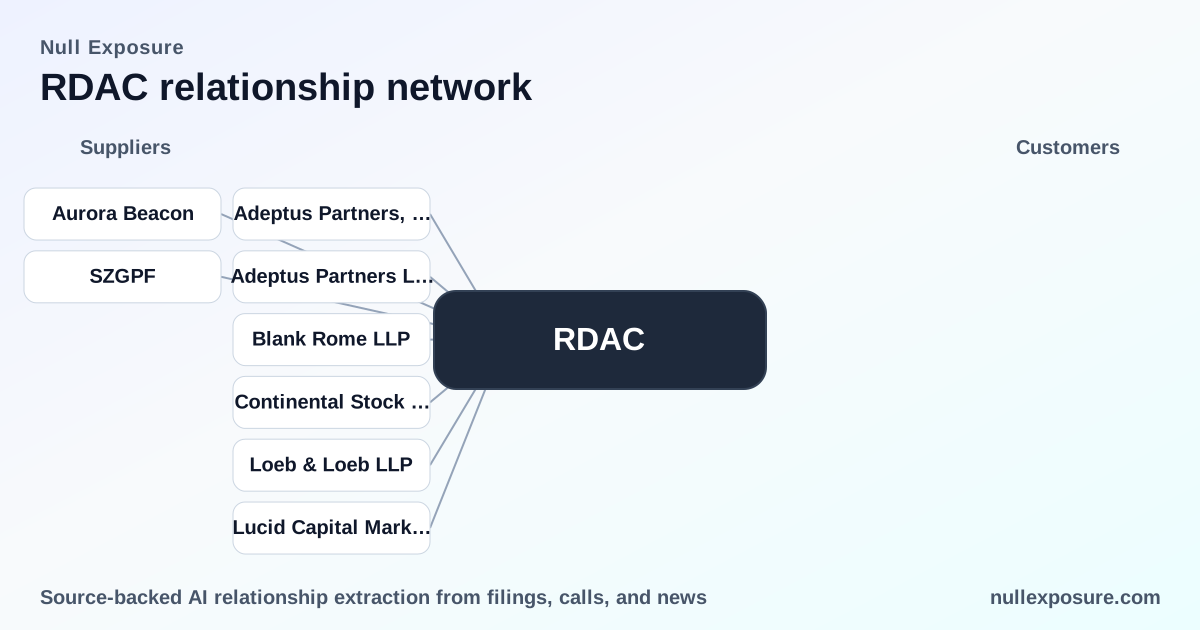
Rising Dragon Acquisition Corp. (RDAC): Supplier Relationships and Operational Signals for Investors
Rising Dragon Acquisition Corp. is a Nasdaq-listed special purpose acquisition company that monetizes by aggregating public cash through an IPO trust, collecting underwriting proceeds and fees, and deploying sponsor-backed short-term financing to underwrite an eventual business combination in the Asian technology and consumer sectors. Revenue is not yet operating income — the company’s economics today are driven by trust-accounted IPO proceeds, underwriting arrangements, sponsor liquidity support, and the cost profile of advisors and intermediaries. For investors evaluating supplier risk, RDAC’s supplier map is focused, transactional, and dominated by service providers essential to a SPAC lifecycle. Explore more on the homepage: https://nullexposure.com/
How RDAC runs the business and why suppliers matter
RDAC operates as a classic sponsor-led SPAC: it raised public capital, placed the proceeds in a trust account, and retained a constellation of legal, accounting, transfer-agent, and underwriting partners to execute the IPO and prepare for a business combination. The company’s operating posture is short-term and execution-driven — suppliers are primarily service providers contracted for discrete events (IPO, trustee services, audit, counsel, underwriting and sponsor loans). That contracting posture creates concentrated counterparty exposure around a handful of firms that manage compliance, custody and capital formation risks.
- Contracting posture: short-term, event-driven agreements dominate (sponsor promissory notes, over-allotment options, trustee custody).
- Concentration and criticality: trustee, underwriter and sponsor relationships are critical to liquidity and the ability to consummate a deal.
- Maturity and stage: RDAC is in an active pre-combination stage, where supplier performance is operationally material but not yet reflected in operating revenues.
Learn more about supplier-driven risk for SPACs at https://nullexposure.com/
The supplier map — concise, sourced relationship summaries
Adeptus Partners, LLC
Adeptus acts as RDAC’s independent registered public accounting firm and billed modest audit fees for 2024; the Form 10‑K confirms Adeptus as the auditor and discloses aggregate audit fees of $32,000 for services rendered for the year ended December 31, 2024. According to RDAC’s FY2024 Form 10‑K, Adeptus is the named independent registered public accounting firm (Form 10‑K, FY2024).
Adeptus Partners LLC (news mention)
Media coverage of the offering reiterated Adeptus’s role as auditor in the IPO press commentary (SPACInsider, March 10, 2026). The repeated public mention underscores Adeptus’s formal audit role in deal documentation and press communications.
Blank Rome LLP
Blank Rome LLP serves as underwriter’s counsel on the IPO, a role that places the firm in a gatekeeping position for underwriting legal opinions and offering documentation (SPACInsider, March 10, 2026).
Loeb & Loeb LLP
Loeb & Loeb LLP is serving as issuer’s counsel, responsible for the company-side legal work around the registration and offering, which is material for disclosure and deal structure (SPACInsider, March 10, 2026).
Continental Stock Transfer & Trust Company
Continental is acting as trustee for the public trust account where $57,787,500 of net IPO proceeds were deposited, making this relationship operationally critical for investor protection and redemption mechanics (RDAC Form 10‑K, FY2024; SPACInsider, March 10, 2026).
Lucid Capital Markets
Lucid Capital Markets served as the sole book-running manager for the offering and, per underwriting terms, exercised the over-allotment option in full, generating an additional $7.5 million in proceeds — a primary distribution partner for RDAC’s capital raise (SPACInsider, March 10, 2026; RDAC Form 10‑K).
Aurora Beacon
Aurora Beacon, identified as the sponsor, received a $50,000 unsecured promissory note issued by the company and is a direct sponsor counterparty that provided bridging liquidity; the note bears no interest and matures upon completion of the initial business combination (TradingView reporting on March 10, 2026).
SZG (SZGPF)
RDAC issued a $50,000 non‑interest bearing note to SZG that similarly matures upon closing of the initial business combination; SZG is therefore a sponsor-related lender and short-term counterparty in the capital structure (TradingView reporting on March 10, 2026).
What these supplier relationships mean for risk and execution
The relationship roster is lean and concentrated, which is typical for SPACs but elevates single-counterparty importance. Continental’s trustee role combined with the trust account deposit of roughly $57.8 million puts custody and redemption mechanics squarely dependent on the trustee and the bank custody chain. Lucid’s active exercise of the over-allotment option demonstrates successful underwriting execution and contributes materially to the cash runway.
- Execution risk is concentrated in a few service providers. Trustee, underwriter and sponsor liquidity provision are the dominant operational levers.
- Short-term contracting dominates the supplier posture. Sponsor promissory notes and underwriting over-allotment options are time-limited instruments tied to IPO and deal-closing events.
- Cost profile is front-loaded and bounded. Transaction costs reported include underwriting discounts and deferred underwriting commissions totaling multiple millions, while audit fees are immaterial in the larger spend picture ($32,000).
- Sponsor involvement is operational and financial. Sponsor-provided administrative services and small sponsor loans indicate dependence on sponsor goodwill and financing until a target is closed.
Practical implications for investors and operators
For investors underwriting a position or conducting counterparty diligence, focus on three areas: (1) trustee and custody arrangements — verify bank custody and trustee indemnities; (2) underwriting mechanics and over-allotment exposure — confirm the size and terms of options exercised; and (3) sponsor liquidity and related-party services — document the scope of sponsor-provided services and any promissory notes that affect closing incentives.
Explore a deeper supplier-risk briefing and comparative SPAC counterparty profiles at https://nullexposure.com/
Bottom line
RDAC’s supplier network is concentrated, transaction-oriented, and sufficient for a SPAC at the pre‑combination stage: trustee custody of IPO funds, an active book-runner that increased proceeds via over‑allotment, issuer and underwriter counsel, and modest audit fees. The predominant risks for investors are single-counterparty trust custody, sponsor dependency for pre-closing liquidity, and the concentrated nature of underwriting execution. For actionable diligence and competitive supplier benchmarking, return to our homepage: https://nullexposure.com/