RDACR supplier intelligence: what investors should know about counterparties and operating posture
Rising Dragon Acquisition Corp. Rights (RDACR) is a SPAC vehicle pursuing an initial business combination with technology and consumer businesses in Asia; it generates value for holders through a successful merger or liquidation mechanics embedded in its trust structure, sponsor support and underwriting execution. RDACR’s operating cash is largely ring‑fenced in a public shareholder trust, supplemented by short‑term sponsor financing and standard IPO underwriting arrangements — a profile that makes vendor selection and accounting relationships operationally important despite the blank‑check stage of the company.
Explore the full supplier map and supporting intelligence at https://nullexposure.com/.
The supplier footprint at a glance: concentrated, service‑focused, and short‑term
RDACR’s supplier universe is small and task‑oriented, reflecting the SPAC model: providers are largely service firms (audit, trustee, underwriting, sponsor services) rather than long‑running technology or production vendors. That concentration keeps recurring vendor spend low, but it also raises operational dependency on a handful of service relationships that must execute flawlessly through the merger process or dissolution events.
Key structural facts drawn from RDACR filings:
- Trust mechanics are critical. On October 15, 2024, RDACR deposited $57,787,500 of IPO and private placement proceeds into a trust account for public shareholders, where funds will not be released except under strictly defined conditions. This trust is the central economic control in pre‑combination life and determines liquidity outcomes for public holders.
- Sponsor financing is short‑term and contractually limited. On March 29, 2024, the company issued an unsecured promissory note permitting borrowings up to $300,000 that are non‑interest bearing and payable on defined termination events.
- Spend is concentrated and modest at the relationship level. Total transaction costs for the offering were $3,431,288, while specific professional fees to the audit firm were reported at $32,000 for FY2024.
These are company‑level operating signals; where a filing names a supplier directly, that supplier’s profile is presented in the relationship section below.
Supplier deep dive — Adeptus Partners, LLC
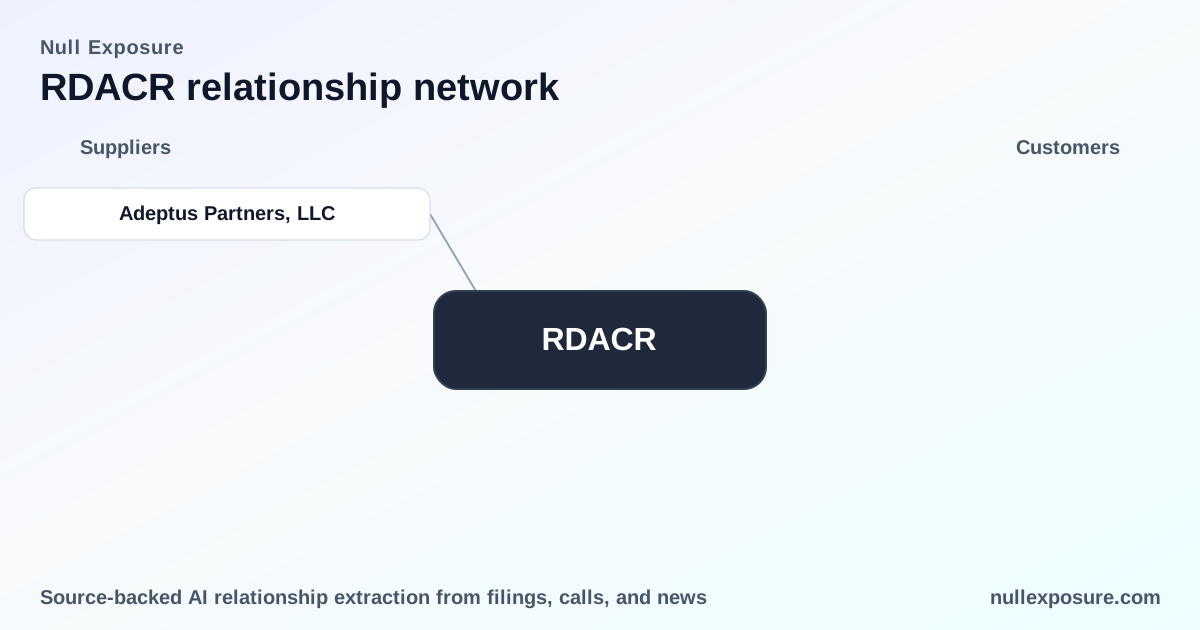
Adeptus Partners, LLC is RDACR’s independent registered public accounting firm; the firm billed $32,000 for audit and related SEC filing work for the year ended December 31, 2024, reflecting the limited scope of assurance work typical for a SPAC in pre‑combination life. The filing also lists Adeptus with PCAOB number 3686 and an Ocean, NJ address (March 26, 2025). (Source: RDACR 10‑K / FY2024 disclosures.)
Adeptus’s role is explicitly service‑provider and active; the company’s filings state that Adeptus “acts as our independent registered public accounting firm.” This relationship is small in spend but high in functional importance because audit and SEC filing work underpin investor confidence and the timeline to combination or liquidation. (Source: RDACR 10‑K / FY2024.)
What the constraints tell investors about RDACR’s business model and contracting posture
Translate the filing excerpts into capital‑markets operational intelligence:
- Contracting posture — short‑term and event‑driven. The promissory note to the sponsor is explicitly short‑term and tied to discrete lifecycle events (closing, IPO, or abandonment), signaling a tactical financing posture rather than long‑term vendor commitments.
- Concentration and criticality — trust and a few service vendors. The trust account holding $57.8 million is the dominant asset during the pre‑combination phase, making trustee, sponsor and audit functions materially critical to shareholder outcomes. This elevates counterparty importance beyond their headline spend.
- Maturity and stage — active pre‑combination. Multiple filing excerpts describe ongoing pre‑combination activities (trust funding, underwriting fees, sponsor services), confirming the relationship stage is active rather than dormant.
- Spend profile — skewed toward transaction and one‑time costs. Total transaction costs of $3.43M and the small audit fee demonstrate a front‑loaded, one‑time spend model consistent with IPO and deal closing activity rather than recurring operational procurement.
None of the above constraints require speculative interpretation; they are direct operational signals pulled from RDACR’s own disclosures.
Investment implications: risks, mitigants, and red flags
- Risk — single‑event dependency. The trust account structure centralizes risk: if the initial business combination fails or shareholders redeem heavily, the economics for public holders and counterparties change rapidly. Monitor redemption dynamics and time remaining on the SPAC lifecycle.
- Risk — limited third‑party spend can hide concentration risk. Small audit fees and minimal vendor lists reduce recurring costs but increase dependence on a few providers to perform under compressed, high‑visibility deadlines.
- Mitigant — transparent contractual mechanics. The trust mechanics and the promissory note are documented with crisp triggers and amounts; that contractual clarity reduces ambiguity about cash flows in pre‑combination outcomes.
- Operational red flag — sponsor exposure. The unsecured promissory note to the sponsor and sponsor‑provided services (office space, secretarial duties) create a governance axis that requires scrutiny in diligence.
Actionable monitoring checklist:
- Confirm the remaining permitted timeframe for completing an initial business combination and any outstanding sponsor commitments.
- Verify audit continuity and independence ahead of any financing or de‑SPAC activity.
- Stress‑test investor redemption scenarios against trustee and sponsor obligations.
Mid‑stage diligence and supplier mapping are available at https://nullexposure.com/ for investors and operators who require a structured review.
Practical next steps for investors and operators
- Request the latest interim filings and any auditor engagement letters to validate current fees, independence statements and scope.
- Verify trustee documentation (JPMorgan/Continental Stock Transfer references are in the filings) to understand timing and permitted disbursements from the trust.
- Track underwriting and sponsor compensation clauses that will affect net proceeds available for a business combination.
For a consolidated view of counterparties and contract risks across similar issuers, visit https://nullexposure.com/ to access supplier mapping and comparable SPAC relationship analysis.
Conclusion — compact vendor base, concentrated operational leverage
RDACR’s supplier posture is lean, service‑oriented and event‑driven: a small number of professional firms handle the audit, trust, underwriting and sponsor services that determine pre‑combination outcomes. That setup reduces recurring cost but increases the operational leverage of each counterparty — especially the audit firm and the trustee — on transaction timing and investor returns. Diligence should prioritize timeline risk, sponsor financing capacity, and audit/trust continuity ahead of any merger decision.
Explore our full suite of supplier intelligence and comparative SPAC supplier benchmarks at https://nullexposure.com/.