Radcom (RDCM): Strategic supplier ties to NVIDIA and ServiceNow accelerate an AI-first observability push
Radcom is a Tel Aviv–based vendor that sells 5G-ready, cloud-native network intelligence and service-assurance software to communication service providers (CSPs). The company monetizes through a mix of software licenses, recurring subscriptions and professional services sold into operator networks; its FY‑TTM revenue is $71.5 million and gross margins are healthy, supporting a capital-light SaaS-style business with operator-specific delivery requirements. For investors and operator procurement teams, the decisive question is whether Radcom’s supplier relationships give it durable performance and go‑to‑market leverage. Learn more at the NullExposure homepage: https://nullexposure.com/
Partners that change product economics and go-to-market
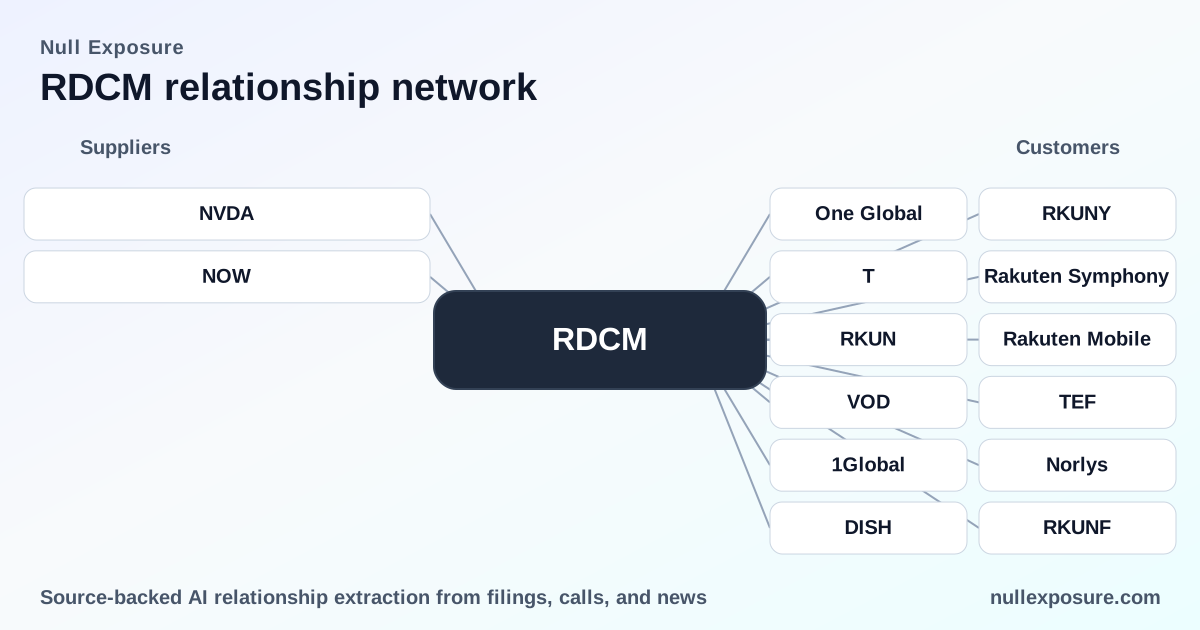
Radcom’s commercial progress in 2025–2026 is not just product evolution — it is a supplier-driven repositioning toward AI and operational automation. Two external suppliers dominate the headlines: NVIDIA, providing data processing units that materially increase analytics capacity, and ServiceNow, enabling AIOps integrations and marketplace distribution. These relationships are directly tied to Radcom’s ability to sell high-volume, real‑time analytics into operator environments and therefore to revenue growth and margin expansion.
NVIDIA — delivering high-capacity user analytics and lower TCO
Radcom has integrated NVIDIA BlueField‑3 DPUs into its high-capacity user analytics offering, which the company highlights as the foundation for real‑time, large‑scale packet inspection and analytics. Management referenced NVIDIA DPUs in both Q3 and Q4 2025 earnings remarks, and The Fast Mode and other industry outlets described the DPU integration and field trials. According to The Fast Mode and the company’s earnings commentary, the NVIDIA-powered solution has demonstrated large reductions in total cost of ownership in trials and is positioned as a key differentiator for selling into tier‑1 operators. Sources: Q3/Q4 2025 earnings call transcripts reported by InsiderMonkey and The Globe and Mail, and product reporting in The Fast Mode and TradingView (FY2025–FY2026).
Why it matters: the DPU integration is a product-level multiplier — it supports real‑time scale and cost economics that operators require for mass deployments, converting a niche monitoring tool into a platform able to handle operator-scale traffic.
ServiceNow — embedding AIOps into operator operations
Radcom reports that RADCOM AIM AIOps is fully integrated, certified and available as a connector in the ServiceNow store, enabling automated workflows and real‑time network monitoring inside operator ITSM/AIOps stacks. The company reiterated this capability in its Q4 2025 remarks and it was captured in coverage of the earnings call. Sources: Q4 2025 earnings call coverage reported by InsiderMonkey and The Globe and Mail.
Why it matters: ServiceNow certification lowers procurement friction for enterprise buyers and embeds Radcom into operator automation toolchains, making the product more sticky and shortening sales cycles when operators standardize on ServiceNow for incident and change management.
A single consolidated view of the relationship coverage
- NVIDIA: multiple references across earnings calls and industry press (InsiderMonkey Q3/Q4 2025 transcripts; The Fast Mode and TradingView coverage in early 2026) emphasize use of BlueField‑3 DPUs to power next‑generation user analytics and lower TCO in field trials.
- ServiceNow: cited in Q4 2025 earnings commentary (reported by InsiderMonkey and The Globe and Mail) as the platform where RADCOM AIM AIOps is certified and available as a connector.
These entries collectively demonstrate two coordinated supplier dependencies: one on specialized hardware (NVIDIA DPUs) for performance and cost, and one on a major enterprise automation platform (ServiceNow) for adoption and workflow integration.
How supplier ties translate into operating constraints and business signals
Radcom’s supplier relationships create specific operating model characteristics that investors and operators must account for:
- Contracting posture: Radcom is an enterprise supplier to CSPs with productized integrations rather than a pure services reseller; contracts are likely multi-year and include software subscription and services components. This posture requires established vendor agreements, hardware procurement coordination, and certified integrations (a point reinforced by ServiceNow listing).
- Concentration: Customer concentration risk is inherent when selling primarily to carriers, but the move to platformized analytics and marketplace distribution through ServiceNow reduces sales friction and diversifies routes to market.
- Criticality: Network observability is mission‑critical for CSPs; Radcom’s solutions sit in the operational stack where downtime or degraded performance has high impact, which favors sticky, high-switch‑cost relationships once deployed.
- Maturity: Product maturity is strong for core service-assurance functions and is now scaling into AI-powered analytics; recent quarterly results show positive revenue growth (quarterly revenue growth YOY ~15.9%) and increasing profitability (operating margin ~14.2%, profit margin ~16.8%), supporting the narrative of a maturing, monetizable product platform.
These are company-level signals that shape negotiation leverage, vendor risk, and go‑to‑market predictability; they are not specific to any single supplier unless explicitly stated by the company.
Upside vectors and supplier risks — a balanced operational read
- Upside: NVIDIA DPUs materially improve RADCOM’s capacity and cost economics, which directly enables larger deals and increases addressable market; ServiceNow certification accelerates enterprise adoption and shortens procurement cycles. Both factors support the company's recent revenue acceleration and enterprise traction.
- Risk: Dependence on third-party hardware introduces supply and price risk; heavy reliance on operator procurement cycles constrains near-term revenue visibility. Radcom’s valuation multiples (trailing P/E ~15, EV/Revenue ~0.99, EV/EBITDA ~8.5) reflect modest growth expectations with profit conversion, but supplier dependencies are the primary operational variable that could widen or compress those multiples.
The Fast Mode reported field trials indicating up to 75% TCO reductions with NVIDIA-powered analytics — a compelling commercial claim that accelerates enterprise sales if validated at scale (The Fast Mode, 2026).
Mid-article reading: for a concise supplier-risk checklist and relational coverage, visit https://nullexposure.com/
Practical next steps for investors and operator procurement teams
- For investors: model scenarios where NVIDIA-powered performance drives larger average contract sizes and faster conversion through the ServiceNow channel; stress-test supply risk and procurement timing against cash-flow forecasts.
- For operator buyers and procurement: verify DPU compatibility, request proven field trial results on TCO for workloads comparable to your network, and confirm the depth of the ServiceNow integration and supported automation playbooks.
- For due diligence teams: review the Q3/Q4 2025 earnings transcripts and the product announcements cited in industry press to confirm timelines and certification claims.
Closing action: track Radcom’s partner traction and supplier risk profile more closely at https://nullexposure.com/
Bottom line
Radcom’s supplier relationships with NVIDIA (hardware acceleration) and ServiceNow (marketplace and AIOps integration) are strategic and operationally consequential: they simultaneously increase product capability and reduce buyer friction. For investors, these ties underpin Radcom’s AI-driven revenue trajectory; for operators, they lower the barrier to deploy carrier‑scale analytics if the vendor’s field claims translate into repeatable production outcomes.