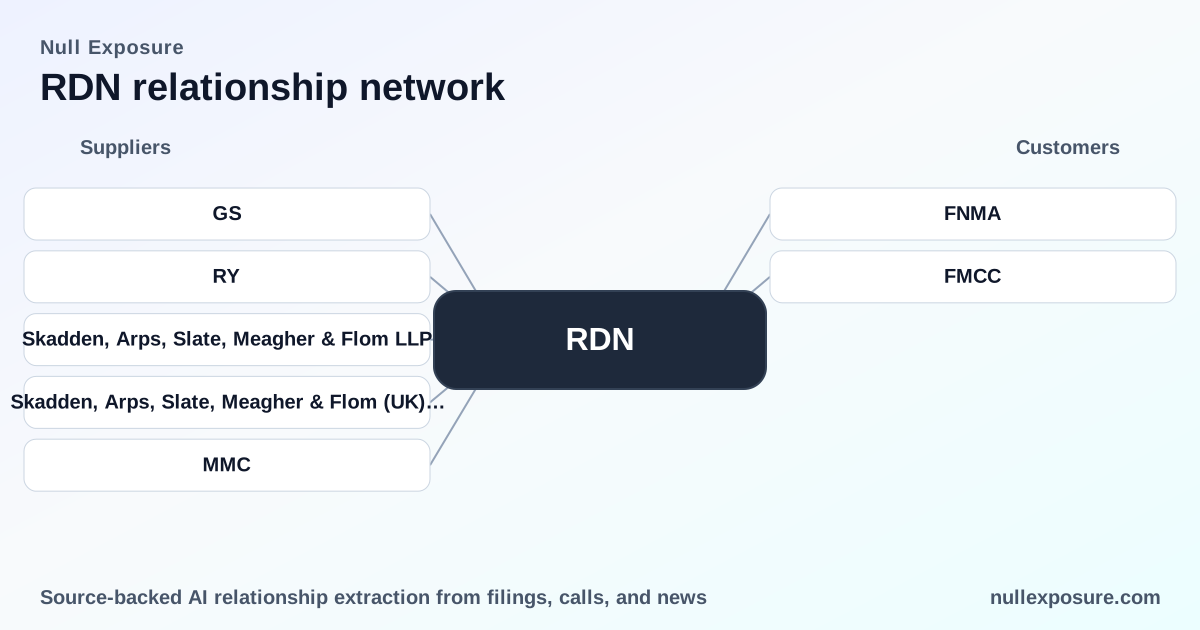
Radian Group (RDN): Supplier relationships signal scale, duration and capital interdependence
Radian Group operates as a diversified mortgage and real estate services company that monetizes through mortgage insurance premiums and fees, mortgage servicing and investment income from capital deployed against insurance liabilities and mortgage assets. The company combines underwriting and guaranty economics with balance-sheet financing and marketplace activity (including secured repurchase facilities and purchase conduits) to create a capital-efficient model that magnifies underwriting returns. For investors and operators, the crucial takeaway is that Radian’s supplier relationships are less about one-off vendors and more about long-dated capital and advisory linkages that support underwriting, distribution and liquidity.
Explore deeper supplier risk signals and counterparty trails at https://nullexposure.com/.
Deal advisers and legal counsel on the Inigo acquisition — who did what
Radian disclosed a completed acquisition of Inigo Limited in FY2026 and the announcement identified several professional services firms that supported the transaction. Each relationship below is drawn from the transaction announcement reported by MarketScreener on March 10, 2026.
- Goldman Sachs & Co. LLC — Goldman Sachs acted as a financial advisor to Radian on the Inigo acquisition, providing transaction advisory and capital markets counsel during execution. MarketScreener reported the advisory role on March 10, 2026.
- RBC Capital Markets, LLC — RBC Capital Markets served as a financial advisor to Radian, participating alongside other advisors to structure and market the deal. MarketScreener reported the advisory role on March 10, 2026.
- Guy Carpenter & Company LLC (Investment Banking Arm) — Guy Carpenter’s investment banking arm acted as a financial advisor to Radian, indicating use of reinsurance/insurance capital markets expertise in the transaction. MarketScreener reported this on March 10, 2026.
- Skadden, Arps, Slate, Meagher & Flom LLP (U.S.) — Skadden U.S. partners Todd Freed and Elena M. Coyle provided legal advice to Radian on transaction documentation and regulatory matters, according to the March 10, 2026 transaction notice.
- Skadden, Arps, Slate, Meagher & Flom (UK) LLP — Skadden’s UK team (George Gray, Jisun Choi, Robert A. Chaplin, Sebastian J. Barling) acted as legal advisor on cross-border and UK-law elements of the acquisition, as reported March 10, 2026.
Each firm played a discrete role—financial structuring, distribution and legal execution—pointing to a coordinated advisory stack for a capital-intensive acquisition. All citations above are drawn from the MarketScreener announcement dated March 10, 2026.
What the supplier and contract signals reveal about Radian’s operating model
Radian’s disclosed supplier relationships and contract language create a clear operational profile: capital intermediation anchored by long-term reinsurance arrangements, complemented by short- to medium-term funding facilities and a national servicing footprint.
- Contracts show duration layering. Radian Guaranty’s quota-share reinsurance arrangements (QSR agreements executed in 2022–2024) include scheduled termination dates out to June 30, 2035, establishing a long-term structural hedge for new insurance written and indicating predictable ceded exposure over a decade-long horizon. Radian’s public filings and disclosures document these QSR agreements.
- Funding is both long and near-term. The company has a $275 million unsecured revolving credit facility maturing in December 2026 that underpins liquidity, while multiple master repurchase agreements with major banks carry expirations in 2025—creating a mix of long-dated reinsurance certainty and shorter-term market funding reliance (repurchase facility expirations disclosed in the company’s filings).
- Geographic and operational scale are national. Radian Mortgage Capital is licensed in 49 states plus DC and is positioned to buy and hold residential mortgages and servicing rights nationwide, which increases counterparties’ exposure to a single national operational platform (company licensing notes).
- Service-provider posture is strategic. Radian both uses and provides outsourced services: it engages third-party subservicers for day-to-day loan servicing and relies on external asset managers for the bulk of its investment portfolio, while also acting as master servicer for certain loan pools—signaling a hybrid model where critical functions are split across internal teams and external vendors (company filings on servicing and asset management).
- Spend and exposure are material. Repurchase agreements include maximum borrowing amounts of $200 million, $300 million and $400 million with major counterparties, indicating counterparty exposure in the hundreds of millions rather than token vendor spend (disclosed facility sizes).
These contract and supplier realities translate to a business model where capital providers and advisers are strategic suppliers, not commodity vendors; their continuity and credit appetite directly affect Radian’s ability to underwrite and hold assets.
What investors and counterparties should watch next
Radian’s supplier mosaic creates several actionable focus points for investors, credit officers and operational partners.
- Concentration and counterparty risk. Radian’s funding and liquidity reliance on named banks and repurchase facilities implies concentration risk; monitor renewals and haircuts on repurchase lines as short-dated expirations land in 2025.
- Reinsurance continuity. The long-term QSR architecture reduces volatility for newly written insurance but concentrates performance risk into the reinsurance panels; changes to quota-share percentages or panel composition would materially affect net written exposure.
- Operational third-party dependencies. A majority of the investment portfolio is managed externally and servicing is partially outsourced; governance and vendor oversight are critical to preserve valuation and capital assumptions.
- Regulatory and licensing footprint. National licensing supports scale but also imposes state-level regulatory complexity and operational compliance cost.
For investors targeting balance-sheet insurance franchises, the interplay between long-dated ceded reinsurance and near-term market funding is the key underwriting lever that determines capital efficiency and risk transfer effectiveness.
Explore supplier risk lenses and counterparty mapping at https://nullexposure.com/ to model these dynamics across counterparties.
Tactical implications and closing view
Radian’s public metrics—**market capitalization approximately $4.46 billion, trailing P/E ~7.5, price-to-book ~0.94, and strong reported operating margin—**position the company as a high-margin, capital-dependent insurer whose value hinges on capital access and reinsurance economics. Supplier relationships disclosed in the Inigo acquisition announcement and in company filings are not peripheral: they are core plumbing for underwriting scale and for executing M&A.
Actionable items for investors and operators:
- Validate counterparties’ capacity to roll repo and credit lines through 2025 and beyond.
- Stress-test insurance economics under alternative quota-share configurations and counterparty failure scenarios.
- Prioritize vendor governance where third-party subservicers and external asset managers influence fair value and liquidity.
For a practical, counterparty-focused supplier analysis that maps these relationships to balance-sheet risk, visit https://nullexposure.com/ and begin a tailored review of Radian’s supplier profile.
Bottom line: Radian’s supplier relationships reflect a capital-centric operating model where long-term reinsurance contracts and short-term market funding jointly determine the firm’s ability to monetize underwriting strength. Investors should treat major financial advisors, banks and reinsurance panels as principal counterparties rather than incidental vendors.