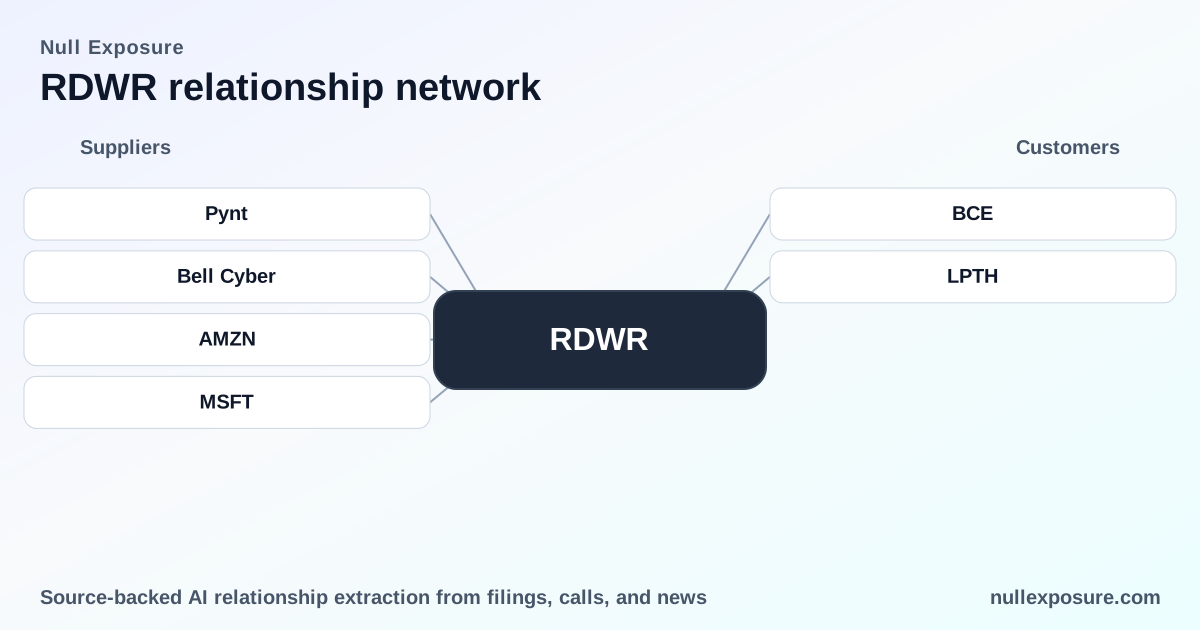
Radware Ltd (RDWR) — supplier relationship briefing for investors and operators
Radware sells cybersecurity and application-delivery technology into enterprises and service providers, monetizing through a mix of appliance/software licenses, cloud-delivered subscriptions, and managed security services; strategic tuck‑ins and partner integrations expand product reach and recurring revenue. The company’s go‑to‑market blends product sales with cloud and managed offerings, and its recent M&A and partner moves emphasize API and AI-era protection as growth levers. For a quick overview of data and supplier signals, visit the Null Exposure home page: https://nullexposure.com/.
Why suppliers and partner flow matter to RDWR’s investor thesis
Radware’s revenue mix and margin profile depend on two supply/partner dynamics: ecosystem integrations that increase SaaS and managed-service monetization, and acquisitions that accelerate capability expansion. These relationships influence contract structure, customer stickiness, and topline visibility — critical inputs for valuing a security vendor whose forward multiple compresses or expands with subscription growth. Learn more on the platform here: https://nullexposure.com/.
Relationship map: what the market is reporting now
This section lists every supplier/partner relationship surfaced in recent coverage and gives a concise, sourced read for investors and procurement teams.
Pynt — API security testing capability (acquisition, FY2026)
Radware acquired Pynt to add a testing toolkit for API security, accelerating product coverage for enterprises that expose APIs. According to Security Boulevard in March 2026, the deal is positioned to strengthen Radware’s application and API protection roadmap (Security Boulevard, March 2026 — https://securityboulevard.com/2026/01/radware-acquires-pynt-to-add-api-security-testing-tool/).
Bell Cyber — managed security distribution partnership (announced February 2026)
Radware expanded its partnership with Bell Cyber to launch an AI-driven, cloud-delivered security service combining Radware’s application and API protection with Bell Cyber’s fully managed security operations across Canada and the U.S. Simply Wall St reported the partnership expansion in February 2026 (SimplyWallSt, Feb 2026 — https://simplywall.st/stocks/us/software/nasdaq-rdwr/radware/news/will-radwares-rdwr-ai-driven-bell-cyber-alliance-reshape-its).
Bell Cyber (AMP link) — duplicate mention of the same managed-service rollout (February 2026)
The same Bell Cyber expansion is syndicated via an AMP feed that repeats the February 2026 announcement; the duplication underscores distribution of the partnership news across equity research and retail channels (SimplyWallSt AMP, Feb 2026 — https://simplywall.st/stocks/us/software/nasdaq-rdwr/radware/news/will-radwares-rdwr-ai-driven-bell-cyber-alliance-reshape-its/amp).
Amazon Web Services (AWS) — integration target for agent protection (FY2026)
Radware’s new agentic AI protection product lists deep integration with AWS Bedrock among supported platforms, signaling that Radware is positioning its protections to attach to major cloud AI stacks and third‑party agent frameworks. The Fast Mode covered this product launch and the integration mentions in March 2026 (The Fast Mode, March 2026 — https://www.thefastmode.com/technology-solutions/46940-radware-launches-agentic-ai-protection-for-enterprise-security).
Microsoft — platform-level integration for AI agent protection (FY2026)
Radware cites support for Microsoft 365 Copilot and Copilot Studio as part of its agentic AI protection offering, indicating explicit product-level integrations with Microsoft’s productivity/AI ecosystem. The Fast Mode article that announced the product launch named Microsoft among the integration targets (The Fast Mode, March 2026 — https://www.thefastmode.com/technology-solutions/46940-radware-launches-agentic-ai-protection-for-enterprise-security).
What these relationships reveal about Radware’s operating model
- Contracting posture: Radware pursues hybrid commercial contracts — perpetual and appliance sales coexist with cloud subscriptions and managed-service arrangements; the Bell Cyber tie shows a deliberate push toward managed recurring revenue.
- Concentration and reach: Integrations with hyperscalers and major productivity platforms (AWS, Microsoft) reduce go‑to‑market friction and increase addressable market, but they also make product adoption dependent on successful platform integrations.
- Criticality: Product integrations into AI agent platforms and API testing tools point to higher technical criticality for enterprise customers, which increases stickiness if implemented deeply.
- Maturity and cadence: The firm’s acquisition of Pynt and partner expansions reflect a mid‑cycle strategic emphasis on capability gaps and go‑to‑market scale rather than broad pivots; this is consistent with a company transitioning more revenue toward cloud and managed services.
Because there are no constraint records surfaced against supplier relationships, these operating characteristics are presented as company-level signals rather than being attributed to any single partner.
Investment implications and risk framing
Radware trades at a premium relative to trailing earnings multiple and shows modest profitability metrics versus peers (reported TTM revenue ~ $302M and trailing P/E ~ 55.8). Key investment drivers are increasing subscription and managed revenue, successful integration of Pynt into product bundles, and platform adoption with AWS and Microsoft. Risks center on execution of channel expansions (Bell Cyber), integration risk from tuck‑ins, and the general security market’s competitive intensity. Institutional ownership is high (~80%), suggesting investor attention on execution milestones and recurring revenue cadence.
Practical takeaways for procurement and operator teams
- For vendor evaluations, prioritize proof points on product-to-platform integrations (evidence of certified connectors to AWS Bedrock, Microsoft Copilot).
- For sourcing and contracting, expect combined offers that blend product license, cloud subscription, and managed service SLAs — negotiate clarity on escalation and incident ownership across partners (Radware + Bell Cyber).
- For roadmap diligence, verify how Pynt features will be packaged: as a bundled capability, modular add‑on, or as part of managed testing services.
Mid‑article reference: For a consolidated supplier signal dashboard and supplier relationship intelligence, see https://nullexposure.com/.
What to watch next and recommended actions
- Monitor Radware’s FY2026 filings and investor calls for revenue mix disclosure showing subscription and managed services growth, and for specific revenue contribution from the Pynt acquisition.
- Watch customer case studies with Bell Cyber to confirm managed-service conversion metrics and renewal economics.
- Track technical certifications and partner announcements from AWS and Microsoft that demonstrate deeper platform embedding.
For a structured supplier-risk review or to track these relationships over time, visit the Null Exposure home page: https://nullexposure.com/.
Final verdict
Radware is executing a deliberate shift toward platform-integrated protection and managed offerings, underpinned by tactical M&A and partner distribution. If Radware converts integrations into scalable recurring revenue, the current valuation reflects upside; if not, multiple expansion will be limited by spot sales cyclicality. Investors and operators should focus diligence on subscription/managed revenue cadence, Pynt integration progress, and measurable outcomes from the Bell Cyber alliance.