RDWU launch: who’s on the hook and what investors should price
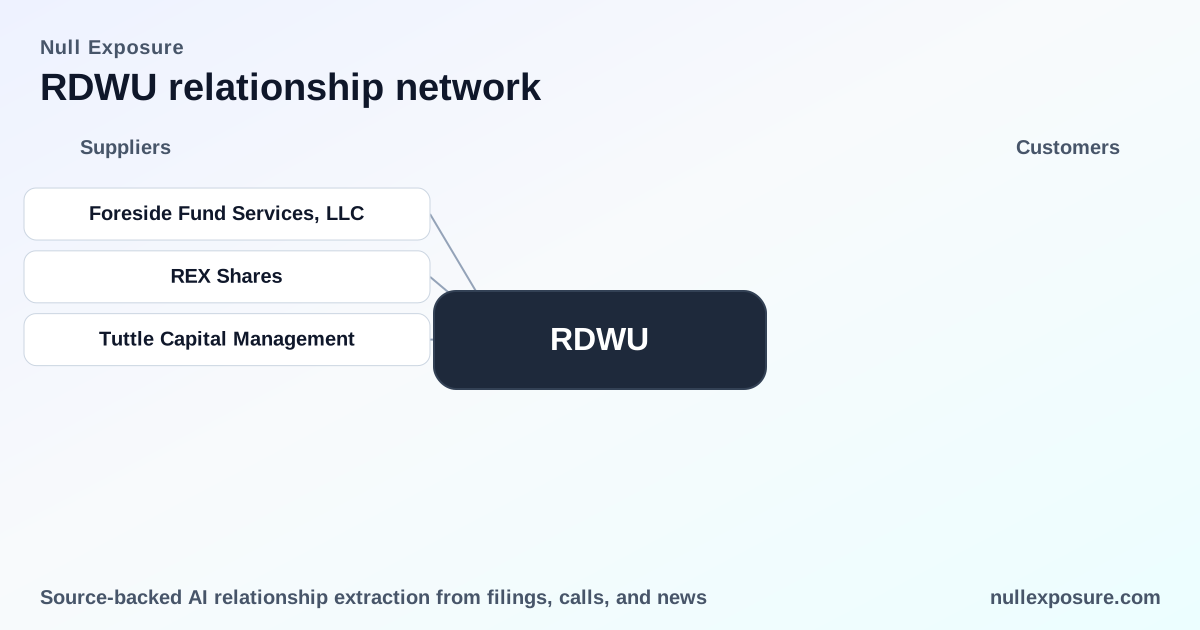
The T-REX 2X Long RDW Daily Target ETF (CBOE: RDWU) is a sponsor-driven leveraged ETF product that monetizes through management and distribution economics tied to investor flows. REX Shares serves as the fund sponsor, Tuttle Capital Management provides portfolio management expertise, and Foreside Fund Services handles distribution compliance — a classic outsourced ETF operating model where revenues scale with assets under management and trading activity rather than product-level IP. Investors should evaluate RDWU as a new, sponsor-dependent product whose economics and operational risk profile are governed by third‑party partner performance and underlying liquidity in Redwire (RDW). Learn more about supplier risk for ETF products at https://nullexposure.com/.
Why the partner roster matters for a leveraged ETF
Leveraged ETFs are operationally intensive: daily rebalancing, margin/derivative counterparties, and tight execution windows make vendor reliability a commercial necessity. The RDWU launch demonstrates an outsourced contracting posture where the sponsor delegates distribution and portfolio management to specialists rather than internalizing all functions. That structure reduces fixed cost but raises counterparty criticality — the sponsor’s product success depends on the competence and regulatory standing of its named partners.
- Concentration: The launch names three service firms in public materials, indicating a focused partner set rather than a broad multi-vendor program. Concentration amplifies execution risk if a single partner underperforms.
- Criticality: Each partner carries a discrete, high-impact role (sponsor, manager, distributor). Disruption at any link would directly affect go‑to‑market and compliance.
- Maturity: RDWU is a FY2026 launch; product-specific operational maturity is low and should be monitored through early AUM trends and tracking error performance.
Relationship-by-relationship: the essentials investors need
Foreside Fund Services, LLC Foreside is named as the distributor for RDWU, and the firm is a FINRA member responsible for fund distribution activities and associated broker-dealer compliance functions. According to a March 2026 press release published in the National Law Review, Foreside is listed explicitly in the fund’s offering materials as the distributor. (National Law Review, Mar 10, 2026)
REX Shares REX Shares is the fund sponsor that launched the T-REX 2X Long RDW Daily Target ETF, placing RDWU on CBOE to provide the 2x daily long exposure product structure. The launch announcement identifies REX as the filing sponsor and product vehicle. (National Law Review, Mar 10, 2026)
Tuttle Capital Management Tuttle Capital Management is disclosed as the portfolio manager/partner providing the leveraged exposure mechanics and day-to-day investment decisions for RDWU, implementing the 2x targeted exposure to Redwire Corporation. The March 2026 release names Tuttle as a co-announcer of the fund launch. (National Law Review, Mar 10, 2026)
Operational implications for investors and operators
The partner list sets a clear operating architecture: sponsor + outsourced manager + distributor. For investors, that architecture translates into specific monitoring priorities:
- Execution and tracking risk: Leveraged funds require intraday rebalancing; the manager’s execution capabilities determine tracking error and realized leverage outcomes.
- Distribution dynamics: Foreside’s role as distributor affects market access and product shelf placement; early distribution channels will drive AUM growth and fee revenue.
- Regulatory and compliance posture: The presence of a FINRA-member distributor indicates formalized broker-dealer oversight, reducing basic compliance risk but not eliminating operational execution risk.
- Concentration and vendor risk: With a compact partner roster, counterparty failure or reputational damage to any single firm would be material to the product, particularly in early life when AUM is small.
Investors should watch early NAV behavior, published expense ratio (when available), and tracking metrics against 2x RDW to price both expected returns and execution drag. Operators assessing supplier relationships should require detailed SLAs and testing windows around rebalancing and settlement to limit first‑year operational shocks.
For a deeper read on supplier concentration effects and mitigation strategies, visit https://nullexposure.com/.
Constraints and company-level signals
No formal operational constraints were reported in the supplier feed for RDWU. Absent explicit constraint excerpts, the available relationship information yields the following company-level signals:
- Vendor-centric contracting posture: The product launch uses established third-party industry participants rather than in‑house distribution or management.
- Moderate concentration risk: Public materials name a limited set of critical suppliers, creating single-point dependencies during rollout.
- Low product maturity: RDWU is newly launched (FY2026), which implies elevated early-stage operational risk until AUM and performance history develop.
- Compliance scaffolding present: Inclusion of a FINRA-member distributor signals formal regulatory oversight on the distribution side, which reduces some legal and compliance exposure.
These are structural signals about the fund’s operating model rather than discrete, contract-level constraints.
Quick risk checklist for investors evaluating RDWU
- Monitor first 90-day tracking performance and realized leverage outcomes.
- Evaluate AUM growth trajectory to understand fee revenue potential versus fixed operating costs.
- Confirm counterparty arrangements for derivatives or margin (public materials may follow) and whether liquidity providers are disclosed.
- Verify distribution channels and placement; initial distribution intensity correlates directly with early revenue generation.
Bottom line and next steps
RDWU is a classic outsourced leveraged ETF product: sponsor-led, manager-executed, and distributor-backed. That structure yields scalable economics if asset inflows arrive, but it also concentrates operational risk in a small set of third-party providers during a low-maturity phase. Investors should price a premium for early-stage execution risk and monitor partner performance closely.
For operational due diligence and supplier-risk playbooks tailored to ETF launches, explore our resources at https://nullexposure.com/. If you need a supplier-risk briefing or ongoing monitoring setup for this product, the team at Null Exposure provides targeted coverage and alerts.