Dr. Reddy’s (RDY): Trademark buys, margin leverage, and what suppliers reveal about strategy
Dr. Reddy’s Laboratories operates as an integrated pharmaceutical manufacturer that monetizes through a blend of branded specialty drugs, branded generics, and global generics distribution. The company expands margins and channel control by acquiring intellectual property and trademarks for established brands in region-specific markets, then leveraging its manufacturing and commercial footprint to extract higher ASPs than commodity generics. For investors, the recent string of announcements around acquisition of two HRT brands from Mercury Pharma underscores an explicit brand-led growth tactic alongside the company’s traditional volume-led generics business. Learn more background and relationship analytics at https://nullexposure.com/.
A compact recap of the Mercury Pharma transactions and why they matter
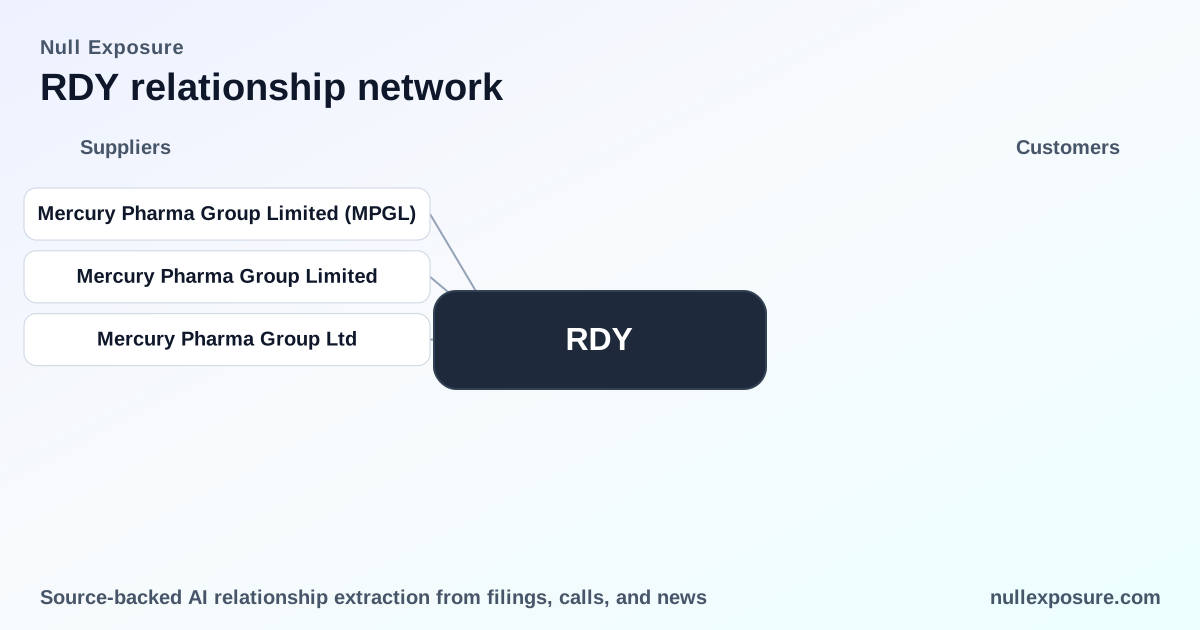
Dr. Reddy’s announced agreements to acquire trademarks and related assets for Progynova® and Cyclo‑Progynova® in India from UK-based Mercury Pharma Group Limited (MPGL). These are targeted, country-level brand acquisitions intended to accelerate entry into the hormone replacement therapy (HRT) category in India with recognized brand equity, rather than building a new product from scratch.
Mercury Pharma Group Limited – Economic Times (March 10, 2026)
Dr. Reddy’s bought the India trademarks for Progynova and Cyclo‑Progynova from Mercury Pharma, a move picked up by markets as a strategic brand acquisition that will drive attention in trading sessions. Economic Times reported the deal as a focused acquisition of specialty HRT brands for the Indian market. (Economic Times, March 10, 2026)
Source: https://m.economictimes.com/markets/stocks/news/dr-reddys-laboratories-shares-in-focus-after-acquiring-india-trademarks-for-two-hrt-drugs-for-32-million/articleshow/128537483.cms
Mercury Pharma Group Limited – Times of India (March 10, 2026)
The Times of India quantified the transaction at approximately USD 32.15 million (around Rs 295 crore) and described it as Dr. Reddy’s formal foray into India’s HRT segment through acquisition of the trademarks and related assets. The coverage frames this as a market-entry via brand acquisition rather than organic product development. (Times of India, March 10, 2026)
Source: https://timesofindia.indiatimes.com/business/india-business/dr-reddys-acquires-india-trademarks-for-2-hrt-drugs-from-uks-mercury-pharma-for-32-million/articleshow/128515248.cms
Mercury Pharma Group Ltd – Business Today (February 19, 2026)
Dr. Reddy’s filed a definitive agreement on February 18; Business Today reported details of the USD 32.15 million transfer of trademarks and related assets from UK-headquartered Mercury Pharma, confirming the regulatory filing and the company’s intent to integrate the brands into its India commercial operations. (Business Today, February 19, 2026)
Source: https://www.businesstoday.in/markets/stocks/story/dr-reddys-labs-shares-in-focus-as-pharma-major-inks-32-million-deal-key-details-516852-2026-02-19
What these supplier/asset relationships signal about operating posture
These announcements sit alongside broader company-level signals that shape how investors should view RDY’s supplier and partner posture:
- Contracting posture — acquisitive and brand-focused. The use of trademark purchases rather than licensing or co-marketing indicates a preference for owning end-to-end commercial control where brand economics matter.
- Concentration — selective, not broad-supplier dependence. The available relationship entries show a discrete transaction with a single UK counterparty, implying RDY is not relying on an expansive network of similar third-party brand suppliers for this strategic thrust.
- Criticality — moderate-to-high for category entry. Acquiring established HRT trademarks is a higher-leverage route into a specialty segment: these assets are strategically important to accelerate revenue and margin capture in the Indian HRT market.
- Maturity — executing inorganic scale-up. Purchasing mature brands signals a move away from early-stage product development to faster time-to-market via recognized labels, which is consistent with a company that balances R&D with commercial rollouts.
No formal supplier constraints or contractual flags are listed in the available results; that absence is itself a signal of clean, straightforward M&A disclosure rather than complex supplier entanglements.
If you want a consolidated view of RDY’s supplier relationships and M&A exposure, visit https://nullexposure.com/ for a comprehensive supplier-risk profile.
Financial and strategic context investors need
Dr. Reddy’s is not an early-stage consolidator — its financial profile shows scale and operating profitability that supports acquisitions like this:
- Revenue TTM: 345.8 billion INR, with profit margin ~16.4% and operating margin ~16.4%, which provides bandwidth to deploy capital behind targeted brand purchases.
- Market capitalization ~ USD 11.7 billion and trailing P/E ~19.3, placing the stock in a value-for-growth territory relative to many specialty peers.
- Low beta (0.31) suggests stability that supports patient integration of acquired brands into the commercial machine.
The USD 32.15 million purchase price is modest against Dr. Reddy’s scale and offers the potential for high ROI if the company converts existing distribution channels and salesforce to these brands quickly. This is a capital-efficient way to raise ASPs and protect gross margins in a market where generic pricing pressure persists.
Operational and procurement implications for operators
For procurement and commercial teams evaluating RDY as supplier or partner, actionable takeaways include:
- Prioritize integration playbooks that convert trademark ownership into channel roll-out—salesforce training, packaging localization, and physician targeting will determine uplift.
- Assess regulatory and labeling resets required after ownership transfer; the regulatory filing suggests RDY has accounted for the transfer but integration timelines determine revenue recognition.
- Monitor brand cannibalization risk against existing DRL portfolio; owning a specialty HRT label can increase margins but requires careful channel segmentation to avoid eroding generic volumes.
If you are an investor or operator tracking supplier relationships and M&A impact, our platform curates these linkages — see more at https://nullexposure.com/.
Bottom line for investors and operators
The Mercury Pharma trademarks acquisition is a targeted, low-cost route for Dr. Reddy’s to enter a specialty segment with established brand equity. For investors, this demonstrates disciplined, margin-conscious capital allocation that complements RDY’s generics base. For operators, the transaction points to an integration runway where execution will determine whether the brands deliver outsized returns or simply stabilize HRT category share.
Final actionable thought: prioritize monitoring commercial rollout metrics (prescription share, ASP retention, and physician adoption) over headline acquisition value — the latter is small relative to RDY’s balance sheet; the former will drive earnings impact. Explore supplier relationship maps and deal-level disclosures at https://nullexposure.com/.