Real Brokerage Inc (REAX): Platform monetization through brokerage services, fintech, and ancillary verticals
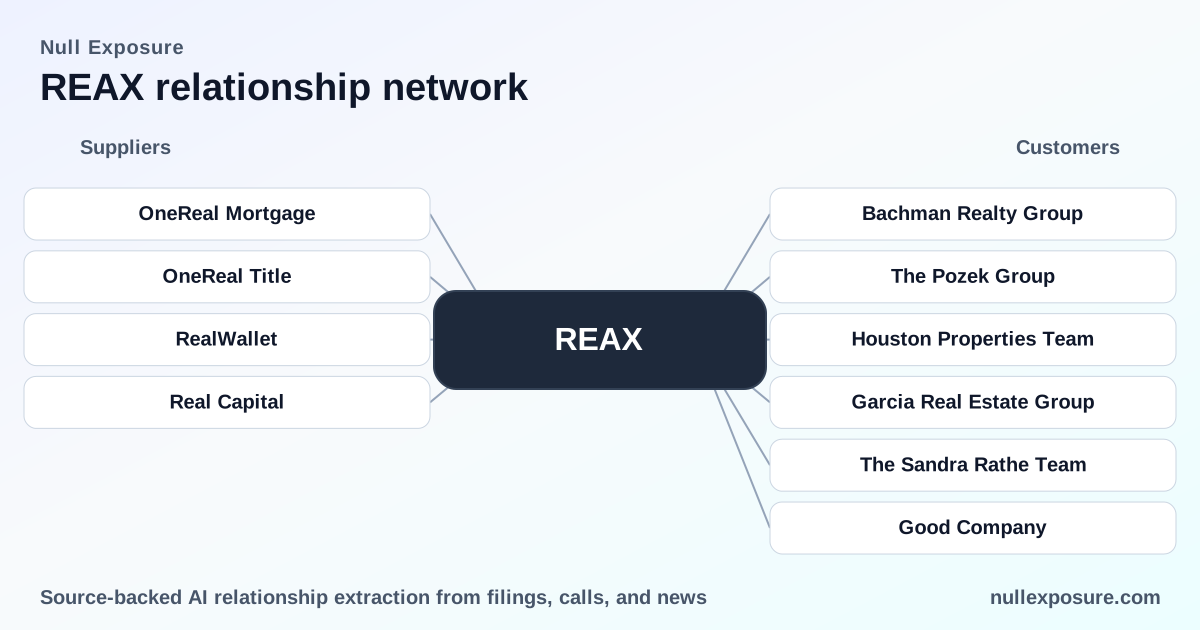
Real Brokerage operates as a technology-driven residential real estate platform that monetizes primarily through agent transaction fees and an expanding set of vertically integrated services — mortgage, title, fintech wallet, and capital — designed to capture share of wallet and lift lifetime customer value. The core commercial model is scale-first: drive agent growth and transactions through a low-capital, technology-enabled brokerage and convert closed transaction flow into higher-margin ancillary revenue. For investors, the thesis is straightforward: Real’s platform can compress customer acquisition cost and extract incremental margin via internal suppliers, but execution risk centers on scaling nascent verticals and moving the consolidated business from revenue growth to sustainable profitability. Learn more at https://nullexposure.com/.
Where the economics sit today
Real reported roughly $1.97 billion in trailing revenue, yet remains unprofitable on an operating and EBITDA basis, reflecting investment in growth and new verticals. Revenue scale is meaningful, but margins are thin and negative: trailing operating margin is approximately -0.9% and EBITDA is negative $6.6 million. Market capitalization of about $505 million implies the market is valuing the platform at modest multiples to revenue (Price/Sales ~0.26, EV/Revenue ~0.23), pricing in execution risk and a heavy dependence on turning ancillary lines into durable margins.
- Growth vs. profitability trade-off: Quarterly revenue growth has been solid (quarterly revenue growth YoY +44%), but net income metrics and ROE remain negative, signalling the company is still in an investment phase.
- Balance of internal vs external supply: Many of the company’s supplier relationships are internal or closely affiliated entities that serve to capture more of the transaction economics; that structure lowers third-party supplier concentration but raises execution and governance demands.
The supplier and affiliate relationships that move financial levers
Below I summarize every relationship surfaced in our review of Real Brokerage’s supplier scope, using the company’s investor commentary as reported in public transcripts.
OneReal Mortgage
According to the Q4 2025 earnings call transcript reported by InsiderMonkey, OneReal Mortgage generated $6 million in revenue in 2025, up 50% year-over-year, driven by loan officer growth and productivity. This business is explicitly positioned as a revenue-capture engine for mortgage origination tied to Real’s transaction flow. (InsiderMonkey, Q4 2025 / FY2026 commentary)
OneReal Title
The same earnings transcript states that OneReal Title generated $5 million in revenue in 2025, up 5% year-over-year, and that management is transitioning the title model toward more scalable, state-based joint ventures, indicating a shift from captive operations to shared-risk arrangements. That change signals a deliberate contracting posture to reduce capital intensity while preserving upside. (InsiderMonkey, Q4 2025 / FY2026 commentary)
RealWallet
RealWallet completed its first full year and reported nearly $900,000 of revenue in 2025 with 77% gross margins, and a current run rate reported around $1.5 million, highlighting early profitability at the gross margin line for this fintech product. As a nascent payment/settlement vehicle tied to customer flows, RealWallet is one of the clearer margin levers if adoption continues. (InsiderMonkey, Q4 2025 / FY2026 commentary)
Real Capital
Management identified Real Capital as a primary driver of revenue to RealWallet, noting expansion into additional states to scale its contribution to the wallet business; Real Capital functions as a growth engine that routes capital flows back into Real’s fintech and servicing layers. Geographic expansion of Real Capital therefore acts as both a revenue and a distribution lever. (InsiderMonkey, Q4 2025 / FY2026 commentary)
Operating-model constraints and company-level signals
Our supplier-scope review returned no explicit third-party constraints in the source data. That absence is itself a signal at the company level: Real is emphasizing internal verticalization and joint-venture structures rather than reliance on external suppliers flagged in public disclosures. From an operating-model perspective:
- Contracting posture: Management is shifting toward state-based joint ventures for title, which reduces upfront capital exposure while creating a patchwork of localized partnerships that require tight governance.
- Concentration and criticality: Because several revenue drivers are internal affiliates (mortgage, title, capital, wallet), the platform’s success is concentrated on successful integration and cross-sell execution; these units are critical to margin expansion.
- Maturity: Units range from early-stage fintech (RealWallet) to more established brokerage flows; RealWallet is high-margin at gross level but low absolute revenue today, while mortgage and title are larger but lower margin and require scale.
- Governance implications: Internal supplier relationships lower external vendor dependency but increase complexity for investors evaluating related-party risk, operating KPIs, and capital allocation choices.
Investment implications and risk factors
Real’s model offers a clear play on vertical capture: control the agent and transaction origin, then harvest ancillary fees and payments. Key implications:
- Upside: If RealWallet and mortgage/title JVs scale as management projects, the company can materially lift consolidated gross margins because wallet and capital flows show higher margin characteristics.
- Downside: Execution risk sits squarely in scaling these businesses simultaneously while converting top-line growth into operating profit; negative operating leverage is the primary near-term risk.
- Valuation posture: Market multiples reflect skepticism on execution rather than on the addressable market; current EV/Revenue ~0.23 implies the market prices modest realized benefits from ancillary verticals.
For investors and partners who want to track these dynamics, a regular review of segment-level revenue and margin disclosure is essential. For more detailed supplier and partner monitoring, visit https://nullexposure.com/ to see our coverage framework.
How to use this insight
- For operators: prioritize governance and integration roadmaps for state-based JVs and fintech onboarding to ensure consistent customer experience and margin capture.
- For investors: watch gross-margin trends in RealWallet and joint-venture ramp metrics in title and mortgage as leading indicators of sustainable profitability.
- For potential partners: evaluate the balance between capital-light JV structures and the operational bandwidth required to manage multiple state relationships.
If you want ongoing tracking of Real’s supplier and affiliate signals and how they affect valuation and operating risk, visit https://nullexposure.com/ for continuous coverage.
Bottom line
Real Brokerage’s platform strategy — grow agent counts, then extract ancillary revenue via mortgage, title, wallet, and capital — is coherent and structurally capable of improving margins if execution succeeds. The immediate read from public commentary is that ancillary lines are nascent but moving in the right direction: mortgage and title are scaling, RealWallet shows high gross margins, and Real Capital is expanding geographically. The critical question for investors is whether management can convert these early wins into consistent, scalable profit contribution without diluting the core brokerage economics. For a deeper supplier-focused due diligence approach and regular updates, go to https://nullexposure.com/.