Reborn Coffee Inc (REBN): Supplier relationships, distribution strategy, and investor implications
Reborn Coffee, Inc. operates and franchises specialty coffee retail stores and kiosks, primarily in California, and monetizes through a mix of company-owned outlets, franchise fees, product sales and strategic distribution agreements that support franchise rollouts. The company’s operating model blends asset-light franchising with selective company-owned sites, while relying on third-party distributors and ingredient suppliers to enable national expansion and international sourcing. For a concise supplier-risk intelligence briefing and ongoing monitoring, visit https://nullexposure.com/.
The big-picture operating thesis for investors
Reborn Coffee’s growth depends on scaling franchised locations while maintaining quality control and supply continuity. Revenue is small relative to market cap (Revenue TTM ~$6.66M) and profitability is negative (EBITDA -$10.42M), so supplier and distribution relationships that lower unit economics and accelerate rollout are central to converting footprint into profits. High insider ownership (about 47.6%) and low institutional stakes (about 11.0%) indicate concentrated control and potential execution risk as management pursues expansion.
What the supplier map reveals about strategy and risk
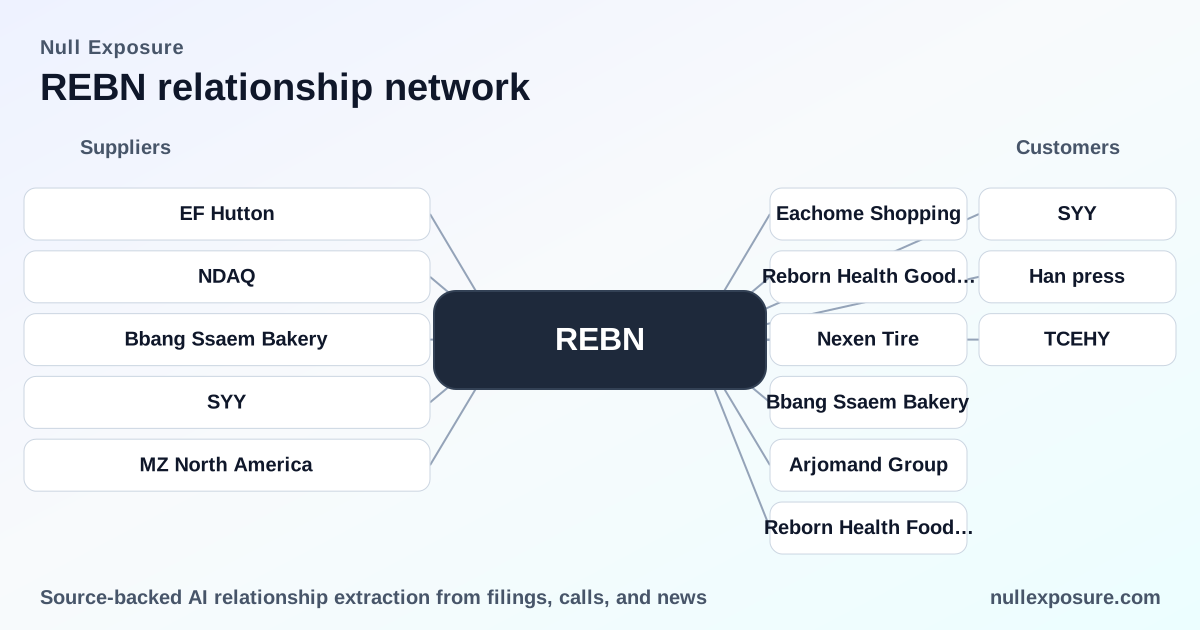
Reborn pairs food-technology acquisitions, national distribution partners and capital markets activity to execute expansion. Distribution scale and a proprietary bakery technology are immediate growth levers, while underwriter and investor-relations touchpoints indicate continued capital-market engagement. These relationships are not peripheral — the company explicitly flags supplier disruptions as potentially material. For more on how supplier concentration affects valuation and portfolio decisions, see https://nullexposure.com/.
Relationship-by-relationship review
Below are all vendor and partner mentions surfaced in public reporting; each entry is a plain-English summary with the originating source.
EF Hutton (news: AlphaStreet, Mar 10, 2026)
Reborn engaged EF Hutton as the underwriter to manage its Nasdaq listing process, signaling past reliance on boutique capital markets partners to access public funding. According to an AlphaStreet report (March 10, 2026), EF Hutton was identified as the manager for the REBN Nasdaq application.
EF Hutton (news: Renaissance Capital, IPO coverage)
EF Hutton acted as sole bookrunner on Reborn Coffee’s upsized IPO, demonstrating a completed capital markets transaction that supplied growth capital. Renaissance Capital’s IPO coverage of the upsized $7 million offering at $5 noted EF Hutton acted as sole bookrunner during the IPO process.
The Nasdaq Stock Market LLC (news: The Globe and Mail, FY2026)
Nasdaq notified Reborn that the company has regained compliance with the Capital Market’s minimum stockholders’ equity requirement, removing an immediate listing-related regulatory overhang. A Globe and Mail press release covering the company’s FY2026 filing states Nasdaq informed Reborn Coffee it regained compliance with Listing Rule 5550(b).
Bbang Ssaem Bakery (news: Food Business News, FY2024)
Reborn announced plans to acquire Korean bakery brand Bbang Ssaem to leverage its proprietary dough technology in franchise rollouts, indicating product differentiation and unit-level margin support for baked goods. Food Business News reported the deal and highlighted that Bbang Ssaem’s proprietary dough technology will support franchise expansion across the U.S.
Sysco (news: GlobeNewswire press release, Aug 29, 2024)
Reborn executed a strategic distribution partnership with Sysco to support national franchise expansion, establishing a credible logistics and foodservice distribution channel for scaling outlets. A GlobeNewswire release (Aug 29, 2024) announced the strategic distribution partnership with Sysco as a supporting element for national expansion.
MZ North America (news: Yahoo Singapore, FY2026)
Investor-relations and communications for Reborn are handled in part through MZ North America, which signals the use of retained IR agencies to manage public investor communications and outreach. A Yahoo Finance Singapore post (FY2026) lists MZ North America and provides an investor relations contact for Reborn.
Sysco (news: GlobeNewswire press release, Jan 29, 2026)
Sysco’s distribution relationship is reiterated in later company releases tied to international expansion efforts, reinforcing its ongoing role as a core distribution partner as Reborn opens flagship locations abroad. A GlobeNewswire release (Jan 29, 2026) again references the strategic distribution partnership with Sysco as Reborn advances its China presence and flagship locations.
What the constraints tell investors about the company (company-level signals)
The public constraint excerpts present company-level signals about how Reborn operates:
- Contracting posture: long-term leasing — Reborn reports leasing all company-owned retail locations with operating leases that include escalations and renewal options; this signals fixed occupancy commitments and lease-exposure as a recurring cash requirement.
- Geographic sourcing: global — The company sources green coffee from multiple countries (Mexico, Ethiopia, Colombia, Guatemala, Brazil, Honduras), indicating supply-chain diversity but exposure to global commodity and logistics risk.
- Materiality: supplier dependence is material — Reborn explicitly warns loss or poor performance by suppliers could have a material adverse effect, making supplier continuity a central operational risk.
- Role with middlemen: distributor relationships — The company uses third‑party importers/exporters to purchase green coffee beans, showing reliance on intermediated supply chains rather than fully integrated sourcing.
- Relationship stage: active — Supplier and lease relationships are described as current and operational, confirming ongoing dependencies rather than planned or potential deals.
These are company-level constraints and should be read as high-level governance and operational signals rather than tied to any single vendor.
Investment implications and risk checklist
- Distribution is a critical path: Sysco’s presence is a strategic enabler; disruption or unfavorable terms would materially slow franchise rollouts and unit economics.
- Product differentiation through acquisition: The Bbang Ssaem acquisition supplies proprietary bakery technology that can lift same-store economics if franchising succeeds.
- Capital markets dependence: Past IPO underwriting activity with EF Hutton and ongoing IR via MZ North America indicate continued engagement with public capital markets for funding and liquidity.
- Operational leverage from leases: Long-term operating leases increase fixed costs and require consistent sales density to cover rent escalations.
- Supply-chain exposure: Global coffee sourcing diversifies origin risk but exposes the company to commodity price swings, trade friction and logistics volatility.
For investors focused on supplier risk and counterparty concentration, a deeper due-diligence package is available at https://nullexposure.com/.
What to watch next
- Monitor Sysco contract terms and distribution coverage changes as a bellwether for rollout velocity.
- Track integration milestones and product rollout from the Bbang Ssaem acquisition to validate unit-level margin improvements.
- Watch liquidity and capital-market announcements; management’s access to capital remains a gating factor given negative EBITDA and high insider ownership.
For ongoing supplier intelligence and to track counterparties linked to public companies like Reborn Coffee, subscribe and view our monitoring tools at https://nullexposure.com/.