Chicago Atlantic Real Estate Finance (REFI): Supplier relationships, debt posture, and operational levers
Chicago Atlantic Real Estate Finance Inc (REFI) is a mortgage-style REIT that originates and holds secured loans concentrated in the cannabis-adjacent real estate market, monetizing through interest income on mortgage and asset-backed lending while distributing cash via dividends. The company finances its portfolio with a mix of unsecured notes and externally managed operations, creating a capital-structure driven earnings profile where debt terms and manager reliability directly determine cash flow stability and credit perception. For investors evaluating supplier and counterparty exposure, the intersection of a $50 million senior note facility, a BBB+ external rating, and an outsourced management model deserves focused scrutiny. Explore supplier and counterparty coverage at https://nullexposure.com/.
How REFI makes money and where suppliers sit in the stack
REFI generates revenue by underwriting and holding secured loans to real estate owners in its target vertical; interest collections flow to the REIT and feed distributions to shareholders. The company’s operating model is externally managed—the Manager handles substantially all investment advisory and general management services—so vendors and counterparties that touch operations or capital markets (lenders, rating agencies, servicers) are direct conduits to earnings delivery rather than peripheral suppliers.
- Capital suppliers (lenders and noteholders) provide funded leverage that magnifies returns but also establish fixed cash outflows under contractual interest terms.
- Service providers (the external Manager and any delegated servicers) execute underwriting, asset management and originations; failures or friction here materially affect asset performance and reporting.
See the corporate site and supplier coverage at https://nullexposure.com/ for a consolidated view of material counterparties.
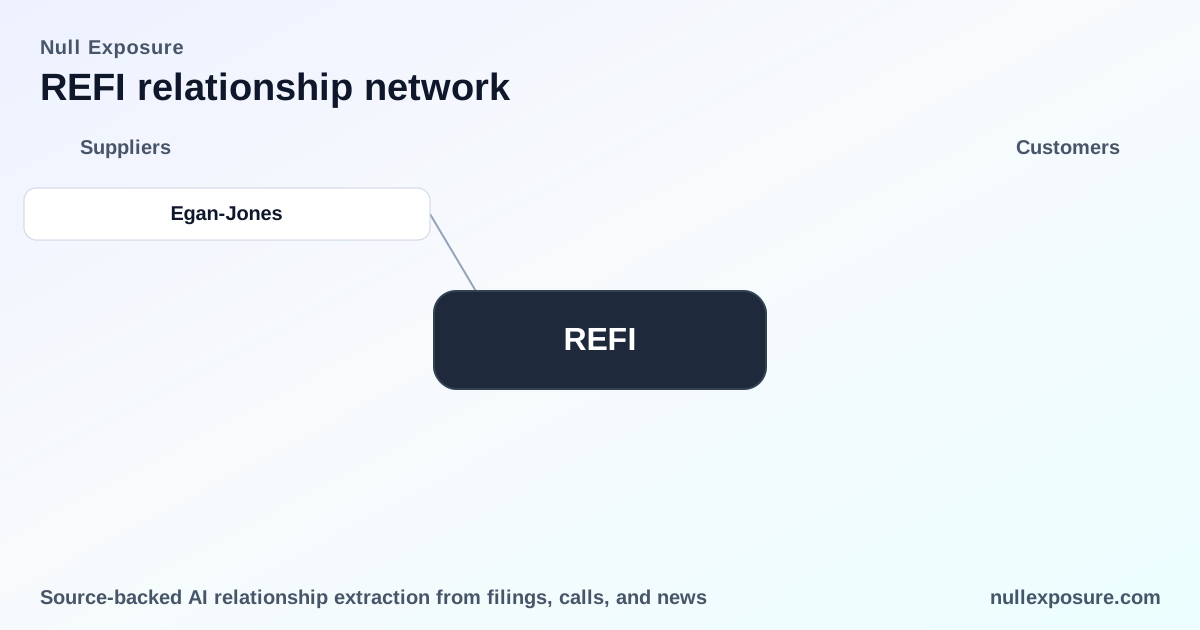
The one recorded supplier relationship: Egan‑Jones (credit rating action)
Egan‑Jones has an explicit connection to REFI via a rating action. A NewCannabisVentures report (March 2026) noted that Egan‑Jones assigned a BBB+ rating to both Chicago Atlantic Real Estate Finance Inc and the senior unsecured term loan tied to the company’s financing activity. This is a credit-market relationship in which the rating firm’s assessment shapes market access and pricing for the company’s unsecured debt. (NewCannabisVentures, March 10, 2026: coverage of REFI borrowing $50 million at 9.0%.)
What the formal constraints tell investors about supplier posture and risk
The extracted constraints from company filings and transaction documents translate into four actionable company-level signals for anyone vetting supplier relationships and counterparty risk:
-
Contracting posture — long-term, fixed-rate debt: The company’s Notes Payable are contractual four‑year obligations maturing October 18, 2028 with a fixed 9.00% interest rate, creating predictable but material cash interest obligations through the maturity date. This is a structural funding commitment that underwrites the company’s leverage profile rather than a short-term working capital facility.
-
Service provider dependency — externalized operations: REFI is externally managed by Chicago Atlantic REIT Manager, LLC under a management agreement (originally dated May 1, 2021 and amended October 2021); the Manager conducts substantially all operations and provides asset management services, and the company states it relies completely on the Manager for investment advisory and general management. This is a core operational dependency that elevates the criticality of the Manager as a supplier.
-
Spend and leverage scale — committed financing is meaningful: On October 18, 2024 the company executed a Loan Agreement for an aggregate $50.0 million in senior unsecured notes, placing the committed facility in the $10m–$100m spend band. Against a market capitalization near $260 million, this financing commitment is a significant funding tranche that materially affects balance-sheet flexibility and refinancing risk.
-
Geographic / legal domicile signal — North America / Delaware management entity: The Manager is a Delaware limited liability company and the company’s operations are structured within U.S. legal and regulatory frameworks, which drives counterparty risk toward U.S.-centric legal recourse and regulatory oversight.
Each of these signals should be treated as company-level characteristics rather than the attributes of any individual external supplier, except where a supplier is explicitly named.
Operational implications for investors and operators
Given the mix above, investors should focus attention on three operational axes:
-
Counterparty concentration and criticality. External management creates a single point of operational dependency; the Manager’s performance is directly correlated with origination quality, asset oversight and compliance. A failure or disruption at the Manager would be a primary operational risk vector.
-
Refinancing and interest coverage risk. Fixed-rate notes at 9.00% through 2028 are costly relative to traditional mortgage product benchmarks; servicing these obligations requires stable interest income and high portfolio occupancy or collections. Debt cost is a principal lever on distributable cash and capital allocation.
-
Market signaling and access to capital. The BBB+ rating assigned by Egan‑Jones informs pricing and distribution in unsecured markets; credit opinions from rating firms materially affect secondary market liquidity and borrowing economics.
If you want a deeper supplier map and counterparty stress views, see the full product suite at https://nullexposure.com/ for structured supplier risk profiles.
Investment considerations and risk checklist
- Credit exposure: The senior unsecured notes and the market rating together determine refinancing windows and spread sensitivity; model debt service under a range of portfolio performance scenarios before sizing position.
- Operational vendor risk: Because the Manager executes most functions, confirm governance rights, termination provisions, and continuity plans in corporate filings.
- Capital dependency: A $50 million unsecured commitment is a substantive claim on future cashflow; monitor covenant language, amortization triggers (if any), and disclosure of any additional liquidity facilities.
Closing—what investors should do next
Chicago Atlantic Real Estate Finance’s commercial profile is capital-structure driven and operationally outsourced, which concentrates supplier risk in its Manager and places refinancing outcomes at the center of valuation. For practitioners evaluating REFI’s supplier relationships, prioritize diligence on the Manager’s track record, the covenant framework around the $50 million notes, and the implications of a BBB+ rating for future funding cost.
For a focused supplier and counterparty report tailored to REITs and mortgage REITs, review our coverage and sign up at https://nullexposure.com/. For bespoke counterparty due diligence or portfolio-level supplier analytics, contact the team through our homepage at https://nullexposure.com/.