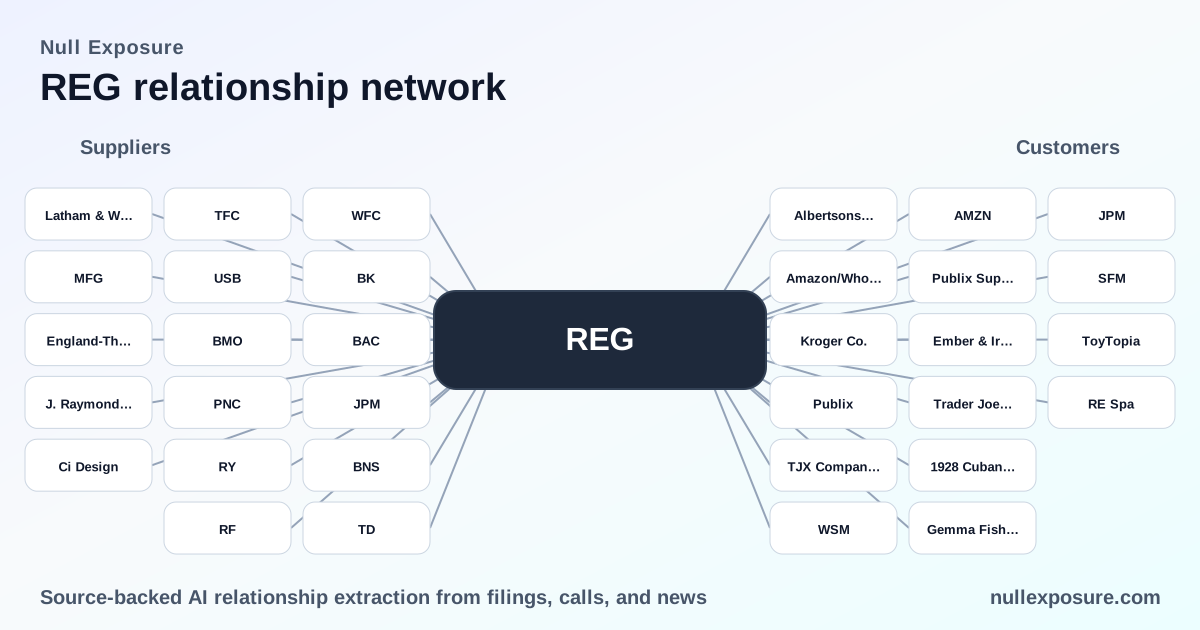
Regency Centers (REG) — 2026 supplier and syndicate map, and what it means for investors
Thesis: Regency Centers monetizes a national portfolio of grocery-anchored shopping centers through rental income and disciplined capital markets activity; the company funds development and liability management by tapping a diversified syndicate of global banks and using established external counsel and project-level contractors. The syndicated $450 million senior unsecured note offering in early 2026 is the operational trigger behind the supplier relationships observed, and it reinforces Regency’s reliance on capital markets partners, outside counsel, and regional construction teams to execute growth and liquidity strategies. For access to the full supplier intelligence behind this note and related projects, visit https://nullexposure.com/.
Why the $450M notes tell a bigger story about Regency’s operating model
Regency priced a $450 million senior unsecured notes offering due 2033 in February 2026. The structure — unsecured corporate paper placed with a broad syndicate — signals a transactional, market-driven contracting posture: Regency sources liquidity from capital markets rather than bespoke bank credit lines. The counterparty set for the deal is diversified across U.S. bulge-bracket and regional dealers, which reduces concentration risk for that financing event but also confirms that capital markets access is critical to Regency’s balance-sheet management. According to the issuer press release on GlobeNewswire (Feb 18, 2026), a mix of joint book-runners and senior co-managers executed the offering; QuiverQuant and ManilaTimes carried the same syndicate detail in March 2026 reporting.
Supplier roll call — who Regency engaged (plain-English notes and sources)
BofA Securities, Inc.
BofA acted as one of the joint book-running managers on the $450M senior unsecured notes offering, positioning it as a primary capital markets execution partner for the transaction. Source: GlobeNewswire press release (Feb 18, 2026) and QuiverQuant coverage (Mar 10, 2026).
J.P. Morgan Securities LLC
J.P. Morgan served as a joint book-running manager on the offering, reflecting a standard investment-bank role in placing unsecured corporate debt into the market. Source: GlobeNewswire press release (Feb 18, 2026).
U.S. Bancorp Investments, Inc.
U.S. Bancorp Investments acted as a joint book-runner, giving Regency distribution into regional institutional channels beyond the bulge bracket. Source: GlobeNewswire press release (Feb 18, 2026) and ManilaTimes republishing (Feb 19, 2026).
Wells Fargo Securities, LLC
Wells Fargo was listed among the joint book-running managers, underscoring Regency’s use of multiple large dealers to diversify placement and underwriting relationships. Source: GlobeNewswire press release (Feb 18, 2026) and QuiverQuant coverage (Mar 10, 2026).
PNC Capital Markets LLC
PNC participated as a joint book-runner on the transaction, providing additional regional distribution and underwriting capacity. Source: QuiverQuant (Mar 10, 2026) and GlobeNewswire (Feb 18, 2026).
RBC Capital Markets, LLC
RBC Capital Markets joined the syndicate as a joint book-runner, supporting cross-border institutional reach for the notes. Source: GlobeNewswire press release (Feb 18, 2026).
Scotia Capital (USA) Inc.
Scotia Capital acted as a joint book-running manager, adding Canadian franchise underwriting presence to the syndicate. Source: GlobeNewswire press release (Feb 18, 2026) and ManilaTimes summary (Feb 19, 2026).
BNY Mellon Capital Markets, LLC
BNY Mellon was named a senior co-manager on the offering, indicating a secondary underwriting and distribution role consistent with custody and institutional sales strengths. Source: GlobeNewswire press release (Feb 18, 2026).
BMO Capital Markets Corp.
BMO participated as a senior co-manager, contributing regional institutional access and underwriting support for the issuance. Source: GlobeNewswire press release (Feb 18, 2026) and ManilaTimes (Feb 19, 2026).
Mizuho Securities USA LLC
Mizuho was named a senior co-manager on the deal, reflecting engagement with a global dealer that provides institutional placement capabilities. Source: GlobeNewswire press release (Feb 18, 2026).
Regions Securities LLC
Regions acted as a senior co-manager, supplying regional distribution and underwriting heft to the syndicate. Source: GlobeNewswire press release (Feb 18, 2026).
TD Securities (USA) LLC
TD Securities joined as a senior co-manager, contributing cross-border institutional reach on the placement. Source: GlobeNewswire press release (Feb 18, 2026) and QuiverQuant (Mar 10, 2026).
Truist Securities, Inc.
Truist was included as a senior co-manager, reflecting participation by southeastern regional dealers in Regency’s financing. Source: GlobeNewswire press release (Feb 18, 2026) and ManilaTimes (Feb 19, 2026).
Latham & Watkins LLP
Latham & Watkins represented Regency in the capital markets transaction, providing capital markets legal counsel and deal documentation services; the firm’s announcement lists the lead partners and associates supporting the representation. Source: Latham & Watkins news release (Feb 2026).
J. Raymond Construction Corp.
J. Raymond Construction is the contractor on The Village at Seven Pines development, illustrating Regency’s use of regional general contractors to execute ground-up projects. Source: JAX Daily Record coverage of the development (Feb 18, 2026).
England-Thims & Miller Inc.
England-Thims & Miller served as the civil engineer on The Village at Seven Pines, indicating Regency’s reliance on established local engineering firms for site work and infrastructure. Source: JAX Daily Record (Feb 18, 2026).
Ci Design
Ci Design is listed as the architect on The Village at Seven Pines project, signaling Regency’s work with regional architectural practices for center design and tenant fit-out. Source: JAX Daily Record (Feb 18, 2026).
Constraints and what they reveal about Regency’s governance and procurement
Regency’s constraint evidence reports that KPMG LLP audited the consolidated financial statements and issued a report on the effectiveness of internal control over financial reporting as presented in the company’s filings (see Item 8 of the referenced report). This is a company-level governance signal that external audit and formal internal control reporting are part of Regency’s financial operations, supporting a mature governance posture that investors should treat as a positive control characteristic. The presence of an external auditor and public internal control reporting complements the firm’s use of multiple, sophisticated capital markets counterparties and established law firms.
Investment implications — what the supplier map implies for risk and opportunity
- Diversified capital partners reduce single-counterparty funding risk. The broad syndicate used for the $450M notes suggests Regency maintains ready access to capital markets across multiple dealer channels, limiting dependence on a single bank.
- Capital markets reliance creates sensitivity to investor sentiment and interest rates. Execution depends on market windows and dealer appetite; the structure is unsecured, so market perception of Regency’s credit profile directly impacts pricing and access.
- Project execution sits with regional contractors and designers, which lowers execution friction on ground-up retail projects but requires active oversight to control cost and schedule risk in a rising-cost environment.
- Governance maturity supports investor confidence. An external audit report on internal controls is a structural signal that financial reporting processes meet institutional standards.
For deeper supplier mapping and counterparty exposure analytics that institutional investors use to stress-test financing scenarios, explore our platform at https://nullexposure.com/ — the home page has the tools and reports investors rely on.
Bottom line: concise takeaways and next steps
Regency’s 2026 supplier footprint is dominated by capital markets dealers, supported by top-tier external counsel and local development contractors — a profile consistent with a REIT that balances portfolio income with periodic market financing and localized development. Key investor takeaways: diversified syndicate reduces concentration risk; unsecured nature of the notes ties cost of capital to Regency’s credit profile; and external audit coverage supports governance assumptions. To review the full supplier list, counterparty signal scoring, and scenario-based funding stress tests, visit https://nullexposure.com/.