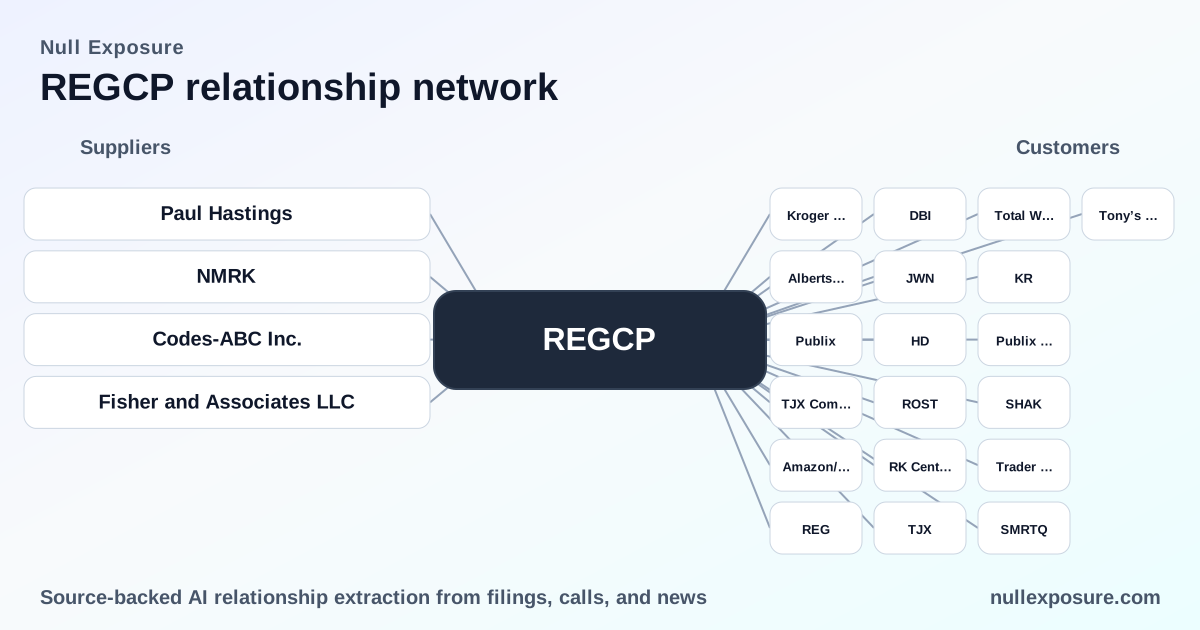
Regency Centers (REGCP) — supplier relationship map and investor implications
Regency Centers is a national owner, operator, and developer of suburban shopping centers that monetizes primarily through rental income, property development and selective asset sales, with preferred equity (REGCP) capturing a claim on cash distributions. The company’s operating cashflow and recurring rent roll fund dividends and development activity; professional suppliers—legal counsel, brokers, architects, and code consultants—support transaction execution and the development pipeline. For a concise supplier-risk assessment and supplier mapping, visit https://nullexposure.com/.
How Regency runs the business and where suppliers fit
Regency’s financial profile shows material operating profitability and recurring revenue: RevenueTTM is $1.611 billion with EBITDA reported at $1.023 billion and a profit margin of 32.7%. Those operating economics underpin leasing, redevelopment and selective portfolio rotation strategies that generate cash available for preferred distributions and growth capex. The preferred series REGCP is a cumulative redeemable instrument issued by Regency Centers, so investor focus is on stable cashflow and counterparty continuity rather than equity upside.
Suppliers are integral to three linked activities:
- Transactions and asset rotation (legal counsel and brokers to execute acquisitions/disposals);
- Development and site delivery (architects and code consultants to enable construction and occupancy); and
- Financial controls and reporting (external auditors validating the financial statements that support dividend capacity).
Visit https://nullexposure.com/ for supplier analytics and relationship intelligence on REIT counterparties.
Who Regency contracts with — a short relationship catalog
Below are all supplier relationships identified in public reporting and local press; each listing is a plain-English summary with source attribution.
-
Paul Hastings: Regency engaged Paul Hastings for legal advice tied to a portfolio transaction referenced in press coverage of a $357 million portfolio closing. According to a Yahoo Finance report covering the transaction (March 10, 2026): https://finance.yahoo.com/news/regency-centers-completes-357m-portfolio-123000466.html.
-
Newmark: Brokerage services were involved in an FY2020 disposition where Regency’s joint-venture asset was marketed and sold, with Newmark (broker Geoffrey Millerd) representing the seller side in the transaction. The transaction detail was reported by New England Real Estate Journal in an article on a 2020 sale: https://nerej.com/rk-centers-acquires-80-000-s-f-stop-shop-plaza-for-23m.
-
Codes-ABC Inc.: For the East San Marco development project, Codes-ABC Inc. provided code-compliance review services supporting permitting and construction readiness. Local reporting on the East San Marco project documented the consultant’s role (November 16, 2020): https://www.jaxdailyrecord.com/news/2020/nov/16/publix-anchored-east-san-marco-could-break-ground-by-january/.
-
Fisher and Associates LLC: Fisher and Associates LLC is named as the architect on the East San Marco project, delivering design and architectural services required to advance the scheme to permitting and ground-breaking. The role was reported in the same Jacksonville Daily Record article (November 16, 2020): https://www.jaxdailyrecord.com/news/2020/nov/16/publix-anchored-east-san-marco-could-break-ground-by-january/.
What the relationship set and constraints signal about operating posture
The public record and corporate disclosures provide clear company-level signals about contracting posture and supplier criticality:
-
Regency’s portfolio includes land subject to long-term ground leases that expire as late as 2121 and typically include renewal options, which establishes a long-tenor landlord operating posture and elevates the need for sustained third-party services across title, legal and land management functions. This is a corporate signal about long-term contractual commitments rather than a supplier-specific term.
-
External audit services are provided by an established national firm—KPMG LLP—which demonstrates Regency’s reliance on mature, professional service providers for financial controls and reporting; this is a company-level indicator of service-provider maturity and governance expectation.
Taken together, these signals indicate a mix of long-duration structural commitments (ground leases) and ongoing vendor reliance for development execution and financial assurance. That combination increases the value of stable, high-quality supplier relationships and raises the cost of supplier disruption.
Visit https://nullexposure.com/ to see how these supplier signals map to counterparty risk scores and operational exposure.
Operational and investor implications
Operationally, the supplier list reflects a pragmatic division of labor: legal counsel and brokers execute transactions; architects and code consultants enable pipeline delivery. For investors and operators this yields several decisive points:
-
Transaction execution is dependent on high-quality legal and brokerage relationships. The Paul Hastings engagement on a major portfolio closing demonstrates Regency’s use of top-tier counsel for deal risk mitigation and documentation.
-
Development risk is concentrated in a small set of specialized service providers. Architect and code consultants (Fisher and Associates; Codes-ABC) are critical to permitting and schedule; delays or poor coordination would directly affect leasing and cashflow timing.
-
Long-term land commitments change the supplier mix from short transactional vendors to long-engagement professional relationships. Ground leases extending to 2121 mean Regency will require sustained property management, legal, and land administration services over decades.
-
Financial controls and governance rely on established auditors. KPMG’s role as auditor signals institutionalized reporting discipline that underpins investor confidence in dividend coverage and earnings quality.
Risk profile and what to monitor
Focus due diligence on supplier continuity, concentration and contract terms:
- Track lead counsel and brokerage continuity around large portfolio rotations; losing a preferred legal firm during high-volume transaction periods elevates execution risk.
- Monitor the development services roster and local permitting outcomes; architect/code issues are execution-critical and directly affect revenue timing.
- Review ground-lease provisions for renewal and contingent obligations; multi-century lease terms imply legacy risks such as environmental or restrictive covenants that require legal and land-management expertise.
- Validate audit tenure and any auditor notes in SEC filings to assess governance stress points that could affect cash distributions.
Bottom line and recommended actions
Regency’s supplier ecosystem is small but functionally comprehensive: legal, brokerage, architectural and code-compliance partners enable transactions and development that generate the cashflow supporting REGCP distributions. For investors, the primary supplier risks are execution delays in development and transactional continuity of top-tier legal/brokerage counsel; for operators, the imperative is retaining experienced, local-capable suppliers who understand long-term ground-lease dynamics.
For a targeted supplier risk profile and relationship scoring tailored to Regency and comparable REIT issuers, visit https://nullexposure.com/. If you are modeling counterparty continuity into preferred-hold scenarios or operational stress tests, Null Exposure’s relationship intelligence provides the data and analysis to do so with precision: https://nullexposure.com/.