Ring Energy (REI): Supplier relationships that steer an acquisition-first E&P
Ring Energy operates as a small-cap exploration & production company that monetizes by acquiring and developing onshore oil and gas assets in the Permian and adjacent basins, then selling produced hydrocarbons into market channels. The company drives value through asset purchases and integration, funded by a mix of cash, equity and debt, and underpinned by third‑party technical, legal and financial advisers that operationalize those deals. For a focused supplier and counterparty overview, see https://nullexposure.com/.
Business model in one line: buy producing acreage or near‑term inventory, consolidate operating control, optimize production and cash flow, and service capital providers while shrinking leverage.
How Ring runs its operating playbook and where suppliers fit in
Ring Energy’s operating posture is acquisition-driven and capital intensive. The firm’s stated revenues and EBITDA (Revenue TTM $292.9M; EBITDA $204.1M) show an oilfield operator with substantial cash generation relative to revenue, while equity metrics (Market Capitalization ~$302.5M; Price/Book 0.37) point to a market that prices the company as a leveraged, turnaround-style E&P. Ring’s monetization relies on extracting near-term cash from producing assets and deploying that cash to pay down debt and fund incremental drilling.
Key business model drivers:
- Acquisitions and integration are central: Ring uses cash and stock consideration to expand acreage and proved reserves.
- External advisers and engineers are critical for valuation, reserve certification and financing; the company sources technical and legal expertise from boutique firms.
- Balance-sheet management—including targeted debt paydowns after purchases—determines free-cash-flow reinvestment and investor returns.
For deeper supplier intelligence and counterparty mappings, visit https://nullexposure.com/.
The relationships that matter — who Ring hires and why
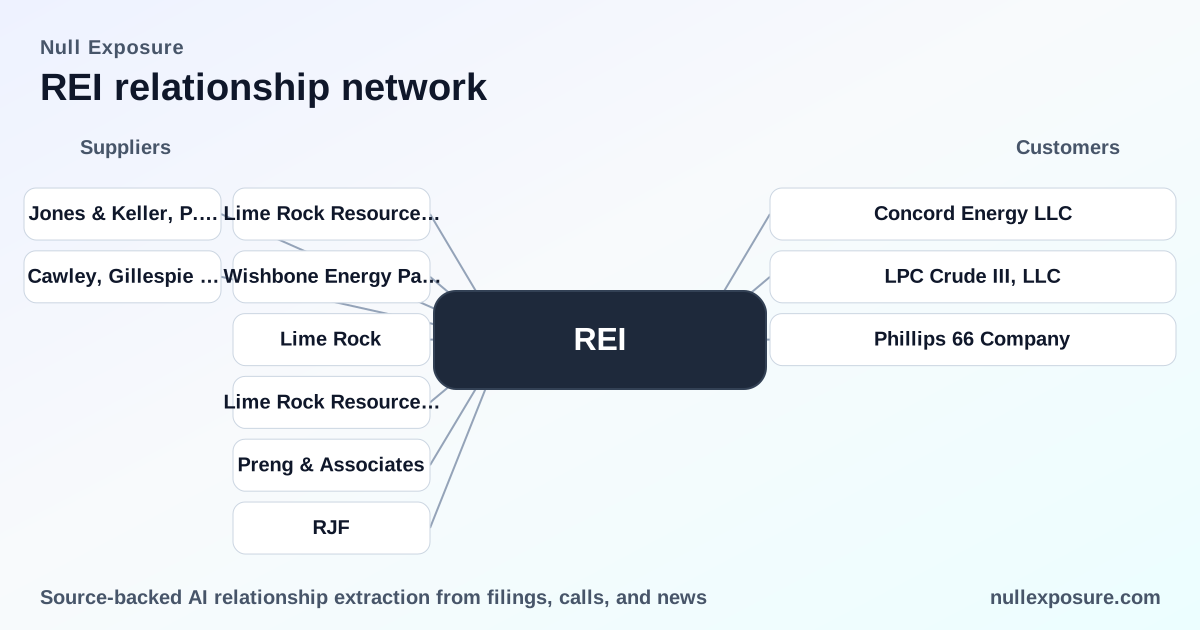
Below are the direct counterparties and suppliers identified in recent public disclosures and media reporting, with concise plain‑English summaries and source references.
-
Lime Rock Resources IV LP / Lime Rock
Ring completed the acquisition of Central Basin Platform (CBP) assets from Lime Rock for approximately $73.6 million in cash plus ~6.5 million shares, a transaction that expanded Ring’s Permian footprint and required subsequent balance‑sheet adjustments. According to Rigzone (April 7, 2025), the deal closed and was a material strategic purchase; Ring later disclosed it paid down $40.0 million of debt following that close (company filing reported via QuiverQuant, FY2026). -
Wishbone Energy Partners LLC
The acquisition of Northern Wolf Springs (NWS) assets from Wishbone materially increased Ring’s scale, effectively doubling production and proved reserves at the time by adding more than 38,000 net acres and 360 drilling locations. NaturalGasIntel reported on this integration and its production impact in its FY2020 coverage. -
Preng & Associates
Ring used retained executive-search expertise from Preng & Associates in appointing a new Chief Financial Officer, signaling reliance on boutique recruiting firms for senior hires. Huntscanlon covered the appointment and noted Preng’s assistance in FY2026. -
Raymond James (RJF)
Raymond James served as Ring’s exclusive financial advisor on an accretive, all‑cash asset acquisition, indicating the company engages full‑service investment banks for deal sourcing and execution. CityBiz reported Raymond James’ advisory role during the FY2023 transaction announcement. -
Jones & Keller, P.C.
Ring retained Jones & Keller, P.C. to provide legal counsel on the same acquisition where Raymond James advised, reinforcing that outside law firms are a standard component of transaction execution. CityBiz noted Jones & Keller’s role in the FY2023 deal. -
Cawley, Gillespie & Associates, Inc.
Ring’s year‑end 2025 proved reserves were prepared by Cawley, Gillespie & Associates, an independent petroleum engineering firm, demonstrating reliance on third‑party reserve certifiers for reporting and financing purposes (reported in Ring’s FY2026 results via QuiverQuant).
What these relationships imply about risk and concentration
These supplier ties reveal a clear operating pattern: Ring outsources specialized capabilities—transaction advisory, legal, recruiting and reserve engineering—while concentrating operational risk in a two‑state footprint (Texas and New Mexico, Permian-focused).
Company-level signals that shape investor risk assessment:
- Contracting posture: Transactional and deal-focused; Ring contracts topically for M&A execution and post‑acquisition integration.
- Concentration: High geographic concentration in the Permian increases operational leverage to regional price and takeaway dynamics.
- Criticality: External advisors and independent engineers are critical to valuation, reserve certification and capital access; those suppliers materially affect financing terms and investor perception.
- Maturity: Mid‑stage E&P profile—positive EBITDA but negative diluted EPS and modest institutional ownership (~30%)—indicates a company that has stabilized operations but remains execution-dependent.
Financial context underscores these operational signals: EV/EBITDA of 5.9 and Forward P/E of 9.0 reflect a market assigning recovery value to the business, while a Price/Book of 0.37 signals depressed equity valuation relative to book capital.
Practical investor takeaways and action steps
- Acquisitions drive growth and risk: Monitor follow‑on debt reductions and integration metrics after any material purchase—Ring’s $40M debt paydown after the Lime Rock CBP deal is the exact metric investors should track. (See QuiverQuant FY2026 reporting.)
- Supplier quality matters: The use of reputable advisers (Raymond James, Jones & Keller) and independent reserve engineers (Cawley, Gillespie) reduces execution risk and enhances financing optionality.
- Concentration is a lever: Permian exposure amplifies upside in favorable differential and takeaway environments and increases downside under local service-cost inflation or logistical constraints.
For a structured counterparty and supplier diligence package tailored to E&P portfolios, visit https://nullexposure.com/ to see how Ring’s network maps to credit and operational risk.
Conclusion: a small-cap E&P run like a roll‑up, supported by boutique suppliers
Ring Energy runs an acquisition-led E&P model that monetizes through near-term production while relying on a compact set of specialized external suppliers for deals, legal work, recruiting and reserve certification. The company’s supplier relationships are not decorative—they are operationally and financially material. Investors should monitor deal cadence, reserve certification outputs, and debt movement as proximate indicators of execution success.
If you want a concise supplier risk scorecard for Ring Energy and comparable E&P names, explore available reports at https://nullexposure.com/ — the fastest way to move from headline transactions to actionable counterparty insight.