RELI: How Reliance Global Funds Operations and Uses Placement Agents to Access Capital
Reliance Global Group operates as an insurance services holding company that funds underwriting and premium-financing activities through a combination of operating cash flow and opportunistic capital raises. The company monetizes by underwriting specialty insurance and providing financing-related products, while periodically tapping the equity markets to replenish capital — most recently engaging a placement agent to execute a public offering in FY2026. If you are evaluating RELI as a supplier or partner, focus on capital access, dilution risk, and the cost of external funding as primary drivers of counterparty stability and supplier payment capacity. For more supplier intelligence and relationship detail see https://nullexposure.com/.
Executive summary: what matters for investors and operators
Reliance’s FY2026 capital transactions underline three strategic facts:
- Capital markets are an active funding source. Engaging a placement agent and closing an offering signals reliance on equity issuance to support operations and growth.
- Execution costs and warrants dilute existing holders and increase funding cost. Using placement agents with customary fees and placement agent warrants is an explicit expense and dilutive element.
- Counterparty concentration is modest but material. The company engaged a named investment bank for the transaction, concentrating execution and fee exposure.
Key takeaway: RELI’s supplier and counterparty counterparties should price the company’s reliance on market funding into negotiation stance and credit terms.
Visit https://nullexposure.com/ for deeper supplier dashboards and transaction timelines.
What the FY2026 placement tells you about RELI’s operating posture
In FY2026 Reliance used an exclusive placement agent relationship to source capital rather than a broad syndication or straight debt placement. Engaging an exclusive placement agent is common for small to mid-cap issuers that require market access and specialized placement support. That contracting posture indicates a proactive approach to capital sourcing but also exposes the firm to the timing and execution risk of a single intermediary.
A placement agent engagement that includes customary cash fees, expense reimbursement and placement agent warrants shifts part of the funding burden onto equity dilution and fee cashflow, effectively raising the company’s all-in funding cost. For counterparties assessing supplier leverage, such terms are material to working capital forecasts and counterparty resilience.
The H.C. Wainwright relationship: placement agent and offering execution
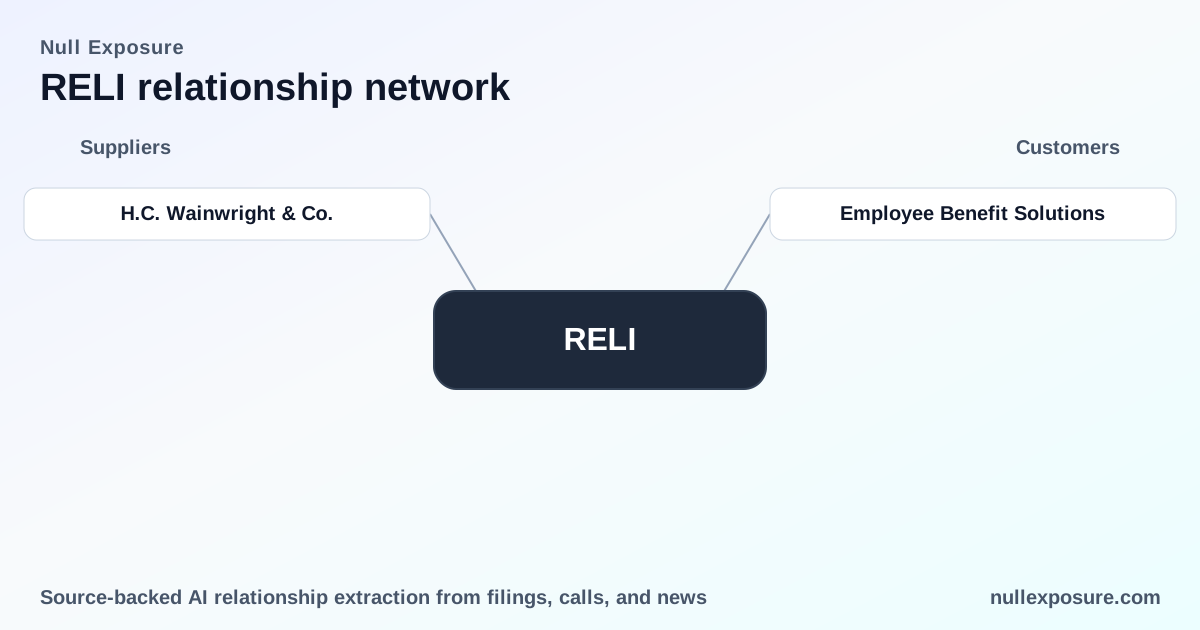
H.C. Wainwright & Co. acted as RELI’s exclusive placement agent in FY2026 and was the intermediary that executed the public offering that closed in March 2026. According to a TradingView report on March 10, 2026, RELI engaged H.C. Wainwright as exclusive placement agent with customary cash fees, expense reimbursement, and placement agent warrants. A QuiverQuant news release the same day confirmed H.C. Wainwright acted as the exclusive placement agent for the completed offering of 7.4 million shares that generated gross proceeds of approximately $2 million. These public disclosures make the placement economics and counterparty explicit and recent. (TradingView, March 10, 2026; QuiverQuant, March 10, 2026.)
Company-level constraints and operating signals investors should weight
The provider feed contains no formal constraints entries for RELI; treat that absence as a company-level signal rather than an omission tied to a single supplier. From the capital transactions and disclosure language, derive these operating characteristics:
- Contracting posture: RELI uses exclusive engagements with boutique investment banks to access equity capital, indicating a preference for focused execution over broad syndication.
- Concentration: The naming of a single placement agent for this raise signals a degree of counterparty concentration for capital markets activity.
- Criticality of capital markets: Equity issuance is a recurring lever for funding; capital markets access is critical to operational liquidity and growth financing.
- Maturity and growth phase: The reliance on placement-agent warrants and equity issuance to raise modest proceeds suggests RELI is in a growth- or preservation-focused phase where non-debt funding is prioritized to avoid fixed interest obligations.
These signals inform how suppliers and counterparties should structure terms — shorter payment windows, covenant-lite protections, or price adjustments where appropriate.
Visit https://nullexposure.com/ to subscribe for alerts on new placement and financing activity.
Relationship-by-relationship summary
- H.C. Wainwright & Co.: H.C. Wainwright was engaged as RELI’s exclusive placement agent in FY2026, with the engagement including customary cash fees, reimbursement of expenses and placement agent warrants, and the firm executed a public offering that closed with gross proceeds of roughly $2 million for 7.4 million shares. (TradingView reporting and QuiverQuant reporting, March 10, 2026.)
Investment implications, operational risks and negotiation levers
Reliance’s FY2026 equity raise and the structure of its placement agreement create actionable implications for investors and operators:
- Dilution and cost of capital are real and quantifiable. Placement fees and warrants reduce net proceeds and increase future share overhang; suppliers should model the impact on working capital coverage.
- Execution risk is concentrated. Using an exclusive agent accelerates execution when markets cooperate but increases vulnerability if the intermediary cannot place the deal favorably.
- Cash runway and liquidity should be monitored monthly. A small gross raise relative to operating scale suggests liquidity buffers are thin; counterparties should require stronger payment protections.
- Contract terms can be adjusted to reflect funding cadence. Consider shorter payment terms, invoice factoring ceilings, or partial advance payments around known financing events.
Risk management tip: Treat funding events as operational catalysts — after a raise suppliers should reassess exposure thresholds and payment terms rather than assume improved liquidity will immediately follow.
Final assessment and next steps
RELI’s recent activity in FY2026 demonstrates targeted capital raising through a named boutique placement agent, with explicit dilutive instruments used to compensate intermediaries. For supplier relationships this translates into heightened attention to payment certainty, a realistic view on dilution-driven equity risk, and contingency planning for capital-market execution failures.
If your organization needs granular supplier intelligence or monitoring of RELI’s capital transactions, review the relationship profiles and historical transaction log at https://nullexposure.com/. For tailored alerts and counterparty risk scoring, start an inquiry at https://nullexposure.com/ and have your procurement and credit teams align on next-step protections before the next financing cycle.