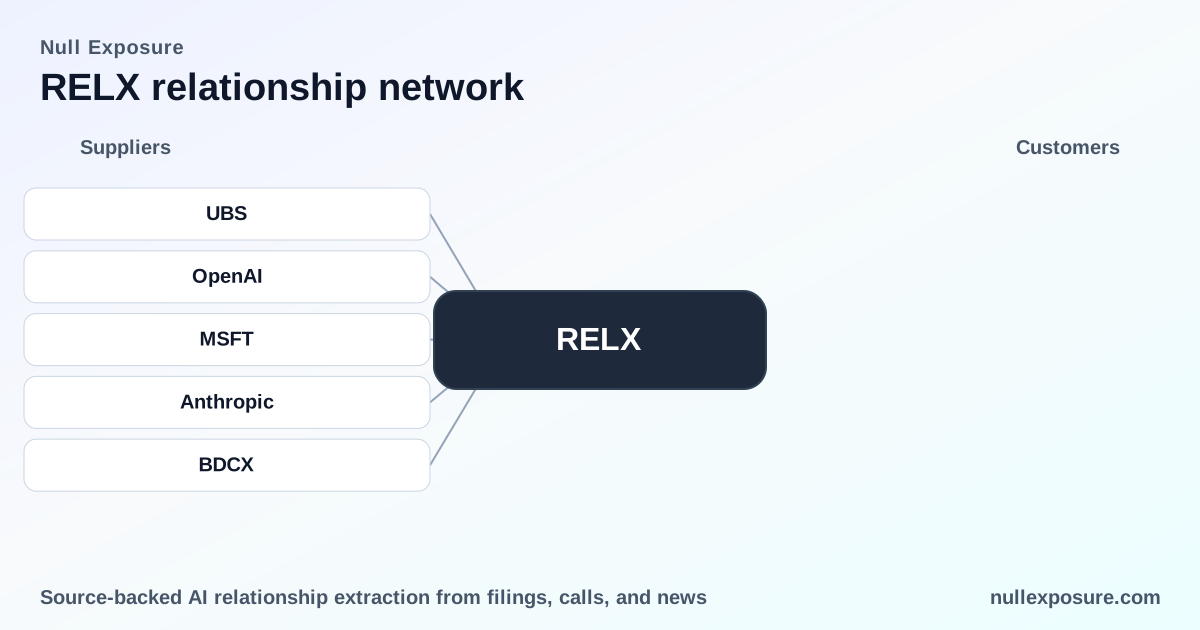
RELX supplier relationships — buybacks, banks and AI partners investors should track
Relx PLC is a global provider of information and analytics for professional and commercial customers; the company monetizes through recurring subscriptions, data and analytics products, and professional services sold to regulated and enterprise buyers across markets. For investors, the supplier profile is defined by a dual dynamic: financial-market counterparties that execute capital allocation (buybacks) and technology partners that extend product capability (large language model providers and cloud platforms) — both sets influence capital returns, product competitiveness, and execution risk.
Explore supplier intelligence and counterparty signals at https://nullexposure.com/ to see how counterparties influence corporate outcomes.
Why these relationships matter to investors
RELX’s supplier roster in the recent reporting window is dominated by a bank executing its non-discretionary buyback program and by strategic AI/cloud partners referenced in earnings commentary. Buyback execution partners affect timing, disclosure, and market reception of share repurchases; technology partners shape product roadmap and client stickiness. For portfolio managers, monitoring execution counterparties and public mentions of partners gives forward-looking insight into cash deployment discipline and product differentiation.
- Capital allocation signal: A sustained, non-discretionary buyback routed through a single custodian suggests a standardized execution posture and predictable disclosure flow.
- Technology signal: Named partnerships with major LLM providers and a hyperscaler indicate product-level integration that supports enterprise selling and upsell economics.
If you want an ongoing feed of counterparties and procurement signals for RELX, visit https://nullexposure.com/.
Operating-model characteristics investors should read into (company-level signals)
RELX’s financial profile and the relationships disclosed imply several operating model attributes:
- Contracting posture: Execution of a public, non-discretionary buyback via an appointed bank points to a transactional contracting model for capital markets services — standardized instructions, measurable execution windows, and centralized oversight.
- Concentration and criticality: The buyback activity is concentrated with a single execution bank during the program, which makes that counterparty operationally critical for on-market repurchases but not strategic beyond the program.
- Maturity: Longstanding integrations with major cloud and AI suppliers signal a mature technology procurement approach — partnerships that are embedded into product flows rather than ad hoc pilots.
- Supplier risk profile: Counterparty risk is asymmetric — financial execution risk is operational and disclosure-driven, while technology partner risk is strategic and adoption-driven.
Relationships detailed — every item in the public results
-
RELX purchased 500,000 ordinary shares on the London Stock Exchange through UBS AG London Branch. Source: a Reuters notice republished on TradingView reporting RELX’s buyback execution (reported Feb–Mar 2026).
-
UBS is executing trades on RELX’s behalf under preset instructions as part of its buyback program. Source: coverage in ts2.tech describing UBS’s role in carrying out the company’s instructed trades (FY2026 reporting window).
-
RELX disclosed a purchase of 357,578 shares executed on the LSE via UBS AG London Branch at prices between 2,598p and 2,684p. Source: ts2.tech article citing company disclosures on specific trade slices (FY2026).
-
The group announced a non-discretionary share buyback of up to £250 million set to conclude on Feb. 6, with UBS handling the process. Source: ts2.tech coverage summarizing the announced non-discretionary program and UBS’s execution mandate (FY2026).
-
In earnings commentary, RELX stated it has been partnering closely with OpenAI and other large language model providers to support product development. Source: Q4 2025 earnings call transcript coverage in InsiderMonkey referencing executive remarks (Q4 2025 / FY2026 commentary).
-
RELX executives noted deep operational integration with Microsoft, enabling customers to work fluidly between RELX tools and Microsoft platforms. Source: InsiderMonkey coverage of the Q4 2025 earnings call where the company described its Microsoft integration (Q4 2025 / FY2026 commentary).
-
On Feb. 6, RELX disclosed it purchased 465,361 shares via UBS on the LSE, bringing cumulative buybacks since Jan. 2 to 8.84 million shares. Source: ts2.tech summarizing company disclosures about buyback volume and dates (FY2026).
-
RELX announced a non-discretionary buyback programme running Feb. 12 through March 20 with £450 million allocated, and UBS was handling the operation. Source: ts2.tech reporting the expanded repurchase program and UBS’s role (FY2026).
-
RELX disclosed it bought 1.8 million shares on Feb. 17 through UBS AG’s London branch at a volume-weighted average price of 2,235.8306 pence. Source: ts2.tech coverage reporting the company’s February trade disclosure and VWAP detail (FY2026).
-
RELX confirmed a partnership dialogue with Anthropic, listed among the large language model providers the company has been working with. Source: InsiderMonkey transcription of the Q4 2025 earnings call in which management named Anthropic (Q4 2025 / FY2026 commentary).
-
TipRanks reported that RELX repurchased 500,000 ordinary shares on March 4, 2026 through UBS AG’s London branch at a volume-weighted average price of about 2,580 pence. Source: TipRanks company announcement coverage summarizing the March buyback execution (Mar 2026).
What to watch next — investment implications and risks
- Execution concentration: The buyback program is consistently executed through UBS, making execution reporting and timing predictable but introducing single-counterparty operational risk during the program window. Investors should track disclosure cadence and any changes in the appointed broker.
- Capital return credibility: Continuous, disclosed repurchases across January–March reflect a credible capital-return posture; the scale and VWAPs cited in disclosures are useful for judging management’s price sensitivity.
- Strategic tech partnerships: Public naming of OpenAI, Anthropic and Microsoft in earnings commentary is a signal that RELX is embedding modern LLM and cloud capabilities into product sets — this supports stickier revenue and potential upside to subscription pricing.
- Regulatory and disclosure sensitivity: Buybacks routed through a single London branch with VWAP reporting increase transparency but also concentrate regulatory and reporting obligations on that execution channel.
If you want a tailored counterparty risk scorecard or to monitor how RELX’s supplier posture evolves across future announcements, start here: https://nullexposure.com/.
Bottom line and investor action points
RELX combines steady capital-return mechanics executed through a consistent banking counterparty with strategic technology partnerships that lift product competitiveness. For investors, the near-term focus is execution and disclosure around the buyback program and the medium-term focus is productive integration of LLM and cloud partners into revenue-driving products.
Track vendor execution and partnership disclosures continuously; for ongoing monitoring and supplier-driven signals for RELX, visit https://nullexposure.com/ and subscribe to alerts.