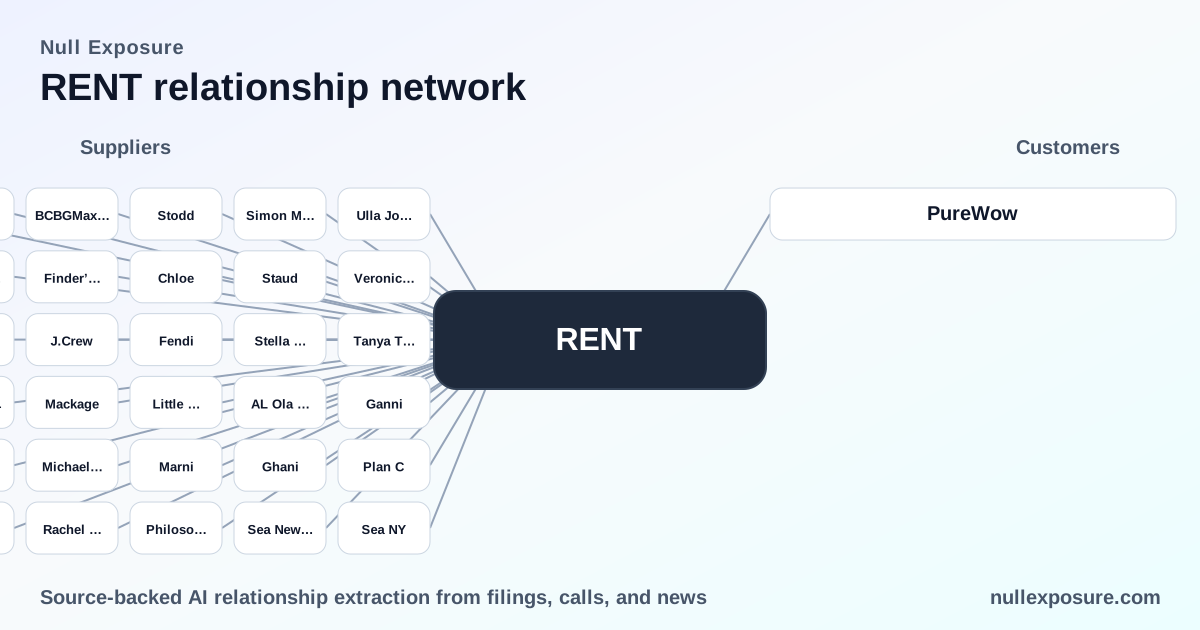
Rent the Runway (RENT): supplier relationships that underpin inventory, margins and brand equity
Rent the Runway rents designer apparel and accessories to consumers through subscription and single-rental models, monetizing via membership fees, one-off rentals, and revenue share arrangements with brands. The company sources most product directly from designer partners — often on consignment or through performance-based buys — and couples that inventory strategy with physical retail points and digital marketing to drive unit turns. Investors should view RENT as a vertically coordinated marketplace: inventory relationships determine gross margins and assortment quality, while real estate and cloud contracts determine fixed-cost leverage.
Discover focused supplier intelligence and relationship mapping at https://nullexposure.com/.
What to watch: model dynamics that drive revenue and risk
Rent the Runway’s operating model combines three forces that investors must track: brand partnerships that determine customer perception, consignment and revenue-share economics that link supplier payouts to usage, and fixed-cost leases and cloud services that create scale leverage. The company reports increased investment in “pillar brands” to lift order value and retention, while simultaneously running long-term leases for retail footprint and operating core infrastructure on a third-party cloud provider.
- Contracting posture: a mix of long-term real estate leases and performance/usage-based arrangements with brands gives RENT both fixed obligations and variable supplier costs tied to revenue.
- Concentration and criticality: inventory is sourced from hundreds of brand partners, but management explicitly identifies a subset of pillar brands that drive higher perceived value — this creates concentration risk around a small group of high-impact suppliers.
- Maturity and dependence: brand partnerships are commercial and transactional (wholesale, consignment, exclusive drops), while infrastructure moves to cloud indicate operational dependence on third-party service providers rather than captive systems.
Learn more about how supplier relationships affect operational risk at https://nullexposure.com/.
Supplier and brand relationships — plain-English investor briefings
Below are concise summaries of every partner relationship noted in public reporting and media coverage. Each line references the original reporting context.
- Ulla Johnson — Rent the Runway expanded styles from Ulla Johnson as part of Q1 product collaborations and assortment growth. (GlobeNewswire Q1 2025 release, June 5, 2025)
- Veronica Beard — Management identified Veronica Beard as a pillar brand with increased buys to drive perceived value and higher order economics. (Earnings transcript, Fool.com, June 5, 2025)
- Tanya Taylor — Tanya Taylor was listed among brands whose style counts rose in the company’s Q1 release, reflecting assortments targeted at member preferences. (GlobeNewswire Q1 2025 release, June 5, 2025)
- Ganni — Ganni featured in the Q1 collaboration slate and inventory expansion, contributing to customer engagement on new drops. (GlobeNewswire Q1 2025 release, June 5, 2025)
- Plan C — Plan C was one of four new collaborations highlighted by management as part of Q1 product initiatives to boost engagement. (GlobeNewswire Q1 2025 release, June 5, 2025)
- Sea NY (Sea New York) — Sea NY led one of the Q1 collaboration drops and was cited as driving customer engagement in earnings commentary. (GlobeNewswire Q1 2025 release; Fool.com earnings transcript, June 5, 2025)
- Simon Miller — Simon Miller was announced as a collaborator in Q1 and noted for strong customer response to the drop. (GlobeNewswire Q1 2025 release; Fool.com earnings transcript, June 5, 2025)
- Staud — Staud was specifically called out among brands for which Rent the Runway increased style counts in Q1. (GlobeNewswire Q1 2025 release, June 5, 2025)
- Stella McCartney — Woman’s Day coverage (2019) lists Stella McCartney as a designer available through Rent the Runway’s kids offering, showing early catalog breadth. (Woman’s Day, 2019)
- AL Ola Johnson — Management identified AL Ola Johnson among pillar brands where buys were increased to lift customer perception and value. (Earnings transcript, Fool.com, June 5, 2025)
- Ghani — Mentioned in earnings commentary as part of the new-collaboration cohort leading engagement. (Earnings transcript, Fool.com, June 5, 2025)
- Stodd — Stodd was named as a pillar brand receiving increased purchasing emphasis to improve order economics. (Earnings transcript, Fool.com, June 5, 2025)
- Chloe — Woman’s Day (2019) referenced Chloe as a designer included in the rental roster for children’s sizes, illustrating multi-category sourcing. (Woman’s Day, 2019)
- Fendi — Fendi appears in early coverage of Rent the Runway’s kids selection, indicating luxury-brand participation in the program. (Woman’s Day, 2019)
- Little Marc Jacobs — Little Marc Jacobs was listed among children’s designers available to members in earlier media coverage. (Woman’s Day, 2019)
- Marni — Marni featured on the list of designers available through the kids offering, reinforcing brand diversity. (Woman’s Day, 2019)
- Philosophy — Philosophy was included in the kids-focused catalog referenced in the Woman’s Day review. (Woman’s Day, 2019)
- BCBGMaxAzria — PureWow (2019) cited BCBGMaxAzria pieces available via Rent the Runway, evidencing platform variety for celebrity-styled looks. (PureWow, 2019)
- Finder’s Keepers — Finder’s Keepers garments were noted in PureWow coverage as part of rentable outfits featured in editorial curation. (PureWow, 2019)
- J.Crew — J.Crew items were identified in lifestyle coverage as available through Rent the Runway, showing mainstream-brand participation. (PureWow, 2019)
- Mackage — Mackage accessories were called out in PureWow editorial as part of a curated week of looks via the service. (PureWow, 2019)
- Michael Stars — Michael Stars was mentioned in PureWow coverage as a provider of rentable casual pieces. (PureWow, 2019)
- Rachel Roy Collection — Rachel Roy Collection dresses were included in PureWow’s roundup of rentable looks. (PureWow, 2019)
- Theory — Theory was listed among designer labels whose pieces were available for rent in lifestyle reporting. (PureWow, 2019)
- Autumn Adeigbo — Page Six noted Autumn Adeigbo accessories appearing on Rent the Runway, referenced in coverage of board-level visibility. (Page Six, 2021)
- Wixow — Management described a Wixow-exclusive design preview event that drew in customers, illustrating event-driven brand promotion. (Earnings transcript, Fool.com, June 5, 2025)
- Donna Morgan — Donna Morgan pieces were cited in editorial recounting of curated looks sourced through the platform. (PureWow, 2019)
- Rosie Assoulin — Page Six coverage included Rosie Assoulin garments as part of high-profile rentals. (Page Six, 2021)
- Neiman Marcus — A PR Newswire release (FY2016) described Rent the Runway’s retail expansion, including a store operating inside a Neiman Marcus location in San Francisco. (PR Newswire, 2016)
- Google (GOOGL) — ChiefMarketer reporting (FY2024) flagged a strategic shift away from bottom-of-funnel Google ads toward brand-building marketing campaigns. (ChiefMarketer, 2024)
What the constraints tell investors about RENT’s supplier posture
The company-level constraint signals from public disclosures are actionable for investors:
- Long-term lease exposure: Rent the Runway maintains real estate and equipment leases that range up to 14 years, creating fixed-cost leverage that amplifies revenue volatility. (Company disclosures)
- Usage-based supplier economics: A portion of product is acquired on consignment or with performance revenue-share terms, producing variable cost tied to rental performance rather than pure upfront inventory expense. (Company disclosures)
- Dual role of partners: Management sources virtually all apparel from designer partners via wholesale, consignment and exclusive arrangements, positioning these brands as critical to the core product offering. (Company disclosures)
- Service provider dependence: The primary production environment and core architecture have migrated to a third-party cloud provider, making operational continuity dependent on external infrastructure. (Company disclosures)
These constraints translate to a simple investor framework: inventory relationships drive top-line quality and gross margin; leases and cloud service contracts drive fixed-cost and operational risk.
Explore supplier mapping and risk scoring on the platform at https://nullexposure.com/.
Investment implications and bottom line
Rent the Runway’s supplier mix is deliberately broad, but management’s emphasis on a set of pillar brands means a small group of designers drives outsized customer perception and purchasing behavior. For investors, the key variables are turnover of rented inventory, price realization on pillar-brand items, and the company’s ability to scale fixed retail and cloud costs without compressing margins. Monitor disclosures for changes in consignment economics, new exclusive collaborations, and lease commitments to track margin trajectory.
If you evaluate supplier concentration or need deeper counterparty intelligence for RENT, visit https://nullexposure.com/ for detailed relationship analytics and source-level documentation.