Replimune Group (REPL): supplier relationships, cash runway, and clinical partnerships investors should track
Replimune develops engineered oncolytic viral therapies and monetizes primarily through clinical development partnerships, collaborations with large pharma, and eventual product commercialization; today its value is driven by clinical readouts, co-development deals and balance-sheet management rather than product revenue. The company funds operations through equity and structured credit facilities while outsourcing substantial elements of manufacturing and trial execution to third parties, so supplier relationships are both operationally critical and signal points of execution risk. For a concise vendor-risk and partnership view for investment diligence, visit https://nullexposure.com/.
How Replimune wins (and where supplier risk sits)
Replimune’s commercial thesis is straightforward: de-risk lead assets through clinical collaborations, then convert efficacy signals into licensing, co-development, or sales. That strategy requires three operational pillars: reliable supply of clinical-grade material, close coordination with clinical research organizations and trial sites, and strategic alliances with large biopharma partners that can scale regulatory and commercial execution.
- Replimune currently records no product revenue and negative EBITDA, so partners and financing are the proximate revenue analogue while its molecules progress through registrational pathways.
- Outsourcing is intentional: the company operates a manufacturing facility but depends on third-party manufacturers for raw materials and critical consumables, increasing counterparty exposure across the supply chain.
For supplier diligence and coverage of related counterparties, see https://nullexposure.com/ for more context.
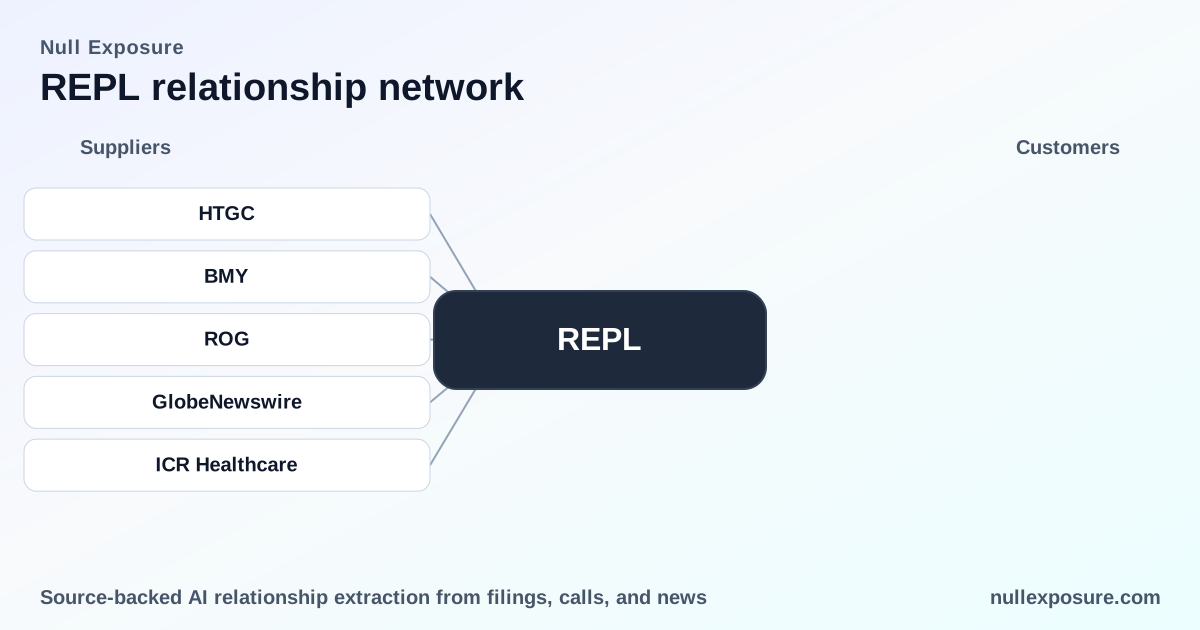
What the public signals say: the five relationships you must know
Below I cover every relationship surfaced in the recent monitoring results and cite the reporting that documents each connection.
Hercules Capital — liquidity and credit support (FY2026)
Replimune amended its credit agreement with Hercules Capital to secure an additional $35 million in immediate capital, bolstering the company’s near-term runway and reducing the urgency of dilutive financing. This change was reported in March 2026 by Ad-hoc-news summarizing the credit amendment and its cash impact. (Ad-hoc-news, March 2026)
Bristol Myers Squibb — clinical partner on RP1 + Opdivo (FY2025)
Replimune’s biologics license resubmission centers on RP1 used in combination with Bristol Myers Squibb’s checkpoint inhibitor Opdivo, reflecting a clinical co-therapy strategy that leverages BMS’s approved checkpoint franchise to strengthen registrational prospects. FierceBiotech reported that the FDA accepted the resubmission and set a decision date in April, citing the RP1/Opdivo combination. (FierceBiotech, March 2026)
Roche — collaboration and supply agreement for a trial (FY2026)
Replimune is conducting at least one trial under a collaboration and supply agreement with Roche, indicating a material strategic and operational relationship that includes supply obligations for clinical product. A corporate update and results release in early 2026 documented the arrangement. (GlobeNewswire via Manila Times, Feb 2026)
GlobeNewswire — press release distribution of clinical data (FY2025)
A press release detailing promising RP1 plus nivolumab data for acral melanoma was distributed via GlobeNewswire and then republished; the distribution is the principal public channel for Replimune’s trial disclosures and investor communications. QuiverQuant reproduced that GlobeNewswire release in its coverage of ESMO 2025 results. (GlobeNewswire / QuiverQuant, FY2025)
ICR Healthcare — investor relations and communications (FY2025)
Replimune lists ICR Healthcare contact details in public investor materials, signaling outsourced investor relations support that amplifies clinical and corporate messages to the market. QuiverQuant’s reproduction of the ESMO release included an ICR Healthcare investor contact line. (QuiverQuant reproducing GlobeNewswire, FY2025)
What the relationship set collectively signals about the operating model
These partner disclosures and the company’s own constraint excerpts together create a coherent operational portrait:
- Contracting posture: Replimune runs a hybrid model — it controls an internal manufacturing facility but deliberately outsources raw materials, single-use components, sterile filters, and certain clinical product supplies. This implies an active vendor management posture where third parties supply inputs crucial to batch release and trial timelines.
- Concentration and criticality: The company’s reliance on CROs, study sites and third-party manufacturers makes those suppliers mission-critical; a failure or delay at a major provider would directly delay registrational milestones and cash conversion events. This is a company-level signal derived from the firm’s public disclosures about outsourced trial conduct and component sourcing.
- Maturity of supplier relationships: The relationships are active and transactional — Replimune is executing trials under collaboration and supply agreements (for example with Roche) while maintaining financing arrangements (Hercules) to extend runway. Active-stage partnerships indicate operational scale-up rather than early exploratory engagements.
- Commercial leverage: Partnerships with large pharma (BMS, Roche) provide regulatory and commercial leverage that de-risks single-asset dependence, but they also import counterparty complexity — collaboration terms, supply commitments and IP sharing will materially influence value capture.
Investment implications: what traders and operators should prioritize
- Cash runway just improved: The Hercules amendment adds $35 million of immediate liquidity and reduces short-term financing risk; monitor covenant terms and amortization schedules disclosed in follow-up filings. (Ad-hoc-news, March 2026)
- Regulatory binary remains principal driver: Acceptance of the RP1 resubmission and a PDUFA-like review clock with Bristol Myers Squibb as the partner focuses risk on a near-term FDA decision. Positive agency feedback would re-rate the equity; a negative decision would materially increase dilution risk. (FierceBiotech, March 2026)
- Supplier diligence is not optional: The active collaborations and reliance on outsourced manufacturing components make supplier continuity and quality control top operational risks — investors should interrogate backup suppliers, single-use component concentration, and manufacturing-release timelines during diligence.
- Communications cadence matters: The company uses GlobeNewswire and external IR firms (ICR) to distribute results; expect scripted newsflow tied to major conferences and regulatory milestones. (GlobeNewswire/QuiverQuant, FY2025)
For actionable counterparty risk screening and a checklist tailored to clinical-stage biotech supplier exposure, review our coverage at https://nullexposure.com/.
Final takeaways and recommended next steps
Replimune is a clinical-stage biotech whose value is governed by clinical outcomes, large-partner collaborations, and liquidity management. The Hercules credit amendment provides a short-term safety cushion while collaborations with BMS and Roche materially influence both regulatory trajectory and manufacturing complexity. The company’s operational model — internal capability augmented by outsourced manufacturers and CROs — improves flexibility but raises concentration and execution risk that investors must quantify.
If your thesis depends on an upcoming FDA decision, prioritize supplier and collaboration clauses in SEC filings, monitor cash runway metrics, and subscribe to formal press releases for real-time updates. For a curated supplier-risk dossier and ongoing monitoring tools, visit https://nullexposure.com/ — we maintain structured coverage aimed at investors and operators evaluating counterparties across the clinical supply chain.