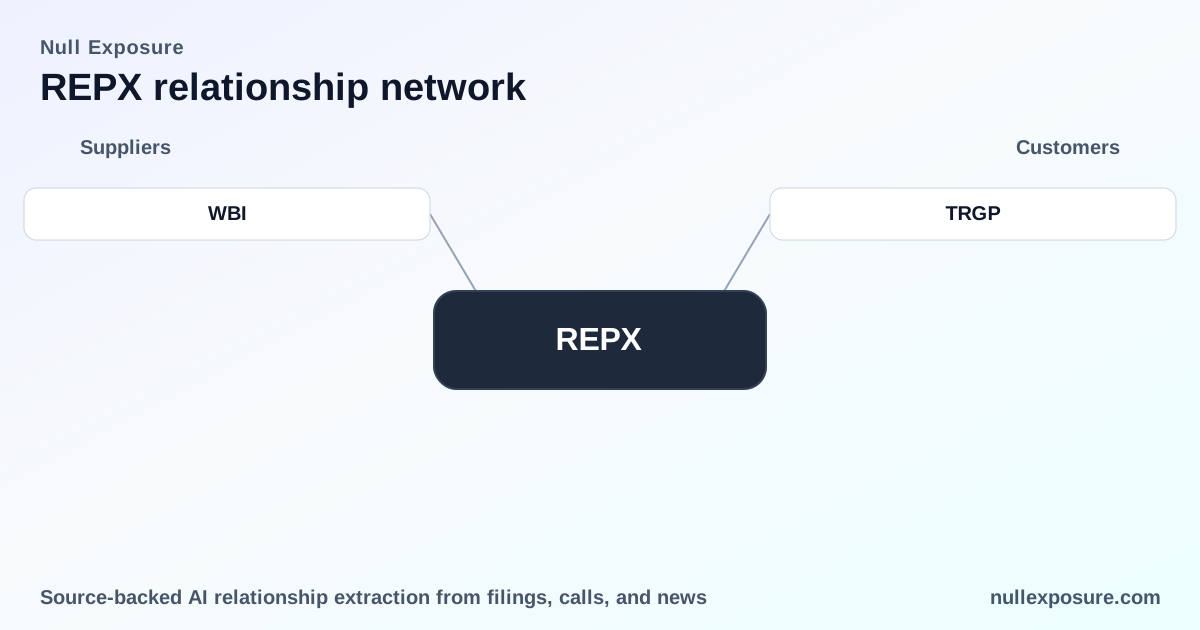
Riley Exploration Permian (REPX): Supplier relationships and what they mean for investors
Riley Exploration Permian monetizes acreage and production in the Permian Basin by selling oil, gas and NGLs and by contracting midstream and field services to convert subsurface production into marketable hydrocarbons. Revenue is driven by commodity sales and protected by a mix of long-dated midstream commitments and short-term service arrangements; capital exposure to midstream buildouts is capped contractually. For investors evaluating supplier risk, the profile is a mix of long-term counterparty dependency for take-away capacity and flexible, month-to-month operational vendors for surface services. Learn more about granular supplier signals at https://nullexposure.com/.
How Riley actually makes money and where supplier contracts fit in
Riley is an independent E&P operator concentrated in the Permian Basin that sells produced hydrocarbons into midstream systems and downstream markets. The company’s financials show healthy margins and free-cash-generation—a trailing profit margin of 41% and an EBITDA of roughly $235 million on about $392 million revenue (TTM)—which underpins both its $1.56-per-share dividend and ongoing capital programs. Operationally, midstream access and processing capacity determine realized prices and uptime, while surface service providers govern drilling and completion execution. That makes supplier relationships strategically important: midstream arrangements affect revenue realization and permanence of production, while short-term services control operating flexibility and cost structure.
What the public relationship signals show
Below I cover every supplier relationship identified in the available results and give a plain-English takeaway for each.
WaterBridge (WBI)
Riley’s management disclosed on its FY2026 earnings call that the company signed an agreement with WaterBridge that takes effect in September 2026, indicating a planned midstream linkage timed to new in-service dates. According to an earnings call transcript published March 10, 2026, management specifically referenced a WaterBridge agreement coming into effect in September 2026 (InsiderMonkey, March 10, 2026).
Company-level contract signals and what they imply about risk and leverage
Riley’s supplier constraints — drawn from company disclosures — reveal a mixed contracting posture and a measurable but capped capital exposure:
- A long-term gas purchase agreement executed as of December 31, 2024, relates to Riley’s New Mexico field and includes dedicated acreage for a significant portion of the company’s New Mexico assets; the contract requires Riley to reimburse the midstream counterparty for pipeline connection construction costs up to $18.7 million, with an initial 15‑year term from in-service date followed by year-to-year continuation and a 180-day termination notice. This is a company-level signal that Riley is locking in long-haul take-away and demonstrating commitment to long-term throughput capacity.
- In contrast, the company also discloses that a material service provider remains on a month-to-month contract as of December 31, 2024, reflecting operational flexibility for certain non-core services.
- The $18.7 million reimbursement cap places this midstream exposure squarely in a $10M–$100M spend band, meaning the company assumes modest but non-trivial capital reimbursement risk rather than unlimited build-cost exposure.
Together these signals describe a company that combines long-term strategic midstream commitments (maturity ≈ 15 years) with short-term vendor arrangements. The long-term midstream deal increases revenue reliability and market access but concentrates counterparty and midstream execution risk; the short-term service posture preserves operational flexibility and bargaining power on routine services.
Why these constraints matter for investors and operators
- Revenue and margin stability: Long-term midstream commitments that include dedicated acreage reduce basis risk and support predictable offtake, improving margin visibility for investors tracking cash flows. Riley’s reported margins and EBITDA lend credibility to its ability to service such contractual obligations.
- Capital exposure and downside control: The reimbursement cap of $18.7 million limits Riley’s build-cost exposure on midstream tie-ins to a single counterparty, containing a key tail risk to a manageable range within the $10M–$100M band.
- Concentration and counterparty criticality: Dedicated acreage clauses concentrate dependence on a midstream counterparty for a meaningful portion of New Mexico production; operational disruptions or midstream execution failure would have a high impact on throughput and realized prices.
- Operational flexibility versus execution risk: Month-to-month arrangements for field services preserve cost control and agility but can increase execution risk if tight capacity or price spikes occur during high-activity periods.
These are not theoretical trade-offs—Riley’s balance sheet and operating metrics indicate it can absorb the midstream commitment while continuing to deliver shareholder returns: market capitalization around $740 million, dividend yield roughly 4.7%, and return on equity above 28%. That financial footing supports both capital contributions to midstream tie-ins and the flexibility to manage short-term service costs.
For a deeper supplier analysis and structured reporting on these contracts, see https://nullexposure.com/ — the platform centralizes supplier exposures and contract maturities for investment due diligence.
Practical implications for relationship management and downside scenarios
Operators and investors should track a handful of clear KPIs around these relationships:
- Timing and in-service milestones for agreements coming online September 2026 (WaterBridge) and associated volumes that will flow under the 15-year commitment.
- Actual reimbursements claimed by midstream counterparties versus the $18.7 million contractual cap.
- Continuity and cost of month-to-month service providers during peak drilling/completion activity, which can compress margins if rates spike.
- Concentration of production routed under the dedicated-acreage clauses; greater share routed to a single midstream operator increases counterparty concentration risk.
If midstream capacity arrival slips or a counterparty fails to perform, Riley would face realized basis pressure and potential production interruptions; if short-term service rates elevate sharply, unit costs could increase rapidly during periods of activity. Both outcomes are manageable given Riley’s profitability but are key downside vectors for investors to monitor.
For readers who want actionable supplier intelligence on REPX and peer E&P firms, consider visiting https://nullexposure.com/ for subscription-grade supplier mapping and contract timelines.
Bottom line: Where the investment trade sits
Riley pairs long-term midstream commitments that enhance revenue predictability with short-term services that preserve operational flexibility. The $18.7 million reimbursement cap limits capital exposure while the 15-year initial term of the gas purchase agreement signals a long runway for contracted take-away. Major risk vectors are counterparty concentration and execution of midstream build-outs; both are trackable and bounded by contract language. For investors and operators focused on contract-driven production risk, Riley’s current supplier posture is strategically coherent and financially supported, but it requires active monitoring of in‑service timing and reimbursable build claims.
If you evaluate supplier risk as part of your investment process, start with a structured supplier map and milestone tracker at https://nullexposure.com/.