ATRenew (RERE): Supplier relationships that fuel a circular-electronics platform
ATRenew runs a vertically integrated recycling and refurbishment platform in China that monetizes through refurbished device sales, trade-in services with retailers and OEMs, and logistics/inspection fees. The company secures low-cost, high-quality supply by embedding trade-in flows into new-device retail channels and by licensing proprietary inspection and data-cleansing technology; these elements collectively drive gross-margin capture in a market that prizes scale and trust. For investors and operators, the relevant question is how durable and concentrated those supply-side relationships are—and whether they create a defensible, low-cost feedstock for continued growth. Learn more about our coverage at https://nullexposure.com/.
Quick overview of the supplier landscape driving ATRenew
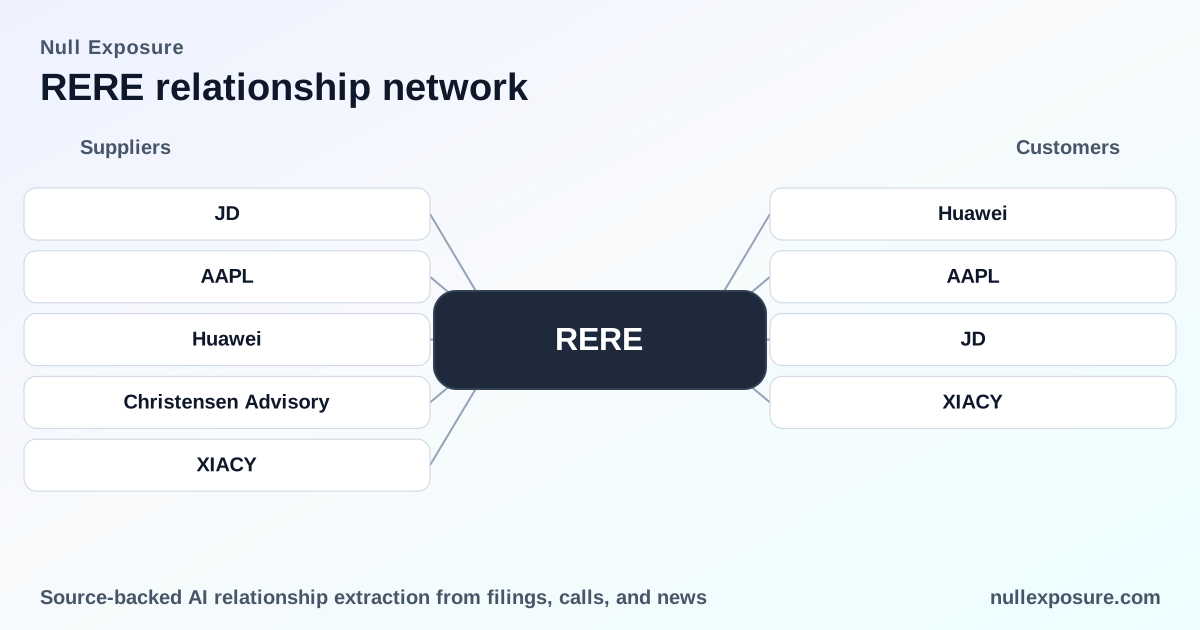
ATRenew’s publicly visible supplier and partner mentions cluster around major retail platforms and OEMs, plus investor-relations and advisory contacts that surface in press materials. Key commercial partners—JD.com, Apple, Xiaomi and Huawei—are explicitly cited as trade-in and channel collaborators, while other entries reference advisory and IR firms supporting communications. The pattern is consistent with a business model that integrates OEM and retail channels to secure first-party device supply rather than relying on fragmented secondary-market sourcing.
Every relationship called out in the collected results
JD.com — trade-in and channel partner (InsiderMonkey, FY2026)
ATRenew is described as having a strategic partnership with JD.com that “reinforce[s] supply pipelines” and enables a best-in-class trading user experience, indicating direct integration into JD’s trade-in flows. Source: InsiderMonkey blog post on ATRenew (first seen Mar 10, 2026).
Apple — OEM trade-in collaboration (InsiderMonkey, FY2026)
Apple is cited alongside JD.com as a partner that deepens trade-in collaboration and provides low-cost, high-efficiency access to firsthand supply, signaling OEM-level cooperation on device trade-ins. Source: InsiderMonkey blog post on ATRenew (first seen Mar 10, 2026).
Apple — expanded trade-in scenarios (earnings call transcript, FY2025)
Management stated they are “deepening trade-in collaboration in new device sales channels with partners such as JD.com and Apple,” which confirms Apple’s role in expanding ATRenew’s direct access to first-party devices. Source: ATRenew Q3 2025 earnings call transcript summarized on InsiderMonkey (first seen Mar 10, 2026).
JD.com — mature trade-in supply chain (earnings call transcript, FY2025)
Management specifically referenced collaborating with JD.com to “create the best-in-class trading user experience,” underscoring JD.com’s centrality to ATRenew’s consumer-facing trade-in funnel. Source: ATRenew Q3 2025 earnings call transcript summarized on InsiderMonkey (first seen Mar 10, 2026).
Huawei — OEM trade-in partner (earnings call transcript, FY2025)
ATRenew noted work with brands like Huawei to “facilitate device upgrades” via trade-in offsets, indicating OEM cooperation beyond Apple and giving ATRenew access to a broader model mix and customer base. Source: ATRenew Q3 2025 earnings call transcript summarized on InsiderMonkey (first seen Mar 10, 2026).
Christensen Advisory — investor-relations / contact listed in press (ManilaTimes / PR Newswire, FY2026)
Christensen Advisory is listed as an investor-relations contact in press materials, signaling the firm’s role in ATRenew’s communications and market outreach rather than a commercial supplier relationship. Source: PR Newswire release carried by The Manila Times (Feb 9, 2026) and related Futunn item (2026).
Christensen Advisory — IR contact repeated (Futunn news, FY2026)
A Futunn posting repeats Christensen Advisory as ATRenew’s investor-relations contact in advance of financial results, reinforcing that Christensen handles external disclosure and investor engagement. Source: Futunn news post (early 2026).
Xiaomi — OEM trade-in partner (earnings call transcript, FY2025)
Xiaomi was named along with Apple and Huawei as a brand partner that benefits from trade-in programs, widening the roster of OEMs that feed ATRenew’s supply chain. Source: ATRenew Q3 2025 earnings call transcript summarized on InsiderMonkey (first seen Mar 10, 2026).
What these relationships imply about ATRenew’s operating model
- Contracting posture: The public language frames ATRenew as a collaborative partner that integrates with OEMs and platforms to operate trade-in flows inside new-device channels. That indicates contractual arrangements that are commercial and operationally embedded, not simple spot buying relationships.
- Supplier concentration: Presence of multiple large OEMs and a major platform (JD.com, Apple, Huawei, Xiaomi) reduces single-counterparty concentration risk, but the business still depends on continued cooperation from a handful of highly strategic partners—a concentration nuance that investors must monitor.
- Criticality: These relationships are operationally critical because first-party trade-in access directly supplies ATRenew’s core inventory. Loss of channel integrations would materially raise procurement costs and compress margins.
- Maturity and scalability: Management’s reference to a “mature trade-in supply chain” and proprietary inspection/data-cleansing technologies signals operational maturity and scale advantages—a competitive moat that supports repeatable procurement economics and faster unit turn.
- Commercial orientation vs. advisory: Christensen Advisory is a communications/IR relationship, not a supply counterparty, indicating ATRenew invests in market-facing governance as it scales.
For more context on how these supplier dynamics translate into investable signals, visit https://nullexposure.com/.
Risks to monitor for supplier-driven performance
- Partner renewal risk: Contracts or commercial integrations with OEMs and JD.com are strategic; any deterioration in those relationships would pressure supply and margins.
- Brand and regulatory exposure: Heavy reliance on large Chinese platforms and OEMs concentrates geopolitical, regulatory, and reputational risk inherent to the Chinese consumer-electronics ecosystem.
- Operational dependence on proprietary tech: The inspection and data-cleansing technology is a differentiator, but the business’s profitability depends on maintaining and commercializing that capability at scale.
- Communications risk: Investor-relations outsourcers such as Christensen Advisory shape market narratives; uneven disclosure or miscommunication around partner status can amplify market volatility.
Bottom line and recommended actions
ATRenew’s publicly cited supplier relationships—notably with JD.com and major OEMs including Apple, Huawei and Xiaomi—constitute a strategic supply-side moat that gives the company privileged access to new, trade-in, and upgrade flows. That structure supports a low-cost feedstock and recurring margin opportunity, but it also creates concentrated counterparties whose cooperation is materially important.
- If you are conducting diligence as an investor, prioritize contract-level verification of trade-in integrations with JD.com and OEM counterparties and test operational KPIs tied to inspection throughput and device yield.
- If you are an operator or supplier, evaluate integration points that protect supply fungibility (multi-channel sourcing) and strengthen inspection/data-cleansing capabilities to lock in margins.
Explore further supplier intelligence and relationship mapping at https://nullexposure.com/—our coverage helps investors and operators separate durable partnerships from one-off mentions.
For a practial next step, review ATRenew’s Q4 and FY2025 disclosures and the cited third-party commentary to confirm the scope and term structure of these trade-in agreements before translating them into valuation assumptions. Learn more about our research services at https://nullexposure.com/.