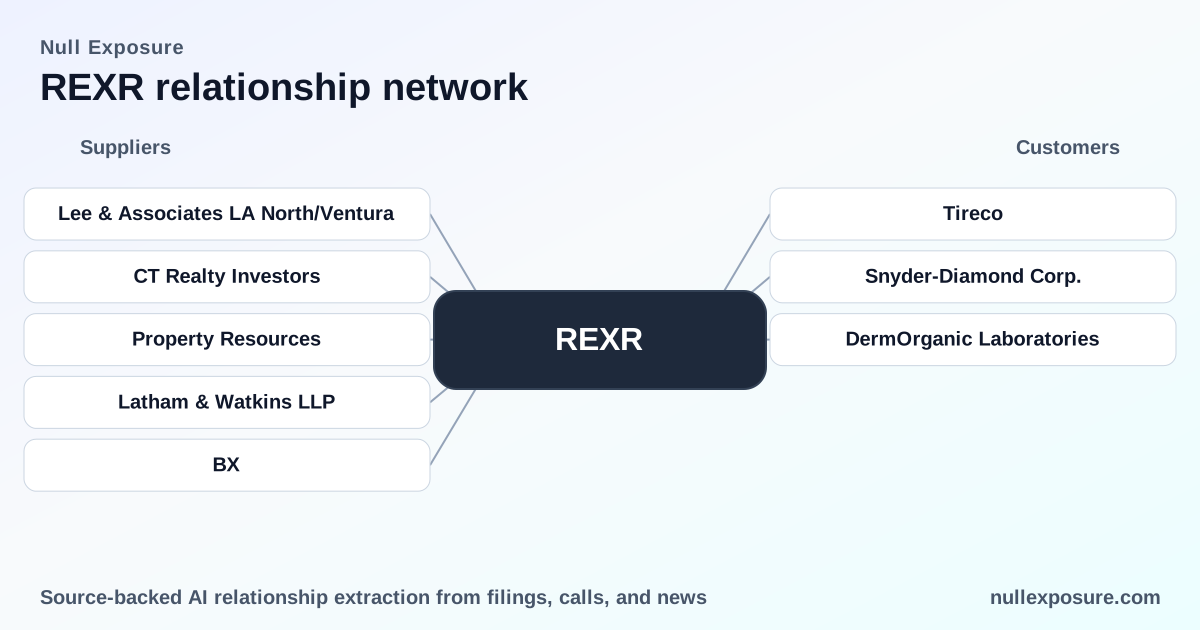
Rexford Industrial (REXR): How supplier relationships and capital markets shape operations and risk
Rexford Industrial operates as a focused industrial REIT that owns and operates 232 industrial properties concentrated in Southern California infill markets and monetizes through leasing, redevelopment and capital markets activity. The company drives value by repositioning assets, signing long-term tenants, and funding growth with a mix of secured mortgages, construction commitments, and exchangeable senior notes — an operating model that makes its supplier, construction and capital-market relationships both operationally critical and financially material.
For a concise supplier-risk assessment and relationship log, visit https://nullexposure.com/ for structured insight and verification.
How Rexford runs the business and pays for growth
Rexford’s operating model is simple and strategic: acquire infill industrial assets, extract rent growth through leasing and targeted redevelopment, and use capital markets to scale. That model produces stable property cash flows but relies on a continual pipeline of construction and leasing vendors plus accessible debt markets to fund value-add projects.
- Capital posture: As of the company’s latest reporting, Rexford carries a substantial, long-term debt profile and deploys exchangeable notes to manage financing needs.
- Operational posture: Rexford contracts with construction and tenant-improvement vendors on multi-year projects, creating predictable near-term cash commitments and contractor dependency.
- Geographic concentration: The portfolio’s infill Southern California focus concentrates both revenue upside and local-market risk.
If you evaluate supplier credit risk or third-party dependency for REXR, the company profile and contract posture are essential inputs — get practical monitoring tools at https://nullexposure.com/.
Supplier and partner roster — what the public record shows
Below are the relationships captured in the available reporting. Each entry is a short, plain-English summary followed by a source reference.
Lee & Associates LA North/Ventura
Lee & Associates’ LA North/Ventura brokerage team represented Rexford as landlord in a high-profile Simi Valley lease transaction, demonstrating Rexford’s use of local brokerage firms for leasing execution. (Valley/L.A. Business Journal, March 2026: https://valley.labusinessjournal.com/featured/rexford-leases-simi-valley-warehouse-in-13-9-million-deal/)
CT Realty Investors
Rexford purchased a nine-property industrial portfolio from CT Realty Investors for $191 million, reflecting an acquisition strategy that includes buying institutional portfolios to build scale. (The Real Deal, April 2016: https://therealdeal.com/la/2016/04/19/the-biggest-property-in-rexfords-191m-industrial-portfolio-is-in-la/)
Property Resources (Torrance)
Rexford acquired an asset from Property Resources in Torrance, illustrating use of private local sellers to fill portfolio gaps and respond to market availability. (The Real Deal, October 2021: https://therealdeal.com/la/2021/10/22/rexford-buys-into-gap-left-by-mitsuwas-move-to-south-bay-mall/)
Latham & Watkins LLP
Latham & Watkins acted as counsel for Rexford in a significant exchangeable senior notes offering — two tranches totaling $1.15 billion aggregate principal — signaling Rexford’s active engagement with top-tier capital markets advisers. (Latham & Watkins news release, April 2024: https://www.lw.com/en/news/2024/04/latham-represents-rexford-industrial-realty-in-exchangeable-senior-notes-offering)
BlackStone Real Estate (Blackstone)
Rexford acquired approximately 3 million square feet of industrial assets from BlackStone Real Estate, an acquisition that materially expanded portfolio scale and demonstrates transactions with large institutional sellers. (Los Angeles Business Journal, 2024: https://labusinessjournal.com/la500-2024/real-estate-2024/la500-2024-howard-schwimmer/)
What the constraints tell investors about Rexford’s supplier and capital relationships
The public constraint signals read like a company-level operating profile rather than vendor-specific allegations. Combined, they outline Rexford’s contracting posture, concentration, criticality, and maturity:
- Contracting posture — long-term and capital-market dependent. Rexford reports multiple long-dated debt instruments, including senior notes and exchangeable notes. The financing structure is long-term, implying stable capital commitments and a reliance on market access for refinancings and growth.
- Concentration and criticality — construction and capital advisers matter. Rexford discloses construction and tenant-improvement commitments and standard developer risks (contractor disputes, strikes, supply disruptions). These vendor relationships are operationally critical because development execution translates directly to cash-flow and re-leasing outcomes.
- Spend scale — two tiers of materiality. Company-level reporting documents aggregate debt of roughly $3.3 billion and commitments of approximately $90.5 million for tenant improvements and construction work; the balance sheet and capital markets activity therefore dominate spend, while project-level commitments are individually in the $10M–$100M band.
- Maturity — active and ongoing. Mortgage and loan balances are carried on the books and described as active at period end, which signals ongoing counterparty exposure for lenders and contractors.
These characteristics mean suppliers and counterparties face a counterparty that is capital-markets sophisticated, contractually long-horizon, and operationally dependent on construction execution.
(For a detailed supplier-monitoring playbook and alerting, see https://nullexposure.com/.)
Investment implications and risk checklist
For investors and operators evaluating REXR supplier relationships, prioritize the following:
- Counterparty capacity: Lenders and construction firms should assess Rexford’s $3.3B gross debt profile and the timing of near-term maturities when pricing exposure.
- Execution risk: Construction vendors are critical; missed TI or redevelopment milestones will directly affect leasing velocity and cash flow. Contractors should evaluate payment cadence and contract remedies before scaling exposure.
- Concentration risk: Geographic concentration in Southern California creates correlated demand and labor/supply dynamics; national contractors should price regional risk into bids.
- Capital markets friction: Rexford’s use of exchangeable notes and other long-term securities reduces refinancing frequency but increases market-sensitivity around convertible instruments and equity-linked financing.
Bottom line — who benefits and where to watch
Rexford is a scaled, capital-markets active industrial REIT whose supplier relationships range from local brokers and private sellers to global institutional counterparties and top-tier legal counsel. The company’s long-term debt profile and multi-million-dollar construction commitments make both its capital providers and construction vendors critical to execution and value creation.
Monitor three vectors closely: 1) debt and notes maturities, 2) project-level TI and construction budgets, and 3) leasing velocity in core Southern California submarkets. If you need operator-grade supplier intelligence or ongoing monitoring for REXR counterparties, visit https://nullexposure.com/ for vendor-level dashboards and alerts.
For hands-on due diligence packages and live supplier relationship feeds tailored to institutional investors, consult https://nullexposure.com/ to get started.