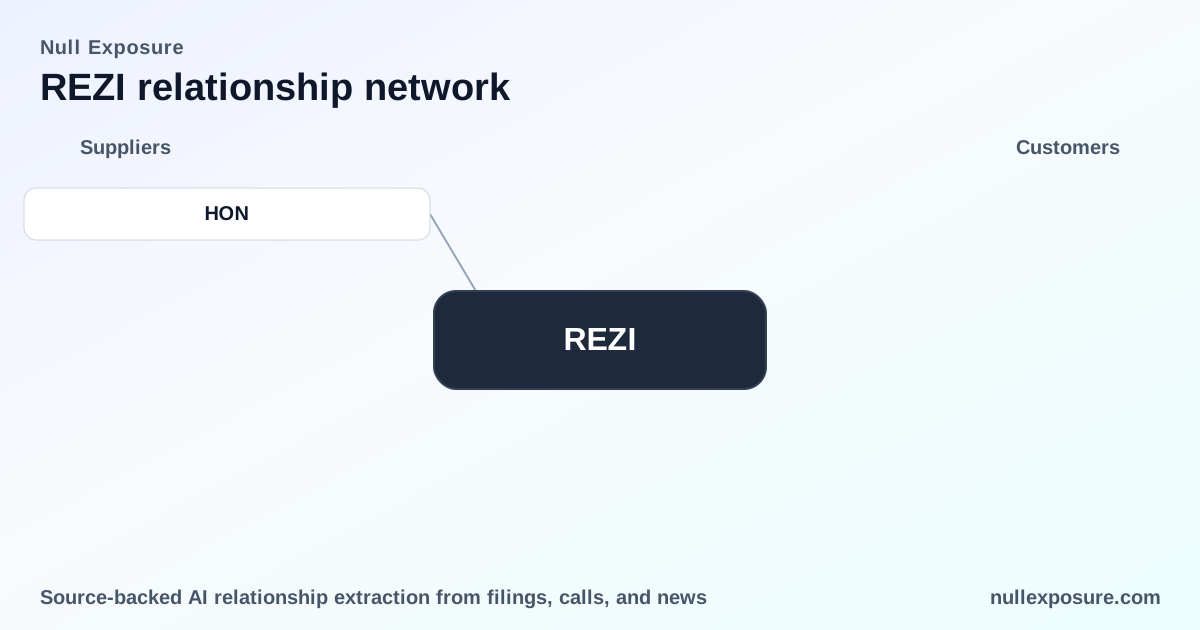
Resideo (REZI) — supplier relationships that define product reach and supply risk
Resideo monetizes through two complementary routes: direct product sales of comfort, residential thermal and security solutions and wholesale distribution through its ADI Global Distribution channel, supplemented by brand licensing (notably the Honeywell Home trademark). Revenue is driven by branded product sales and distribution scale, while margins depend on sourcing economics and the durability of third-party licenses. For investors evaluating supplier exposure, Resideo’s operating model blends manufacturing control with reliance on branded suppliers and long-term licensing — a mix that scales revenue but concentrates supply and reputational dependencies.
Explore deeper supplier intelligence at https://nullexposure.com/.
The supplier picture in plain English
Resideo operates as a product company and distributor: it manufactures products and resells branded products through ADI, while leveraging brand licenses to capture premium demand. That hybrid model creates two supplier relationships that matter: (1) manufacturers who produce Resideo’s exclusive branded goods — often in Asia — and (2) licensors and brand partners whose marks underpin product value. Together these relationships determine gross margins, inventory strategy, and channel resilience.
One explicit relationship in the public record
Honeywell International — long-term trademark license
Resideo uses the Honeywell Home trademark under a long-term license from Honeywell International Inc., a relationship that embeds the Honeywell brand into Resideo’s consumer-facing products and marketing. According to a company news release cited by Sahm Capital in February 2026, the Honeywell Home trademark is used under a long-term license from Honeywell International Inc., reinforcing a branded go-to-market strategy tied to an established industrial name.
What the company-level constraints tell investors
Resideo’s public disclosures include two operational signals that shape supplier risk and contract posture:
-
APAC sourcing concentration: Resideo states that “a significant percentage of our exclusive branded products are sourced with manufacturers located in Asia.” This is a company-level signal that production is concentrated geographically, which compresses supplier diversification and elevates exposure to regional logistics, tariffs, and geopolitical disruption.
-
Manufacturer / ADI distribution reliance: Resideo discloses that, “With respect to our ADI Global Distribution business, we rely on key suppliers of branded products to deliver certain products for resale to our customers.” This indicates a material reliance on third-party branded suppliers to satisfy distribution demand, not just internal manufacturing.
These constraints translate into actionable operating signals: contracting posture is oriented to long-term supplier and licensing agreements; concentration risk is elevated due to APAC manufacturing exposure; supplier criticality is high for the ADI distribution channel; and relationship maturity is apparent through established licensing arrangements.
How those dynamics affect valuation and risk
Resideo reported trailing revenue of roughly $7.47 billion and EBITDA near $843 million, which underscores scale but also sensitivity to gross margin swings driven by supplier costs and brand economics. The company’s operating margin and profitability are a function of both manufacturing cost control and the strength of brand-licensing economics.
Key investor implications:
- Supply concentration in Asia is a tangible source of operational risk. Any disruption in APAC manufacturing clusters will impact product availability and cost of goods sold disproportionately.
- Brand licensing is strategically valuable but operationally constraining. Using an external trademark like Honeywell Home improves shelf appeal and price realization but ties Resideo to the licensor’s negotiation leverage and reputational posture.
- Distribution dependence raises single-point risks for ADI. If key branded suppliers prioritize other channels or face production constraints, ADI’s fill rates and sales mix will be affected.
Mid-deck insight: compare supplier concentration to margin sensitivity before sizing a position — see how Resideo’s supplier posture aligns with portfolio risk tolerances at https://nullexposure.com/.
Tactical red flags and monitoring checklist
Investors and operators should monitor several measurable and qualitative indicators:
- Supply-side metrics: percentage of sourced volume from APAC, lead times, and vendor concentration by spend.
- Contract terms: duration and exclusivity of brand licenses (Honeywell Home) and key manufacturing agreements.
- Channel health: ADI distribution gross margin trend and fill-rate metrics tied to branded supplier performance.
- Macro factors: tariffs, freight costs, and regional labor constraints in Asia, given the stated sourcing footprint.
A simple monitoring framework that links supplier KPIs to quarterly margin variance will surface issues before they become earnings surprises.
Valuation and positioning view
Resideo’s public metrics (forward P/E ~11.0 on available data, EV/EBITDA ~12.0) reflect a company priced for operational steadiness with moderate leverage to margin improvement. The upside thesis rests on stable procurement, improved mix through branded products, and continued ADI channel strength; the downside is a concentrated supply base and license dependency that can compress free cash flow under adverse conditions.
Bottom line for portfolio managers and operators
Resideo is a scaled industrial-distribution and product business that leverages branded licensing and APAC manufacturing to compete on cost and recognition. The supplier map shows a deliberate trade-off: capture brand premium and low-cost manufacturing, at the cost of concentration and counterparty dependence. For active investors, this is a position where operational monitoring (supplier concentration, licensing renewals, ADI fill rates) should be embedded in ongoing due diligence.
If you evaluate supplier risk as part of position sizing or operational due diligence, get continuous, structured supplier intelligence at https://nullexposure.com/.
Key takeaway: Resideo’s economics are materially influenced by where and how it sources products and by the durability of its brand licensing arrangements — both are investable risks that require active monitoring.