Regions Financial Corporation (RF): Supplier Relationships and Operational Constraints Investors Should Price In
Regions Financial is a regional bank holding company that monetizes a mix of net interest income and fee businesses — retail and commercial banking, trust and brokerage, and mortgage services — with a market capitalization near $22.2 billion and trailing revenue of roughly $7.1 billion. For investors and operators evaluating supplier risk, the critical question is how Regions sources and contracts out the infrastructure that supports deposit, payment and digital channels, and how that sourcing affects operational continuity and cost structure. Learn more about supplier exposures and analysis at https://nullexposure.com/.
The operating model in one sentence: externalized infrastructure drives core distribution
Regions runs a classic regional banking model: customer deposits and loan spreads generate recurring margin while third-party vendors provide payment processing, data services, and residual risk mitigation. The bank’s profitability profile (ROE ~11.7%, profit margin ~30.6%) depends on stable distribution and low friction in digital and payments rails; any supplier disruption or unfavorable contract terms will translate directly into service interruptions or higher operating costs.
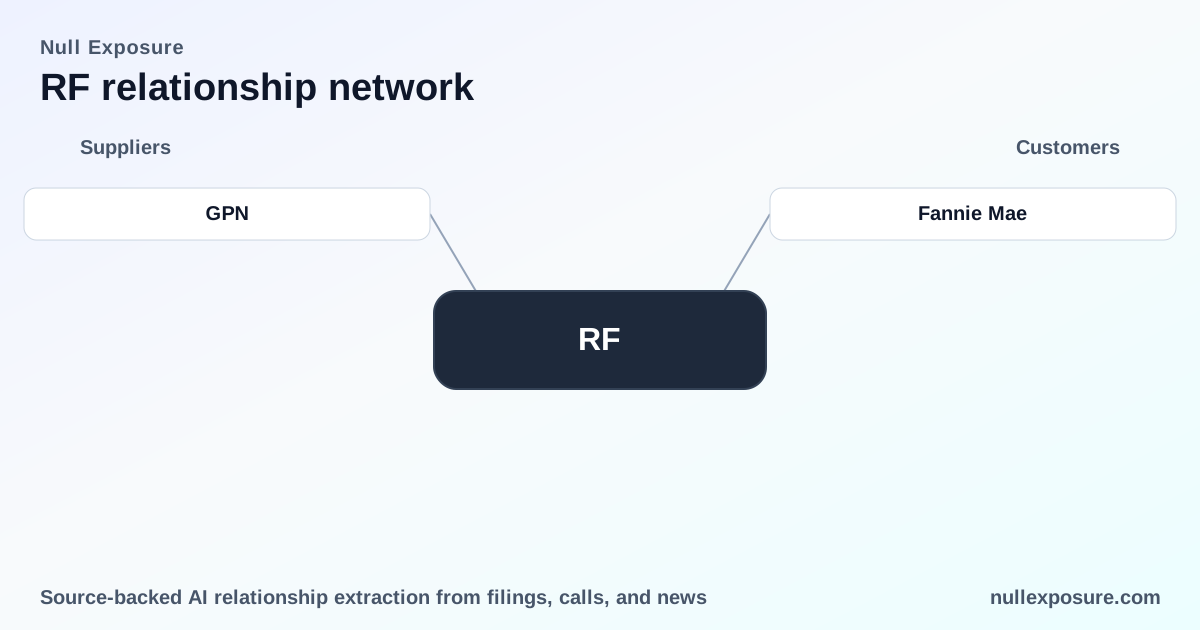
Supplier relationship: Worldpay (Global Payments, ticker GPN)
Regions has a recently reported collaboration with Worldpay, the payments subsidiary of Global Payments Inc., focused on merchant acquiring and payment processing support. This partnership ties Regions’ merchant-facing services to a major global payment processor and is likely intended to broaden Regions’ commercial payments offering and reduce time-to-market for integrated payment products. A StocksToTrade news piece discussing the collaboration was published March 10, 2026.
Source: StocksToTrade report on March 10, 2026 covering the Regions–Worldpay collaboration.
What that single supplier tie means for investors
- Strategic leverage in payments: Partnering with Worldpay gives Regions access to established acquiring and processing capabilities without rebuilding scale internally; for a regional bank, this accelerates product rollout and revenue capture on merchant fees.
- Operational concentration risk: Outsourcing critical payment rails concentrates operational dependency; if Worldpay services degrade or contract economics shift, Regions would face customer remediation costs and a potential revenue hit.
- Commercial upside: If executed cleanly, the arrangement expands Regions’ fee pool and commercial wallet share, improving revenue diversification beyond interest income.
Company-level constraints and how they shape supplier posture
Regions’ disclosures and public excerpts indicate two clear, company-level supplier signals that investors must model into valuations and operational risk assessments:
-
Buyer posture and dependency: Regions is a buyer of vendor-provided infrastructure and explicitly relies on third parties for essential components of its operations. That creates contracting leverage issues — Regions must negotiate SLAs and termination clauses robust enough to protect depositors and commercial clients, but as a regional bank it typically operates with less procurement power than national peers. Evidence of this posture is reflected in the company’s own language about dependence on vendors for equipment and services.
-
Service provider relationships for critical functions: The company routinely uses third parties for data processing, transaction monitoring, online banking interfaces, and network access, and even purchases residual value insurance to manage specific asset risks. That indicates high criticality: these suppliers are not peripheral vendors but core to customer experience and risk management, requiring mature contract management and contingency planning.
From these constraints, derive four practical operating-model characteristics:
- Contracting posture: Defensive and procurement-driven — Regions must maintain strict SLAs and contingency clauses because vendors underpin customer-facing services.
- Concentration: Moderate to high — outsourcing payment processing, data processing, and insurance exposes Regions to concentrated vendor risk pockets.
- Criticality: High — these suppliers support regulated, revenue-generating functions; failures would pressure both earnings and regulatory standing.
- Maturity: Established — the bank uses well-known third-party services and market mechanisms (e.g., residual value insurance), indicating these relationships are operationally mature rather than experimental.
What investors should watch next
- Contract terms and replaceability: Look for public disclosures, regulatory filings, or CFPB/FDIC commentary about vendor management and the bank’s rights to migrate processing if service levels drop.
- Revenue capture from payment initiatives: Track merchant services fee growth and origination volumes tied to the Worldpay arrangement; this will reveal whether the partnership shifts client economics for Regions.
- Operational KPIs: Monitor uptime, incident disclosures and third‑party audit outcomes; these are leading indicators of vendor reliability and future remediation costs.
If you want a concise vendor-risk briefing tailored to Regions’ payments exposures, explore further at https://nullexposure.com/.
Practical portfolio implications for investors and operators
- For long investors: assign a vendor-risk discount when modeling terminal margins and cost of revenue, especially if a meaningful portion of fee income depends on a small set of processors.
- For credit analysts: stress test scenarios where vendor contract renewal is punitive or migration requires capital investment — quantify one- to two-quarter service disruption impact on fee revenue and remediation costs.
- For operations and procurement teams: codify migration playbooks and escrow arrangements for critical code and data; ensure residual risk insurance programs are periodically tested.
Closing recommendation and action items
Regions has structured its go-to-market in payments through third-party partnerships that deliver rapid capability at the expense of concentrated operational dependence. Investors should weigh the growth potential from expanded merchant services against the measurable vendor risks and demand transparency on contract terms, contingency provisions, and performance metrics.
For a concise vendor exposure summary and to subscribe for supplier-risk updates, visit https://nullexposure.com/. For bespoke diligence on bank supplier portfolios and contract risk, start your review at https://nullexposure.com/ — strong operational risk management will be the differentiator for regional banks competing on payments and digital services.