RF-P-E (Regions Financial Corp. Preferred): Supplier Relationships That Shape Credit and Communications Risk
Thesis: RF-P-E represents a claim on Regions Financial Corporation, a bank holding company that generates revenue through retail and commercial banking, trust services, brokerage, and mortgage operations; the company monetizes primarily via net interest margin and fee income, and its supplier relationships concentrate around trade finance partnerships and investor-relations technology that affect operational resilience and market transparency. For investors evaluating preferred stock exposure, trade finance capability and the stability of investor communications infrastructure are the two supplier vectors that materially influence credit and market perception. Learn more about supplier intelligence at https://nullexposure.com/.
Why supplier relationships matter for preferred holders
Preferred securities position investors between debt and equity, so operational counterparty risks that affect franchise stability or market confidence translate directly into valuation and credit risk. A long-running trade finance relationship supports commercial lending activity and fee income stability, while reliable investor-relations technology preserves liquidity by keeping the market informed and compliant. Both functions are non-revenue-facing levers that nevertheless condition cash flow predictability and investor access.
The supplier map: two relationships worth tracking
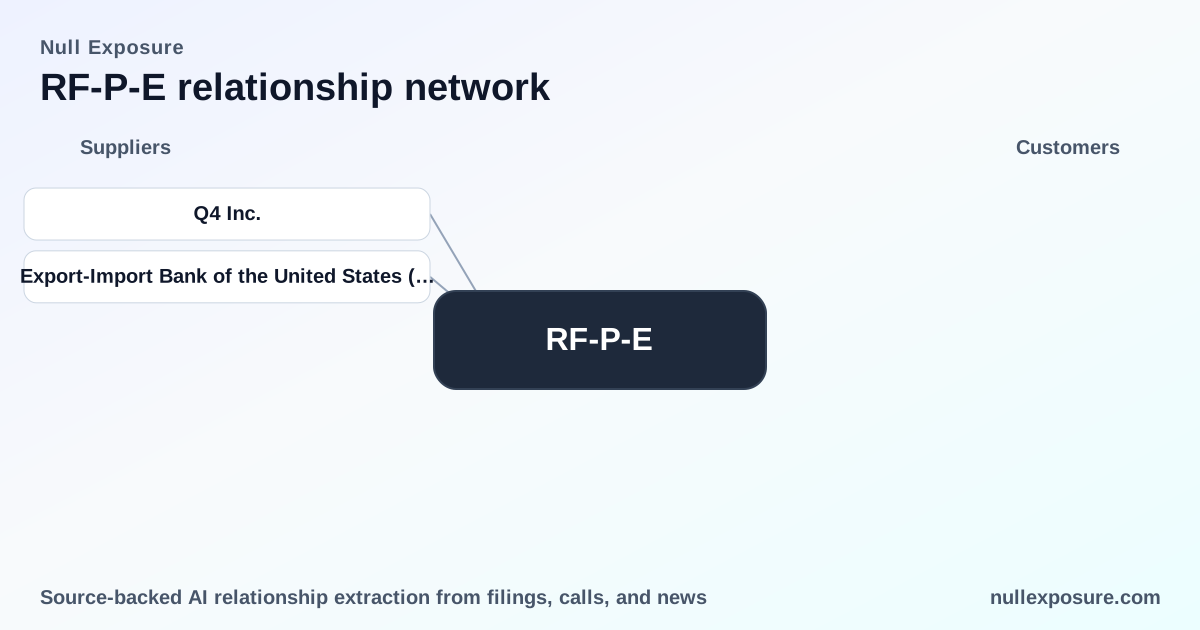
The available records surface two distinct supplier relationships: one with the Export-Import Bank of the United States (EXIM) that affects lending capabilities, and a vendor relationship with Q4 Inc. that supports investor communications. Each has different risk profiles and implications for RF-P-E holders.
Export-Import Bank of the United States (EXIM)
Regions Bank has been an EXIM Delegated Authority Lender since 1994 and an EXIM Letter of Credit policyholder since 1991, reflecting a multi-decade institutional relationship that integrates EXIM-backed trade finance into Regions’ commercial product suite. According to an EXIM news release covering the lender award (FY2020), this standing authorizes Regions to underwrite and service EXIM-supported transactions under delegated authority, which lowers counterparty credit exposure on supported export transactions and enhances Regions’ ability to serve corporate clients on international trade. Source: EXIM news release on Regions Bank lender award (exim.gov, FY2020).
Q4 Inc.
Regions’ investor-relations content and press-release presentation are powered by Q4 Inc.’s platform, as documented in a Regions press release footer that credits "Powered By Q4 Inc. 5.175.1.5" (FY2020). This outsourced IR technology relationship underpins the firm’s ability to distribute earnings materials and compliance disclosures reliably, which in turn affects liquidity and investor sentiment for publicly traded securities including preferred issues. Source: Regions press release crediting Q4 Inc. (ir.regions.com, FY2020).
What the EXIM relationship means for operations and credit
The EXIM delegated-lender status is a strategic operational asset rather than a mere vendor contract. Delegated authority typically allows a bank to originate and service EXIM-guaranteed loans with less direct EXIM oversight, accelerating deal execution and expanding trade financing volumes. For Regions this implies:
- Lowered effective risk on EXIM-backed deals, because EXIM guarantees reduce loss severity for export-related credits.
- Enhanced competitiveness in international commercial banking, supporting fee income and client retention among exporters.
- A mature, institutional partnership—active since the early 1990s—that signals integrated product capabilities rather than a recent or ad-hoc arrangement.
These operational characteristics translate into stabilizing effects on commercial loan cash flows and fee revenue, a positive signal for preferred stakeholders who prioritize predictable distributions.
Why IR tech matters more than investors often credit
Q4 Inc.’s role is functionally different but strategically important: reliable distribution of earnings, notices, and corporate governance materials preserves market access and prevents pricing dislocations. Problems with IR channels can create temporary liquidity shocks, misinformation, or regulatory friction—outcomes that disproportionately affect securities with lower trading depth like preferred shares. The FY2020 crediting of Q4 in Regions’ press release indicates a formal vendor relationship that supports continuous disclosure, which is a credit-positive operational control for market-facing instruments.
Company-level constraints and what their absence indicates
There are no supplier-specific contractual constraints captured in the available feed for RF-P-E. That absence is itself informative: no flagged supplier constraints suggests there were no public disclosures of restrictive vendor covenants, disputes, or concentration warnings in the examined records. Treat this as a company-level signal that publicly disclosed supplier friction is limited in the sampled period, rather than proof of absence of vendor risk. Investors should interpret this as a neutral-to-positive indicator for contracting posture and vendor maturity, with the caveat that detailed contract terms are not publicly visible.
Key takeaways for investors
-
EXIM relationship is material and long-lived, supporting trade finance capability and reducing downside on export-related credit exposures—this is constructive for preferred security resilience.
-
Q4 Inc. supplies investor-relations infrastructure, which is important for continuous disclosure and market liquidity; operational integrity here supports stable pricing and access.
-
No supplier constraints were recorded in the available feed, giving no immediate signal of vendor-induced operational strain; nevertheless, absence of publicly disclosed constraints is not a substitute for contract-level diligence.
-
For a quick view:
- EXIM: long-term delegated lending and letter-of-credit status (since 1991/1994) — supports trade finance and fee stability.
- Q4 Inc.: investor-relations platform provider — supports disclosure and market access.
Next steps for a buyer or steward of RF-P-E
- Validate the scope of EXIM-backed exposure on the Regions balance sheet and the proportion of commercial fees tied to trade finance; examine recent filings and call transcripts for EXIM deal volumes. Learn more about supplier-driven credit signals at https://nullexposure.com/.
- Confirm continuity and SLAs for investor-relations platforms and public disclosure channels, since technical or contractual failure in IR delivery can compress liquidity and widen spreads on preferred issues.
- Maintain monitoring of vendor concentrations and any new supplier constraints that would alter the contracting posture.
Final perspective
Regions’ supplier footprint as observed is concentrated and strategic: a long-standing governmental trade-finance partnership that strengthens credit capacity, plus an IR vendor relationship that preserves market access. For RF-P-E investors, these supplier ties are net-positive levers for distribution stability and market transparency. Conduct targeted diligence on EXIM exposure and IR operational resiliency to convert these observed supplier signals into conviction.
For deeper supplier intelligence and ongoing monitoring, visit https://nullexposure.com/ to see how supplier relationships map to credit and market risk.