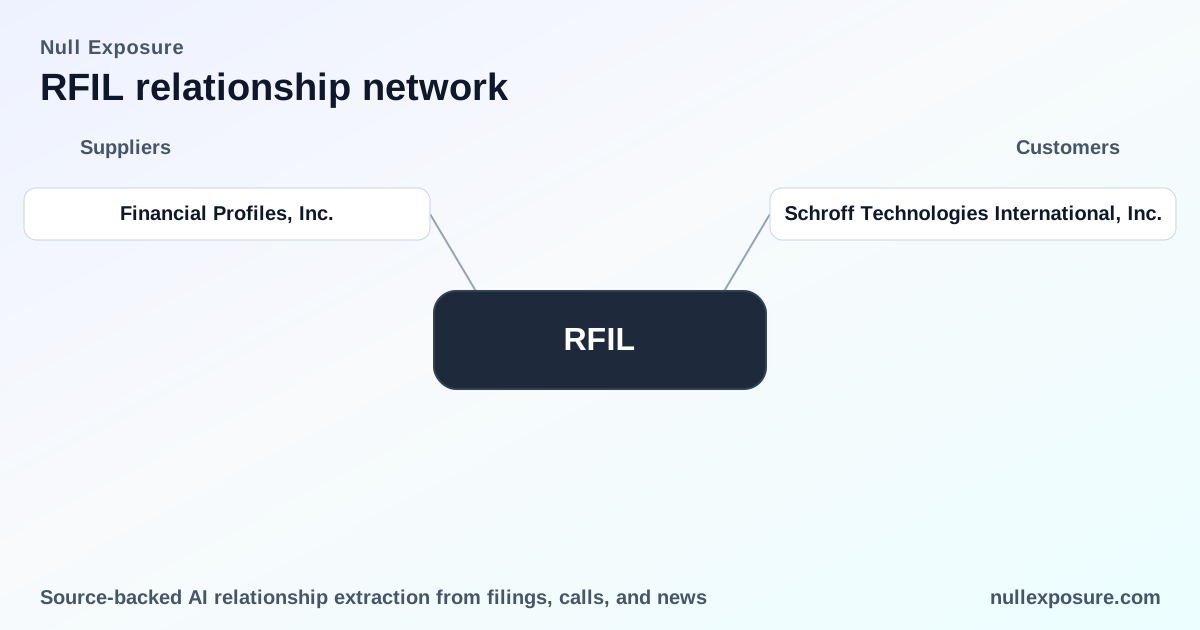
RF Industries (RFIL) — supplier footprint, operating constraints, and what investors should know
RF Industries designs, manufactures and sells interconnection products—coaxial connectors, cable assemblies and related systems—and monetizes through product sales to industrial, telecom and OEM customers. The company runs a lean manufacturing model that outsources a significant portion of connector production while keeping strategic cable procurement in ISO‑approved factories across North America and Asia, creating a mix of margin leverage and supply‑chain exposure that investors must weigh against low supplier concentration and modest operating margins. For a concise supplier risk briefing and primary-source references, visit https://nullexposure.com/.
How RF Industries runs production and why suppliers matter
RF Industries positions itself as a designer and systems integrator with selective outsourcing. Company disclosures state that the firm contracts with third‑party manufacturers for a significant portion of its coaxial connectors, while procuring raw cable from manufacturers with ISO‑approved facilities in the United States, China and Taiwan. That operating posture concentrates operational criticality on a network of external manufacturers rather than on captive large-scale plants.
Financial context matters: RF Industries reported revenue of roughly $80.6M and gross profit of $26.7M on a trailing‑twelve‑month basis, with operating margin around 7.6%, which makes supplier terms, cost pass‑through and lead times meaningful drivers of near‑term profitability. Investors tracking supplier risk should balance the company’s outsourced model against the fact that no single vendor accounted for 10% of inventory purchases in the fiscal years ended October 31, 2025 and 2024—an explicit signal of low supplier concentration in procurement. Learn more about how supplier signals translate to investment risk at https://nullexposure.com/.
The one documented relationship uncovered in this review
Financial Profiles, Inc.
RF Industries uses Financial Profiles, Inc. as an investor relations and press distribution contact; a Jan 6, 2026 press release distributed via FinancialContent lists Donni Case at Financial Profiles, Inc. as the IR contact for the company (https://markets.financialcontent.com/stocks/article/accwirecq-2026-1-6-rf-industries-to-report-fourth-quarter-and-fiscal-year-2025-financial-results-on-january-14). This is a communications/vendor relationship rather than a production supplier and is limited to investor relations and media distribution.
What the constraint signals tell investors about supplier risk
The extracted constraint evidence from company disclosures produces a clear set of operating characteristics that drive supplier risk and opportunity:
- Contracting posture — outsourced manufacturing: Company filings explicitly state RF Industries “contracts with outside third parties for the manufacture of a significant portion of our coaxial connectors.” This shows a strategic preference for third‑party manufacturing to control capital intensity and scale product mix.
- Geographic footprint — dual APAC and North America exposure: The firm notes that “most of the connectors are manufactured for us by third‑party foreign manufacturers located in Asia,” while raw cable is procured from ISO‑approved factories in the United States, China and Taiwan. Supply lines therefore span APAC and North America, exposing the company to both regional manufacturing capacity and trade/political risk.
- Concentration — immaterial by disclosure: The company discloses that no vendor accounted for 10% of inventory purchases for the fiscal years ended Oct 31, 2025 and 2024, which is a company‑level signal of low single‑vendor concentration.
- Supplier maturity — industrial standards in place: Procurement from ISO‑approved factories indicates a supplier base that meets recognized quality and process standards, supporting product reliability and easing qualification for OEM customers.
- Criticality — core inputs are connectors and cable: Connectors and raw cable are essential inputs; outsourcing them increases operational dependency on third parties and the importance of managing supplier lead times and quality control.
These constraints combine into an operating model where RF Industries trades capital intensity for supply‑chain dependency: low supplier concentration reduces single‑vendor leverage but widespread APAC manufacturing increases geopolitical and logistics exposure.
Investment implications — risk, upside and monitoring signals
RF Industries’ supplier posture creates a balanced set of implications for investors:
- Risk: APAC manufacturing exposure. Significant connector manufacturing in Asia introduces geopolitical, tariff and shipping‑disruption risk that can compress margins or force temporary shifts in sourcing.
- Risk mitigation: supplier diversity and ISO controls. The company’s disclosure that no vendor represented >10% of purchases and procurement from ISO‑approved factories reduces the probability of single‑point failures and supports quality continuity.
- Operational leverage: outsourced production supports margin expansion without heavy capex. Outsourcing gives RF Industries flexibility to scale and to adapt product mixes with limited fixed‑asset investment.
- Monitor: lead times, freight cost pass‑through, and disclosure around specific suppliers. Quarterly filling language on supplier reliance and any changes in vendor concentration are leading indicators for margin and fulfillment risk.
For a targeted supplier‑risk monitoring framework tailored to RF Industries, review deeper sourcing and shipping data available at https://nullexposure.com/.
Practical next steps for investors and operators
- Track quarterly filings for any change to the “no vendor >10%” disclosure and for expanded detail on geographic sourcing shifts. Changes in that language will be a primary signal of concentration risk.
- Watch logistics indicators and freight‑cost trends between Asia and North America; given the company’s APAC manufacturing footprint, freight inflation directly pressures gross margins.
- Confirm supplier qualification and contingency plans in investor Q&A and earnings calls—outsourced production puts a premium on supplier redundancy and near‑term capacity visibility.
Conclusion — balancing outsourcing benefits against geographic exposure
RF Industries runs a deliberately outsourced manufacturing model that keeps supplier concentration low while relying on APAC and North American manufacturers for core inputs. The combination of low vendor concentration, ISO‑approved suppliers and meaningful APAC production creates a mixed risk profile: limited single‑supplier dependence but elevated geopolitical and logistics sensitivity. Investors should prioritize monitoring vendor concentration disclosures, lead‑time trends and freight cost pass‑through to the company’s customers.
For a consolidated supplier risk dashboard and primary‑source extraction for RF Industries and comparable suppliers, visit https://nullexposure.com/ and subscribe for updates.