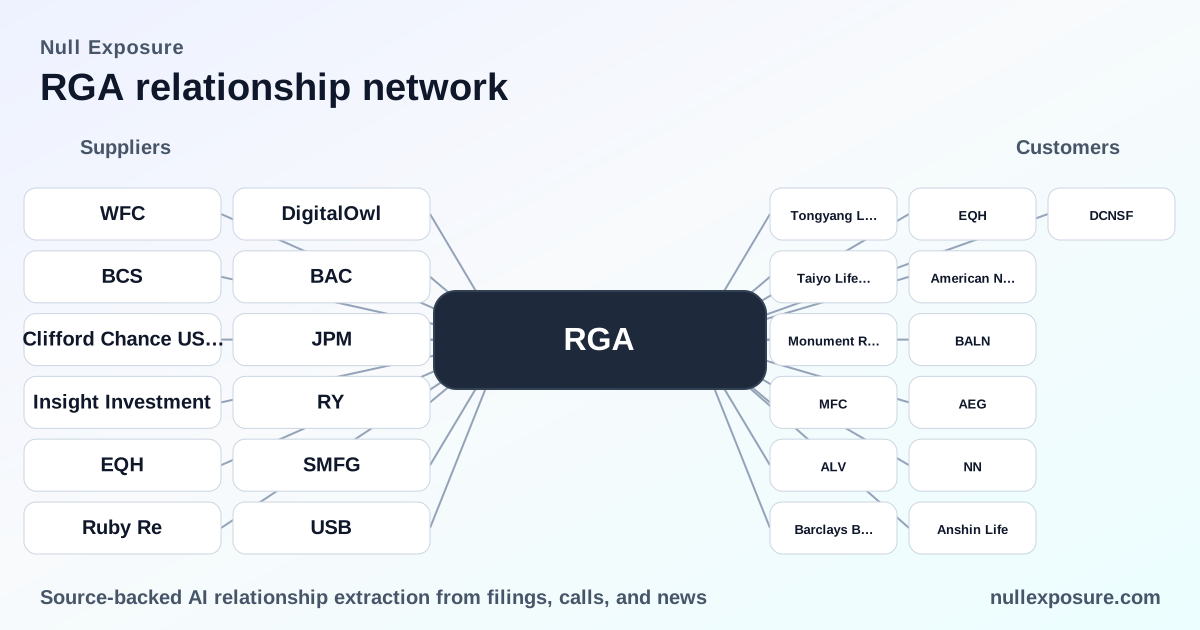
RGA: supplier relationships that shape capital access, risk transfer, and execution
Reinsurance Group of America (RGA) underwrites life and health reinsurance globally and monetizes through underwriting margins, investment income, and access to third‑party capital via structured reinsurance and retrocession arrangements. Its operating model relies on a mix of capital‑market transactions (subordinated debt issuances and swaps), strategic tech partnerships that touch underwriting and distribution, and transactional advisors and legal counsel for large co‑insurance and longevity deals. For investors and operators, supplier links translate directly into capital flexibility, counterparty concentration, and operational dependencies. Learn more at https://nullexposure.com/.
Why counterparties matter more for a reinsurer than for a carrier
RGA’s economics are inherently linked to partners: capital providers that underwrite subordinated debt, counterparties that accept transferred risk, specialist asset managers that collateralize or hedge longevity exposures, and vendors that integrate underwriting tech into core systems. From company disclosures and public reporting, several company‑level signals stand out:
- Concentration of ceded receivables is meaningful. Excluding retrocessions to Ruby Re, three large reinsurers represented roughly 42% of reinsurance ceded receivables as of December 31, 2024 — a concentration signal that increases counterparty risk if one counterparty weakens.
- Global operational footprint. RGA maintains leased office space worldwide, aligning counterparty selection and regulatory complexity with a global supplier base.
- Dual roles: buyer and service integrator. The company acts both as a buyer of services (technology, legal, advisory) and as a service provider/assumer of risk to cedants, reflecting layered contractual postures.
- Dependence on third‑party capital and service providers. Management notes explicit dependence on third‑party investment managers, reinsurers to which it cedes business, and retrocessionaires — these are critical to capital management and claims expense control.
These signals imply a contracting posture that mixes standard market documentation for capital transactions with longer‑term operational agreements for tech and collateral management, and they point to mid‑to‑high criticality for certain counterparties (banks, collateral managers, major retrocessionaires). If you evaluate RGA for partnership or exposure, weigh both counterparty concentration and the diversity of contractual roles.
Explore institutional relationship maps and due diligence tools at https://nullexposure.com/.
Counterparty roll call: what each relationship delivers
Below are the counterparties surfaced in recent reporting, with concise, investor‑oriented summaries and source context.
DigitalOwl
RGA entered a long‑term global strategic partnership to integrate DigitalOwl’s technology into RGA systems, signaling ongoing investment in underwriting automation and analytics that can lower expense and improve risk selection. This was reported in The SaaS News (FY2024).
BofA Securities, Inc.
BofA Securities served as one of the joint book‑running managers for RGA’s subordinated debenture offering, providing distribution and capital markets execution capacity for RGA’s debt financing (FY2026 filing noted by AIJourn).
J.P. Morgan Securities LLC
J.P. Morgan acted as a joint book‑running manager for RGA’s subordinated debt issuance, supporting pricing and placement with institutional investors (AIJourn, FY2026).
U.S. Bancorp Investments, Inc.
U.S. Bancorp Investments was named among the joint book‑running managers on the subordinated debentures, contributing distribution and placement channels for the transaction (AIJourn, FY2026).
Wells Fargo Securities, LLC (and Wells Fargo)
Wells Fargo participates in two roles: as a joint book‑running manager (Wells Fargo Securities) on subordinated debt (FY2026) and separately as exclusive financial advisor to RGA on a $3.5 billion coinsurance transaction with American National (FY2024) — the latter engagement highlights Wells Fargo’s strategic advisory position on large balance‑sheet and reinsurance structuring (AIJourn and Insurance Business Magazine reporting).
Barclays Capital Inc.
Barclays served as a co‑manager on the subordinated debenture offering, adding European and institutional distribution depth to the deal (AIJourn, FY2026).
RBC Capital Markets, LLC
RBC Capital Markets was a co‑manager on the subordinated debentures, supplying capital markets execution and investor coverage for the issuance (AIJourn, FY2026).
SMBC Nikko Securities America, Inc.
SMBC Nikko participated as a co‑manager on the subordinated debenture placement, supporting access to Asian and global investor bases (AIJourn, FY2026).
Clifford Chance US LLP
Clifford Chance provided legal counsel to RGA on the coinsurance transaction with American National, underscoring use of global outside counsel for complex transaction documentation and regulatory navigation (Insurance Business Magazine, FY2024).
Insight Investment
Insight Investment was appointed as collateral manager for a £5 billion longevity swap between Barclays Bank UK Retirement Fund and RGA, indicating reliance on institutional asset managers to structure and hold collateral in longevity hedges (Artemis, FY2020).
Equitable Holdings, Inc.
RGA referenced a transaction with subsidiaries of Equitable Holdings that affected pro forma excess capital, with management estimating pro forma excess capital of approximately $2.3 billion after the deal closed (ReinsuranceNews, FY2025). This underlines how strategic portfolio or reinsurance transactions with life carriers materially affect RGA’s capital profile.
Ruby Re
RGA’s corporate structure includes access to third‑party capital through a reinsurance agreement with Ruby Re, and Ruby Re also appears in retrocession discussions; this relationship functions as an alternate capital source and a retrocession counterparty (ReinsuranceNews, FY2025).
What investors should focus on next
- Capital execution is core. The roster of global banks as book‑runners and co‑managers shows RGA’s active use of capital markets to manage subordinated debt and regulatory capital metrics — monitor deal cadence and pricing for signal on funding costs.
- Counterparty concentration is a real risk. The cited 42% concentration among three reinsurers (excluding Ruby Re) is a structural exposure that affects recovery of ceded receivables under stress.
- Operational dependencies are material. Strategic tech partners like DigitalOwl and collateral managers such as Insight carry outsized operational importance: they influence speed to market and hedging effectiveness.
If you want a structured supplier‑risk briefing or a counterparty scorecard for RGA, start here: https://nullexposure.com/.
Bottom line
RGA’s supplier ecosystem blends capital markets desks, legal and advisory firms, institutional asset managers, retrocession counterparties, and technology partners. Those linkages shape capital flexibility, counterparty risk, and operational capacity—all determinants of how RGA converts underwriting risk into shareholder value. For investors and operators, the focus should be on monitoring issuance activity, counterparty concentration trends, and the operational robustness of critical third‑party interfaces.
For a detailed mapping of RGA’s counterparties and contractual exposures, request a tailored briefing at https://nullexposure.com/.