Regulus Therapeutics (RGLS) — supplier relationships that shape clinical progress and capital access
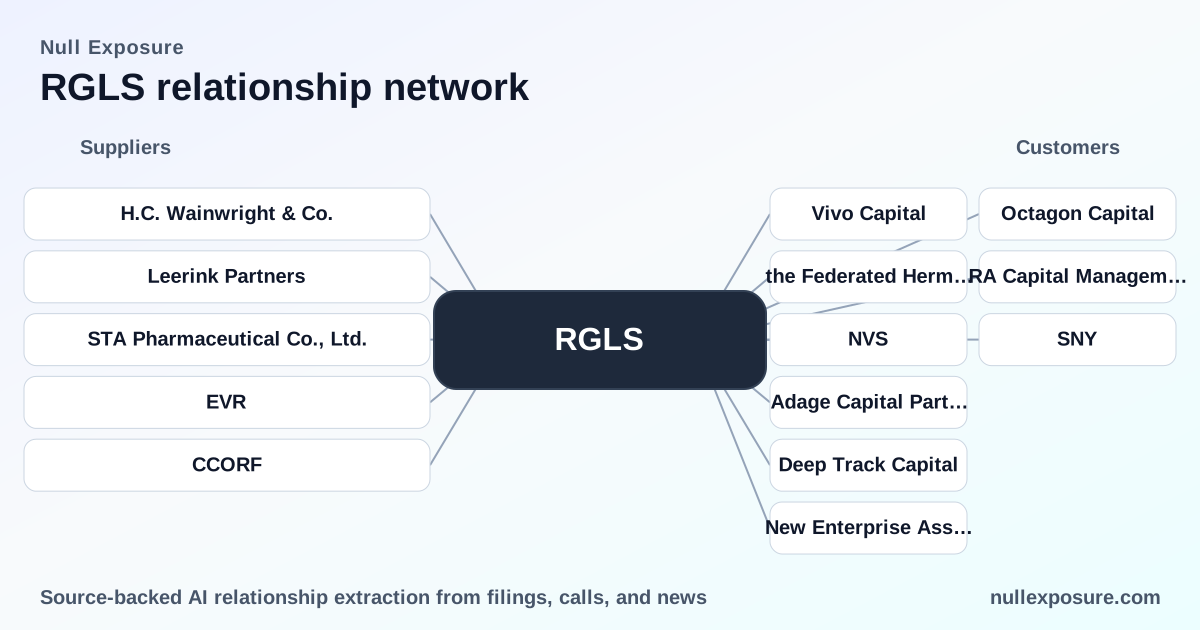
Regulus Therapeutics is a microRNA-focused biopharma that advances oligonucleotide clinical programs and monetizes through a combination of licensing, strategic collaborations, and capital markets activity; the company outsources manufacturing and relies on financial advisors and placement agents to underwrite equity to fund trials and strategic initiatives. For investors, the supplier profile is as much about clinical enablement (CMO partnerships) as it is about capital formation and strategic advisory capacity. If you are evaluating RGLS counterparties for operational risk or commercial leverage, this note maps current supplier relationships, the role each plays, and their implications for execution and valuation.
Explore additional supplier intelligence at https://nullexposure.com/.
What the supplier network tells investors about Regulus' operating model
Regulus runs a lean internal manufacturing footprint and relies on external partners for scale, regulatory-compliant drug substance and drug product development, and transaction execution. Contracting posture is clearly outsourced and relationship-driven—the company uses specialized pharma CMOs for clinical manufacturing and boutique/bulge‑bracket advisors for capital and strategic alternatives. Concentration is moderate: a small number of specialized suppliers handle mission‑critical functions, which creates both operational dependency and clear targets for counterparty diligence.
- Criticality: Manufacturing partners enable trial timelines and regulatory filings; placement agents and financial advisors are central to funding and strategic outcomes. Failure or delays at these suppliers will directly affect cash runway and program milestones.
- Maturity: Relationships span multiple years—evidence of a long-term manufacturing collaboration (dating back to FY2018) and more recent capital markets relationships (FY2024–FY2025), indicating an evolving supplier mix aligned to development and financing cycles.
- Implication for investors: Underwrite both clinical execution risk (quality and continuity of CMO manufacturing) and financing risk (dependence on placement agents and advisors when tapping equity markets). For deeper supplier risk scoring and contract details, visit https://nullexposure.com/.
The supplier list — what each counterparty does and why it matters
STA Pharmaceutical Co., Ltd.
STA Pharmaceutical is Regulus’ strategic development and manufacturing partner for microRNA preclinical and clinical programs, providing development and GMP manufacturing services that enable clinical-stage supply. According to a 2018 PR Newswire announcement, STA was designated to support Regulus’ preclinical and clinical microRNA programs and manufacturing needs (FY2018).
Leerink Partners
Leerink Partners served as the lead placement agent on Regulus’ oversubscribed $100 million private placement, managing pricing and investor distribution for the equity raise. A PR Newswire release tied to the FY2024 financing names Leerink as the lead placement agent (FY2024).
H.C. Wainwright & Co.
H.C. Wainwright & Co. participated as a co-placement agent on the same $100 million private placement, assisting distribution to targeted institutional buyers and contributing to syndication. The FY2024 PR Newswire financing announcement lists H.C. Wainwright as co-placement agent (FY2024).
Canaccord Genuity
Canaccord Genuity acted as a financial advisor to Regulus in conjunction with the FY2024 equity financing, providing advisory services around the raise and possibly secondary-market placement support. PR Newswire commentary on the oversubscribed private placement identifies Canaccord Genuity in an advisory capacity (FY2024).
Evercore ISI
Evercore ISI was engaged as a financial advisor to scout for strategic alternatives, including potential M&A or partnering transactions, a role that intensified after promising early Phase 1b data and ahead of the company’s fundraising activity. FiercePharma reported that Regulus tapped Evercore ISI in June 2024 to explore strategic alternatives, placing the advisory engagement in FY2025 reporting (FY2025).
How these relationships drive risk and value
The supplier map defines two principal value levers for Regulus: clinical enablement through manufacturing partners and capital access through placement agents and financial advisors. STA supports trial readiness and product supply—delays or quality issues there slow programs and erode valuation. The trio of Leerink, H.C. Wainwright, and Canaccord underwrote the company’s ability to raise $100 million in private equity, directly influencing cash runway and optionality. Evercore’s advisory role elevated strategic alternatives and likely increased the company’s M&A visibility to potential acquirers or partners.
- Execution risk is concentrated on the manufacturing relationship (STA), which is mission-critical for advancing clinical milestones.
- Financing risk is concentrated on the capacity and market access of placement agents; the presence of multiple placement/advisory firms reduces single‑point‑failure financing risk but increases cost and control considerations.
- Strategic-readiness signal: Engaging Evercore indicates management’s proactive posture on strategic alternatives, which can compress time-to-exit or partnership if clinical data validates the program.
Constraints and company-level signals
No explicit contractual constraints were provided in the available records. As a company-level signal, the absence of documented constraints suggests the public disclosure set focused on partnership announcements and financial advisory roles rather than detailed supplier contract terms. From an investor diligence standpoint, that means you should treat supplier contractual terms (exclusivity, capacity reservations, quality/recall liabilities, and termination provisions) as unknowns to be clarified in diligence.
- Contracting posture: Outsourced, with strategic CMOs and external capital markets partners.
- Concentration: Moderate—few critical suppliers rather than broad vendor diversification.
- Criticality: High for manufacturing partners; material for capital advisors.
- Maturity: Relationships range from multi-year manufacturing ties (since FY2018) to recent financing/advisory engagements (FY2024–FY2025), indicating evolving supplier sophistication.
For supplier contract-level detail and exposure scores, see https://nullexposure.com/.
Investment implications and recommended next steps
Bottom line: Regulus’ supplier relationships materially de‑risk operational scaling but concentrate execution risk in a small set of specialized partners while relying on established placement agents and advisors for funding. Investors should prioritize verification of manufacturing capacity and contractual protections with STA, and assess the terms, fees, and syndication commitments that underpinned the FY2024 $100 million placement.
- Confirm STA’s GMP compliance records, capacity allocation, and contingency plans.
- Review placement agreements with Leerink, H.C. Wainwright, and Canaccord for any market stabilization or holdback provisions.
- Evaluate Evercore’s engagement scope and whether it includes deal facilitation or only advisory scouting.
To commission a tailored supplier risk brief or to access underlying source documents, start here: https://nullexposure.com/.
By mapping each counterparty’s role and influence, investors can translate operational relationships into clearer risk-adjusted valuations and actionable diligence checklists. For further supplier-level intelligence and contract analytics, visit https://nullexposure.com/.