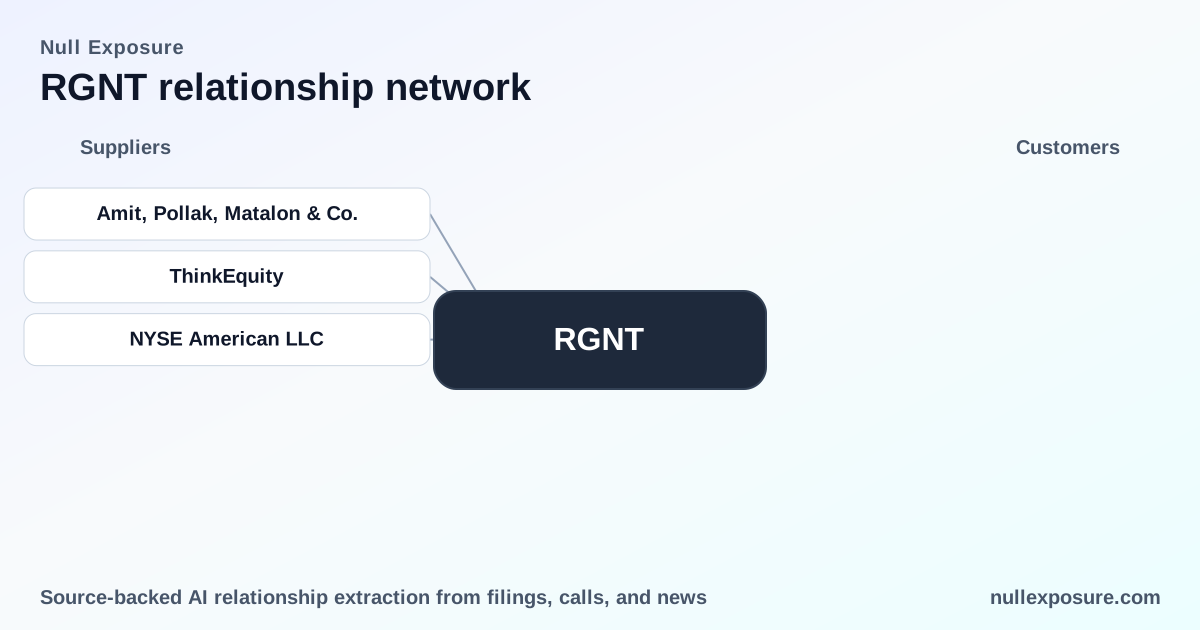
RGNT supplier relationship brief: IPO-era advisors and exchange partners
Regent’s supplier footprint for the RGNT listing is concentrated and transaction-specific: the company monetizes through capital markets execution rather than long-term vendor contracts, relying on a small set of professional advisors to deliver an IPO and an exchange listing. That structure produces a high-concentration, high-criticality supplier posture for the near term—few suppliers, outsized impact—while leaving ongoing operational supplier exposure muted in the public signals. For a quick look at supplier intelligence and to map exposure across other issuers, visit https://nullexposure.com/.
Investment thesis up front: why these suppliers matter
Regent (RGNT) is positioned in this dataset as an issuer completing a U.S. listing and therefore derives immediate value from underwriting, legal counsel, and exchange services that enable public-market access. The supplier relationships captured here are primarily capital-markets professionals whose performance directly determines market access, pricing, and regulatory readiness—critical levers for shareholder value in an IPO window. Investors should evaluate these provider ties for execution quality, exclusivity, and reputational alignment.
What the supplier roster signals about risk and execution
The supplier roster is small and focused on a single event: the initial public offering and listing. That concentration creates two investment-relevant dynamics:
- Execution concentration: When underwriting and legal counsel are bilateral or sole-provider arrangements, trade execution and compliance are dependent on a few named firms. That elevates operational and reputational risk if any counterparty underperforms.
- Maturity and lifecycle posture: These suppliers are transaction-focused (IPO), not ongoing operational vendors, signaling a company in capital formation rather than prolonged vendor outsourcing. That reduces ongoing supplier lock-in risk but increases the importance of post-IPO governance and vendor selection for growth.
For more supplier intelligence and comparative supplier mapping across other issuers, see https://nullexposure.com/.
Detailed relationship inventory — each supplier and what they did
Below are the relationships observed in the collected signals. Each entry includes a concise plain-English summary and a direct source reference.
-
Amit, Pollak, Matalon & Co. — Legal counsel during IPO process. Regent engaged Ronen Kantor of Amit, Pollak, Matalon & Co. as legal counsel for its IPO, a classic arrangement where the firm handled regulatory filings and transaction legal work (news coverage referencing the firm, FY2025). Source: Yahoo Finance / Newswire coverage reporting the counsel role (see https://finance.yahoo.com/news/regentis-biomaterials-commences-trading-nyse-133300677.html and https://www.newswire.com/news/regentis-biomaterials-commences-trading-on-nyse-set-to-transform-cartilage).
-
ThinkEquity — Sole book-running manager for the offering. ThinkEquity served as the sole bookrunner on the offering, meaning the firm led pricing, distribution and primary market placement for RGNT’s IPO (reported in FY2025). That sole-bookrunner posture concentrates underwriting risk and raises questions about distribution breadth. Source: GlobeNewswire press release and Renaissance Capital reporting (https://www.globenewswire.com/news-release/2025/12/04/3199444/0/en/Regentis-Biomaterials-Ltd-Announces-Pricing-of-Initial-Public-Offering.html and https://www.renaissancecapital.com/IPO-Center/News/109840/Israeli-hydrogel-implant-developer-Regentis-Biomaterials-files-and-sets-ter).
-
NYSE American LLC — Listing venue for RGNT ordinary shares. The ordinary shares were scheduled to begin trading on the NYSE American on December 4, 2025 under the symbol “RGNT,” indicating the exchange-level services and market infrastructure used for primary listing and trading (FY2025 reporting). Source: GlobeNewswire press communication about the IPO listing timeline (https://www.globenewswire.com/news-release/2025/12/04/3199444/0/en/Regentis-Biomaterials-Ltd-Announces-Pricing-of-Initial-Public-Offering.html).
How these suppliers shape Regent’s operating model and supplier constraints
No explicit supplier constraints were provided in the collected signals. That absence itself is a company-level signal: the public reporting available focuses on transaction execution rather than long-term supplier commitments. Translating that into operating-model characteristics:
- Contracting posture: Transactional and event-driven. Contracts are short-term, focused on deliverables for the IPO and listing rather than multi-year operational SLAs.
- Concentration: High concentration for the transaction window—few firms bear outsized influence on outcome.
- Criticality: Extremely high for market access; underwriting, legal, and exchange services are critical path items for the company’s capital markets strategy.
- Maturity: Capital-markets relationships are mature enough to execute an IPO but leave open questions about post-listing vendor strategy for corporate operations and growth.
These signals guide a practical diligence checklist: confirm any exclusivity or fee arrangements with ThinkEquity, evaluate counsel scope and any indemnities with Amit, Pollak, Matalon & Co., and review post-listing trading arrangements and liquidity support from NYSE American.
Investment implications and recommended follow-up
- Short-term sensitivity: RGNT’s near-term valuation and liquidity will be sensitive to underwriting performance and initial market reception; the sole-bookrunner dynamic means ThinkEquity’s market distribution capabilities are a key variable.
- Governance and disclosure: Legal counsel assignment is fundamental to regulatory readiness; confirm any ongoing legal retainer or dispute exposure disclosed post-IPO.
- Operational follow-through: After market debut, investor focus should shift from IPO suppliers to operational vendors that will underwrite recurring revenue—no signals in these results indicate that shift yet.
For a deeper supplier-risk assessment or comparative supplier maps across other issuers, see our tools at https://nullexposure.com/.
Final takeaways
- This supplier set is narrowly focused on IPO execution: legal counselor Amit, Pollak, Matalon & Co., lead underwriter ThinkEquity, and the NYSE American exchange.
- Concentration and criticality are the defining supplier risks here—few providers, large impact—so investors should validate underwriting distribution and legal scopes in any follow-up diligence.
- Post-IPO, reassess supplier exposure to operational vendors; current public signals do not capture those relationships.
If you want a tailored supplier-risk memo for RGNT or a comparative report versus peers in the senior living and biomaterials spaces, start a request at https://nullexposure.com/ and our team will prioritize it.