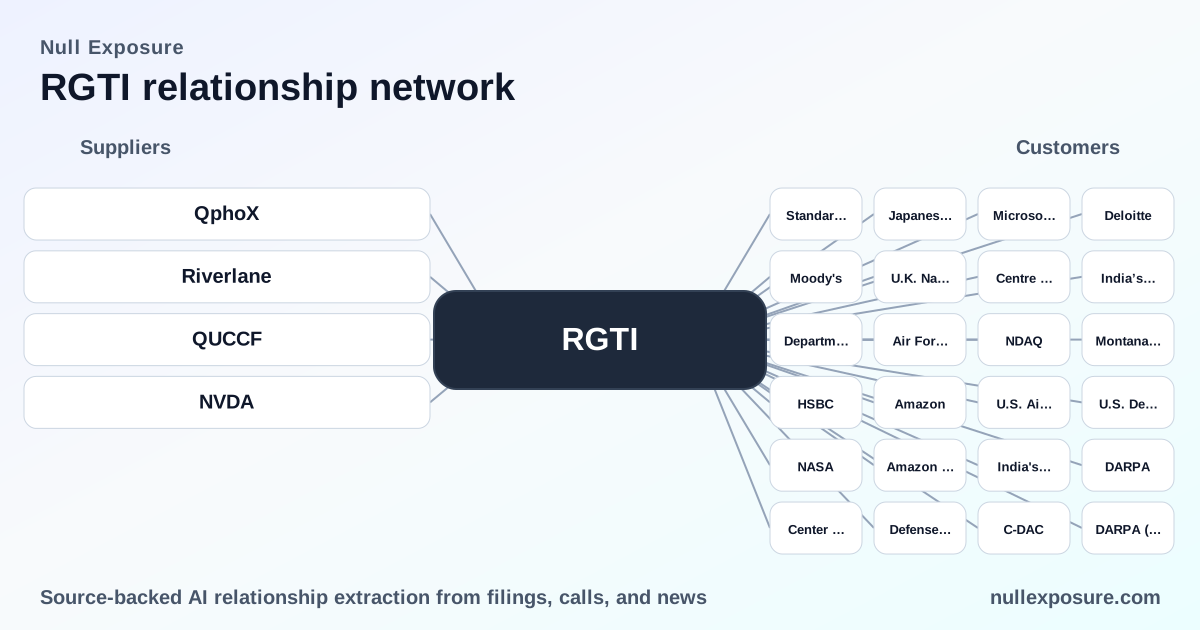
Rigetti Computing: supplier relationships that shape a nascent quantum value chain
Rigetti Computing builds quantum processors, delivers cloud-based quantum compute access, and licenses software that integrates quantum workloads with classical compute. The company monetizes through hardware sales, cloud access fees, and software partnerships while leveraging third-party manufacturing and cloud infrastructure to scale. Review the supplier map and contractual signals at NullExposure to benchmark counterparty risk and strategic leverage: https://nullexposure.com/.
How Rigetti’s partnerships extend the product and go-to-market stack
Rigetti sells access to its quantum machines via a cloud platform and develops control hardware and software that sit between qubits and customer applications. Partnerships accelerate capability delivery in three domains: readout and control engineering, error correction software, and classical compute integration — each critical to turning experimental devices into commercially useful systems. The company’s suppler posture is hybrid: it designs core processors while relying on external manufacturers and cloud providers for components, assembly and operational hosting.
What that operating model implies for investors
- Contracting posture and availability risk are real: Rigetti does not have contractual indemnities from public cloud providers for outages, which exposes revenues and service continuity to third-party availability. This is a company-level signal drawn from recent corporate disclosures.
- Hardware-centric supply chain: Rigetti sources components from electronics, cryogenics and semiconductor vendors, highlighting dependency on specialized suppliers for key parts of the stack.
- Manufacturer and service-provider roles coexist: Rigetti functions as a manufacturer of integrated systems while also depending on external service providers for cloud operations and some hardware elements.
- Materiality of disruptions: The business identifies outages, defects and cloud interruptions as potentially material to revenue, costs and reputation.
These characteristics shape procurement negotiation leverage, concentration risk, and operational maturity. For a deeper supplier map and governance checklist, see NullExposure’s supplier intelligence hub: https://nullexposure.com/.
Supplier relationships that matter — the cited counterparties
Below are the supplier and partner mentions disclosed by Rigetti in the 2025 Q4 earnings call and related commentary. Each relationship summary is concise and tied to the original source.
QphoX — optical readout collaboration
Rigetti described a collaboration with QphoX and the UK's National Quantum Computing Centre on optical readout techniques for superconducting qubits, indicating an effort to improve measurement fidelity and scalability. According to Rigetti’s 2025 Q4 earnings call commentary, this work targets improved readout architectures to accelerate system performance.
Riverlane — real-time quantum error correction partner
Rigetti is partnering with Riverlane to advance real-time quantum error correction, which Rigetti calls foundational to achieving fault-tolerant quantum computing. Rigetti discussed this partnership on its 2025 Q4 earnings call, and an FY2026 industry write-up also singled out the Riverlane relationship as a medium- to long-term value driver for Rigetti’s road to error-corrected systems (InsiderMonkey, FY2026).
Quanta Computer (QUCCF) — control system and server integration in Taiwan
Rigetti confirmed a close partnership with Quanta Computer in Taiwan, noting Quanta’s expertise in CPU/GPU servers and understanding of control system components of the stack. Rigetti mentioned this in the 2025 Q4 earnings call and identified Quanta as a key manufacturing and systems-integration partner (Rigetti 2025 Q4 earnings call; inferred symbol QUCCF).
NVIDIA (NVDA) — NVQLink and classical supercomputing integration
Rigetti is working closely with NVIDIA to support NVQLink, an open platform intended to integrate quantum systems with AI supercomputing, positioning Rigetti to use NVIDIA’s classical acceleration and software ecosystem to scale hybrid quantum-classical workloads. This collaboration was noted on Rigetti’s 2025 Q4 earnings call (Rigetti 2025 Q4 earnings call; referenced NVDA).
How these relationships interact with company-level constraints
The disclosed partnerships sit inside a company model that is simultaneously hardware-led and cloud-delivered, which produces a distinct set of commercial and operational pressures:
- Concentration and critical suppliers: Sourcing specialized cryogenics, silicon and microwave components creates concentrated supplier exposures that are material to delivered system performance. This is a company-level signal — the filing text about sourcing from electronics, cryogenic and semiconductor industries frames supplier criticality.
- Service-provider exposure: Rigetti’s reliance on public cloud infrastructure without contractual availability compensation defines a supplier risk posture where outages propagate to customers and financials; this is explicitly stated in corporate risk disclosures and should inform vendor-management priorities.
- Maturity and modularity: Partnerships with engineering specialists (QphoX), software-first error-correction firms (Riverlane), large-scale integrators (Quanta) and compute-stack leaders (NVIDIA) indicate a modular approach to system development that mitigates single-vendor bottlenecks while introducing multi-party integration risk.
Together, these signals show a firm moving from lab systems to commercial deployments with elevated supplier orchestration requirements and measurable operational risk.
What investors and operators should watch next
- Execution of error correction and readout roadmaps: Real-time error correction (Riverlane) and optical readout (QphoX) are gating capabilities for useful quantum advantage; successful integration unlocks materially higher addressable revenue. Monitor technical milestones and commercial pilots reported in quarterly commentary.
- Manufacturing scale and control-system delivery: The Quanta relationship underwrites hardware scale but transfers integration complexity to a large external partner; monitor lead times, quality metrics, and any supply bottlenecks cited in future filings.
- Cloud availability and contractual protections: The lack of cloud indemnities increases operational volatility; investors should demand disclosure on SLAs, multi-cloud strategies, and internal mitigation plans.
For a consolidated supplier intelligence view and contract-risk scoring, review NullExposure’s supplier profiles here: https://nullexposure.com/.
Final verdict — strategic positioning with execution-dependent risk
Rigetti’s supplier network is strategically coherent: partners map neatly to the company’s nearest-term obstacles (readout, error correction, control systems, and classical integration). The firm’s value creation depends on integrating these external capabilities into stable, high-availability products, and its current disclosures flag supply and availability as material risks that affect revenue durability.
For portfolio managers evaluating RGTI exposure, prioritize milestone tracking on Riverlane and QphoX integrations, supplier lead-time disclosures with Quanta, and cloud resilience statements. Operators evaluating supplier relationships should prioritize contractual SLAs, redundancy for critical components, and staged integration tests with NVIDIA’s NVQLink.
Deepen your supplier risk assessment and track material supplier disclosures at NullExposure: https://nullexposure.com/.