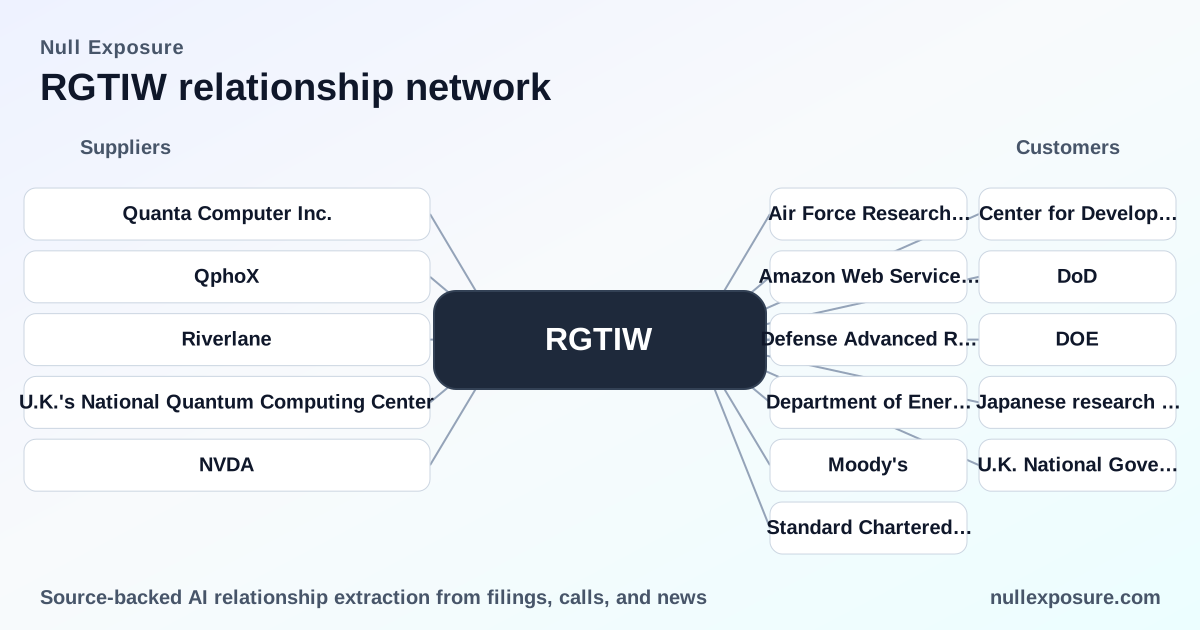
Rigetti (RGTIW) supplier landscape — strategic partners, operational risk, and what investors should price in
Rigetti builds superconducting quantum processors and sells access to those systems through a cloud platform that integrates classical compute workflows; the company monetizes via cloud services, hardware product roadmaps and strategic collaborations that accelerate commercialization and scaling. Supplier relationships are a core enabler of Rigetti’s manufacturing cadence and platform roadmap — investors in RGTIW warrants should treat supplier commitments and partnerships as direct drivers of capacity, R&D velocity and execution risk.
For a concise view of partner disclosures and the implications for commercial scale, visit https://nullexposure.com/.
Why supplier relationships change the valuation equation for Rigetti
Rigetti’s commercial progress is constrained by capital-intensive manufacturing, specialized cryogenic and microwave supply chains, and the integration of software and classical compute infrastructure. The company’s public filings and management commentary signal four actionable operational characteristics:
- Long-term contracting posture: Rigetti describes agreements that grant exclusive or restrictive distribution rights, which make supplier relationships durable and strategically consequential for competitive positioning. This is presented as company-level contract behavior in regulatory filings.
- Buyer and integrator role: Rigetti sources critical components across electronics, cryogenics and semiconductor supply chains and functions as the buyer that aggregates these inputs into a platform offering; these dependencies determine cost structure and time-to-scale.
- Use of third-party service providers: The firm relies on external cybersecurity and professional services to manage operational risk, indicating a hybrid internal/external operating model for specialization and risk mitigation.
- Infrastructure dependency on public cloud: Rigetti’s platform is built to be accessed through third‑party cloud providers such as AWS, which creates an external vector for availability and security risk that is material to platform uptime and customer adoption.
These factors are not abstract: exclusive supplier terms increase execution leverage (positive if honored, negative if counterparty fails), and public cloud dependence trades off engineering focus for market reach.
Learn more about how supplier signals influence investment decisions at https://nullexposure.com/.
Vendor-by-vendor: who Rigetti works with and why it matters
Quanta Computer Inc.
Rigetti disclosed that both parties committed to invest at least $250 million over five years in quantum computing, with Quanta’s contribution directed toward personnel, capital expenditures and manufacturing capability aligned to Rigetti’s Sub product roadmap. According to Rigetti’s FY2024 10‑K, this is a structured industrialization partnership intended to accelerate scale and manufacturability.
Source: Rigetti FY2024 10‑K (investment commitment disclosure).
QphoX
Management highlighted a collaboration with QphoX and the U.K. National Quantum Computing Center on optical readout of superconducting qubits, indicating a joint engineering push to improve qubit measurement and system performance. This was described on Rigetti’s 2025 Q4 earnings call.
Source: Rigetti 2025 Q4 earnings call (optical readout collaboration).
Riverlane
Rigetti is partnering with Riverlane to advance real-time quantum error correction capabilities, which management characterized as foundational to achieving fault-tolerant quantum computing during the 2025 Q4 earnings call. This is a software and algorithmic collaboration with material implications for error budgets and usable qubit throughput.
Source: Rigetti 2025 Q4 earnings call (error correction partnership).
U.K. National Quantum Computing Center (NQCC)
Rigetti confirmed collaboration with the U.K.’s National Quantum Computing Center alongside QphoX on optical readout work for superconducting qubits, underscoring international R&D alliances and access to national lab infrastructure. Management discussed this on the 2025 Q4 earnings call.
Source: Rigetti 2025 Q4 earnings call (NQCC collaboration).
NVIDIA (NVDA)
Rigetti is working closely with NVIDIA to support NVQLink, an open platform intended to integrate quantum systems with AI supercomputing — a strategic interface that ties quantum workload orchestration to leading-classical acceleration. Management referenced this collaboration on the 2025 Q4 earnings call; NVIDIA is cited by ticker NVDA in the disclosure.
Source: Rigetti 2025 Q4 earnings call (NVQLink collaboration with NVIDIA).
What these relationships imply for risk, concentration and runway
Taken together, the partner set implies a dual-track strategy: industrialize manufacturing through Quanta while advancing system-level performance via scientific and software collaborations (QphoX, Riverlane, NQCC) and integrating with AI infrastructure (NVIDIA). For investors, the practical implications are:
- Concentration and criticality: Large, multi‑year commitments (e.g., the $250M Quanta pledge) indicate concentrated, high-impact supplier ties that materially affect production scale. Restricted distribution or exclusivity language amplifies counterparty risk because a single supplier failure would disrupt output.
- Maturity and execution timing: Collaborations with research centers and algorithm companies show a pipeline from lab innovation to productized features; however, converting R&D collaborations into revenue-bearing cloud features requires sustained capital and operational discipline.
- Operational posture: The company’s role as a buyer of specialized components and its reliance on third‑party cloud infrastructure create multiple external dependency vectors — supplier performance, supply chain lead times, and cloud vendor availability are directly tied to customer experience.
Financially, Rigetti’s reported TTM revenue of $7.09M and continuing negative operating margin amplify the sensitivity of valuation to partner-driven scale; supplier commitments that accelerate manufacturability directly reduce time-to-revenue and improve leverage.
Actionable investor checklist
- Monitor milestones tied to the Quanta investment and any supply‑agreement exclusivity language; these are primary drivers of manufacturing scale and unit economics.
- Track technical milestones from Riverlane, QphoX and NQCC that would shift quantum error correction or readout from research to product‑level capabilities; each milestone is a potential inflection in usable qubit counts.
- Observe integration progress on NVQLink and any joint go‑to‑market efforts with NVIDIA, as this affects enterprise adoption narratives and platform stickiness.
For ongoing supplier surveillance and to compare Rigetti’s partner disclosures with peers, visit https://nullexposure.com/.
Final takeaway
Rigetti’s supplier relationships are strategic, concentrated and execution‑critical: manufacturing scale depends on the Quanta commitment, system performance improvements depend on partnerships with specialist firms and national labs, and enterprise integration depends on classical compute partnerships such as NVIDIA. Investors in RGTIW warrants should price both the upside from successful industrialization and the downside from supplier concentration and external infrastructure dependency.