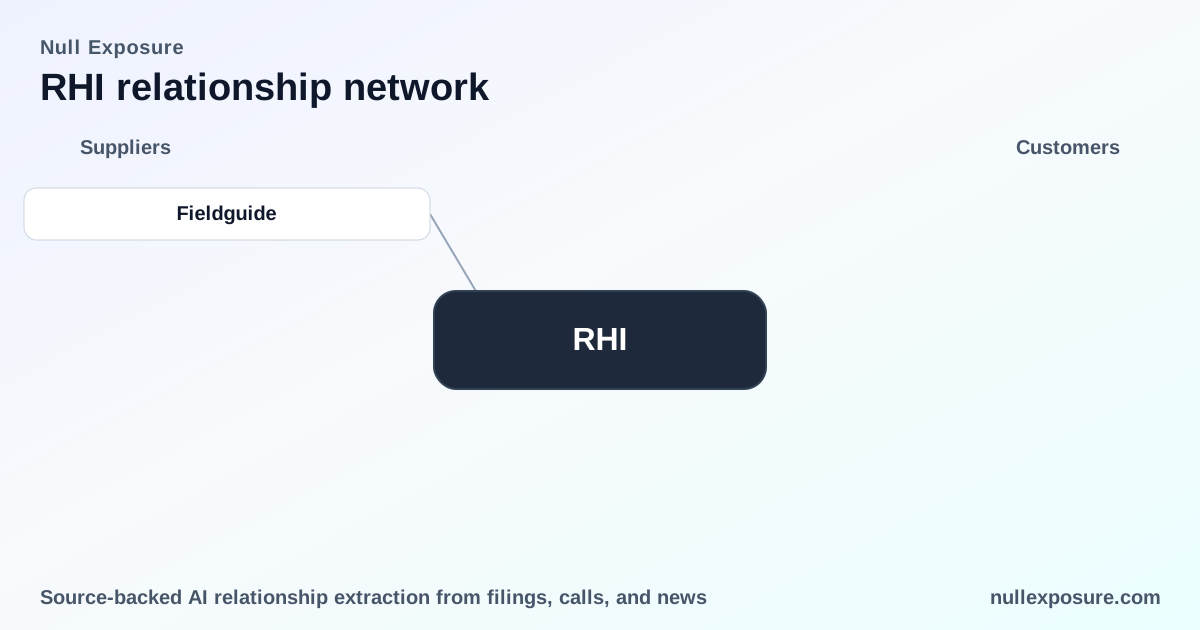
Robert Half (RHI): Supplier Relationship Spotlight — Protiviti’s Alliance with Fieldguide
Robert Half monetizes a global staffing and consulting platform through placement fees, hourly and project-based consulting revenue, and recurring managed services under the Robert Half and Protiviti brands. The business converts expert human capital and advisory services into steady cash flow, with trailing revenue of roughly $5.38 billion and an EBITDA base near $128 million — a profile that makes supplier and technology partnerships a direct lever on capacity, margins, and client retention. For a focused view on how supplier ties shift operational risk and growth potential, visit https://nullexposure.com/.
What investors should watch about supplier relationships at a services firm
Supplier relationships for a staffing-and-consulting firm are not abstract cost lines; they are operational gears that affect service delivery, compliance, and revenue recognition. For Robert Half, partners that supply platforms, automation, or outsourced services can change utilization dynamics and reduce time-to-fill for client engagements, improving effective margins. Conversely, dependency on third-party platforms or long-term facilities can introduce concentrated operational risk and fixed-cost leverage.
Two company-level signals from recent disclosures shape how to think about that trade-off:
- Filings disclose a mix of lease durations extending up to 11 years with options to extend or terminate, which points to a contracting posture that blends short- and long-term commitments and introduces possible future negotiation events around real estate and fixed costs.
- The company records fees paid to client-selected time management or vendor management providers as a reduction of revenues because Robert Half is not the primary obligor for those services, which is a revenue-recognition and pass-through cost dynamic that suppresses gross revenue while preserving net margin transparency.
Both signals should be read as firm-level operating constraints rather than attributes of any single partner. For deeper supplier analytics, start here: https://nullexposure.com/.
The Fieldguide / Protiviti relationship — the facts investors need
Robert Half operates its consulting advisory under the Protiviti name; recent media reports highlight Protiviti’s strategic alliance with Fieldguide to integrate AI and workflow automation into internal audit workflows. The vendor partnership will influence Protiviti’s delivery model for advisory engagements and internal audit managed services.
- According to an Intellectia news item published March 10, 2026, Protiviti formed a strategic alliance with Fieldguide to integrate advanced AI and workflow automation into its global internal audit services, with the explicit goal of improving efficiency and quality and increasing client trust and satisfaction (https://intellectia.ai/news/stock/robert-half-inc-to-release-q4-2025-earnings-on-january-29).
- A separate Intellectia news piece from the same day repeats that Protiviti has allied with Fieldguide to bring AI-enabled workflow automation into internal audit engagements, reinforcing the partnership as a corporate initiative within FY2026 communications (https://intellectia.ai/news/stock/robert-half-named-one-of-fortunes-most-admired-companies-for-29th-year).
Both items reference the same strategic alliance; each is a contemporaneous news mention documenting the partnership during FY2026. The practical implication is that Protiviti is outsourcing or licensing automation capabilities rather than building them exclusively in-house, which alters cost structure, speed of scale, and the competitive position of its advisory practice.
How this alliance translates into operating consequences
For investors modeling Robert Half’s service margins and growth, the Fieldguide tie implies three practical changes in the go-to-market engine:
- Higher productivity per consultant is likely if Fieldguide’s automation reduces time spent on rote audit tasks; that increases revenue per billable hour without a proportional increase in headcount.
- Faster scalability for managed internal audit offerings because technology partners allow Protiviti to extend reach without linear hiring; this can accelerate high-margin consulting revenue growth.
- Vendor-dependency risk increases: reliance on third-party automation means contract renewal, pricing, and integration outcomes become material to client experience and margin sustainability.
These changes interact with the company-level constraints noted earlier: long-term lease commitments maintain a fixed-cost floor while the pass-through treatment of certain vendor fees compresses reported revenue but clarifies net economics.
Risk profile: concentration, contracting posture, and criticality
Investor-grade evaluation of supplier relationships should interrogate four dimensions: contracting posture, concentration, criticality, and maturity.
- Contracting posture: Filings indicate lease terms up to 11 years with extension and termination options, signaling a mixed-duration real-estate footprint that can either lock in advantageous rents or create legacy fixed costs if workforce models shift. This is a company-level signal rather than a statement about Fieldguide.
- Concentration: The Fieldguide alliance is singularly highlighted in recent communications but does not on its face indicate concentration across the entire supplier base; the strategic role of this vendor is proportionally higher within Protiviti’s internal audit product line.
- Criticality: Automation vendors that sit in the middle of audit workflows are functionally critical — outages or integration failures would directly affect delivery timelines and client satisfaction.
- Maturity: Partnering with an established workflow/AI provider is consistent with a buy-versus-build strategy that accelerates functionality but trades off some control.
These risk vectors affect forecasting: assume upside to billable productivity and downside if third-party pricing or performance changes.
Investment takeaways and next steps
- Positive: The Protiviti–Fieldguide alliance is a strategic, revenue-accretive move that should lift utilization and accelerate managed-service scale without a proportionate rise in headcount. Given Robert Half’s $5.38B revenue base, marginal productivity gains are meaningful for operating leverage.
- Caution: Vendor dependency and fixed-cost lease positions are real constraints. The company’s accounting practice of recording certain vendor fees as reductions to revenue clarifies net economics but also hides gross volume effects that can shock top-line comparatives.
- Actionable for operators and investors: Monitor contract terms, renewal cadence with Fieldguide, and any incremental disclosures about technology-driven margin improvement in Protiviti’s segments.
For an operational due diligence brief or to benchmark supplier exposure across peer staffing and consulting firms, visit https://nullexposure.com/.
Final judgement
Robert Half is executing a pragmatic partnership strategy: buy capability, not just build headcount. That improves speed-to-market and can materially shift margins in Protiviti’s favor, but it elevates vendor performance and contract risk to a level investors should actively monitor. For more supplier-level analysis and to track evolving partner disclosures, go to https://nullexposure.com/.