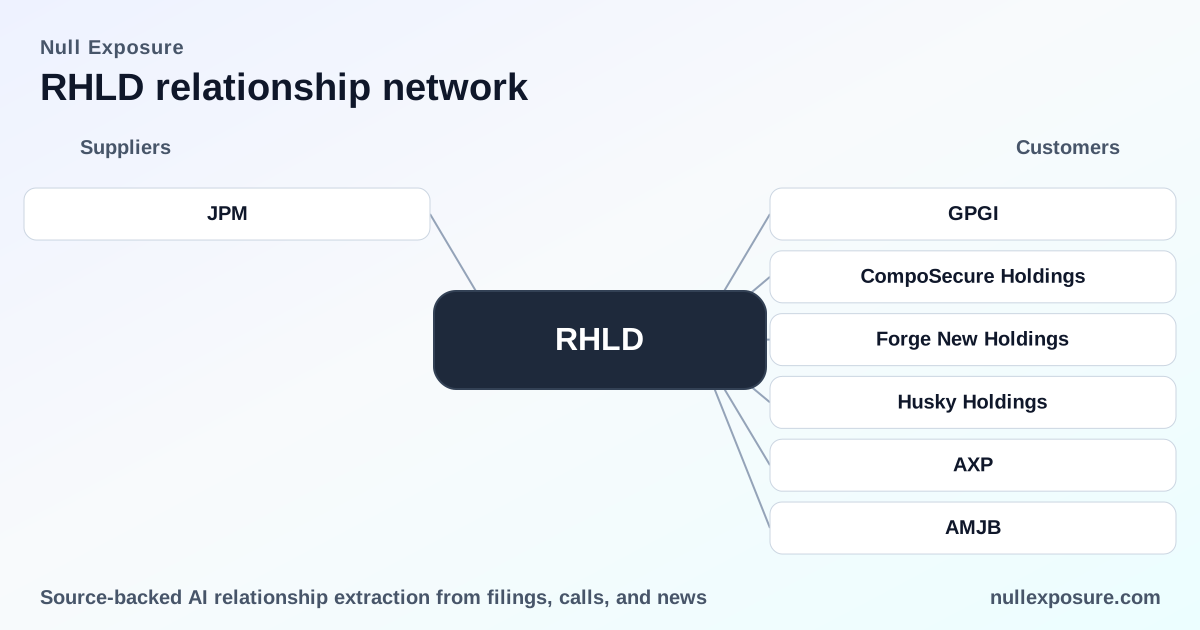
Resolute Holdings Management (RHLD): Banked liquidity, concentrated supplier signals, and what that means for counterparties
Resolute Holdings Management operates as an investment manager and active asset owner across real estate, private equity, and venture ventures, monetizing through asset-level returns, management fees and performance-driven upside across its holdings. The company reported $462m in trailing revenue and $152m in EBITDA, and it is actively using bank-lending capacity to support operating and investment activity. For investors and operators evaluating supplier and bank counterparty exposure, the recent JPMorgan credit facility and indications of supplier concentration are the two most actionable signals.
Explore deeper counterparty intelligence at https://nullexposure.com/ and see how this fits your diligence workflow: https://nullexposure.com/
Why the JPMorgan facility rewrites the near-term liquidity story
Resolute signed a new bank credit arrangement that changes the company’s short-term funding profile from opportunistic draws to a committed, multi-year line. Market reports indicate a five-year revolving credit facility of $30 million with JPMorgan Chase Bank as administrative agent and other lenders — a structure that provides committed liquidity to support working capital, deal execution and smoothing capital calls across investment business lines. A committed revolver of this tenor and size reduces rollover risk and signals an institutional banking relationship, which is an operational control point for counterparties assessing payment and settlement risk.
According to a TradingView news item in March 2026, JPMorgan Chase Bank is the administrative agent on a $30 million five-year revolving credit facility for Resolute. Bitget news coverage in March 2026 also reported that Resolute signed a new credit agreement with U.S. banking giant JPMorgan on February 20, 2026.
Every counterparty finding in the source set — concise, sourced summaries
JPMorgan — Bitget (AMP) coverage, reported March 2026
Bitget’s AMP news feed reported that Resolute signed a new credit agreement with JPMorgan on February 20, 2026, signaling an updated banking arrangement. This item corroborates market attention on the company’s formalization of credit lines with a major U.S. bank. Source: Bitget news coverage, March 2026.
JPMorgan — Bitget standard coverage, reported March 2026
A standard Bitget article reiterated the February 20, 2026 signing of a credit agreement between Resolute and JPMorgan, underscoring multiple independent press placements about the same transaction across outlets. Source: Bitget news coverage, March 2026.
JPMorgan Chase Bank — TradingView report of a $30M five-year revolver, March 2026
TradingView published a note that named JPMorgan Chase Bank as administrative agent on a $30 million five-year revolving credit facility and referenced other lenders as part of the syndication. This description clarifies the facility’s agent structure and committed tenor. Source: TradingView news post, March 2026.
What the relationship map implies for operators and suppliers
- Banking counterparties are now central counterparties for RHLD’s liquidity management. The presence of a multi-year revolver with a top-tier bank increases the operational criticality of that lender for cash management and capital deployment decisions. For vendors evaluating payment risk, the facility length and size are positive signals for near-term settlement capacity.
- Supplier concentration is an elevated procurement risk. Company-level disclosures indicate that Resolute relied on at least one vendor that accounted for more than 10% of supplies purchases for the year ended December 31, 2024, which elevates business continuity exposure if that vendor’s terms or capacity change.
- Spend scale is in the mid-range. A company-level signal places purchase-commitment exposures in the $10m–$100m band, with an excerpt referencing purchase commitments in the low tens of millions for nearby fiscal years; this implies material single-supplier spend that is large enough to influence supplier negotiations but not at monopoly-scale.
Constraints and operating-model characteristics you should factor into diligence
The filings and press signals produce a clear set of operating constraints and characteristics for counterparties and investors:
- Contracting posture: Resolute is using committed bank financing (a five-year revolving facility), which signals a preference for secured, institutional credit relationships over short-term or ad hoc financing. This posture encourages standard bank covenants and documentation, so counterparties should expect formal credit controls and reporting requirements tied to the facility.
- Concentration: Company-level disclosure shows at least one vendor exceeding 10% of purchases for FY2024, a material concentration that increases supplier negotiating leverage and single-point-of-failure risk.
- Spend maturity and scale: The company-level spend band signal sits in the $10m–$100m range, indicating supplier engagements with multi-year commitments and meaningful billing volumes that can materially affect vendor revenue planning.
- Criticality: The JPMorgan facility elevates the bank–company relationship to a critical operational node for cash flow and capital activity; banks and major suppliers should treat credit terms and covenant testing as material event triggers for broader financial covenants or default remedies.
These constraints are company-level signals extracted from filings and reporting; they provide context for counterparties but are not assigned to a specific supplier unless the original excerpt explicitly names that supplier.
Risk and opportunity — what to watch next
- Risk: Supplier concentration >10% combined with meaningful purchase commitments increases vendor counterparty risk; suppliers should price for possible renegotiation leverage and ensure contractual protections around payment timing and dispute resolution.
- Opportunity: The JPMorgan revolver is a clear operational upside — it reduces near-term liquidity risk and gives Resolute capacity to execute on deals and vendor payments, which benefits suppliers who prioritize cash visibility and timely collections.
- Monitoring triggers: Watch upcoming quarterly filings for covenant language, utilization levels of the revolver, any carve-outs that affect vendor payment priority, and whether the company diversifies its supplier base or converts commitments into longer-term purchase agreements.
Take a closer look with tailored counterparty intelligence at https://nullexposure.com/ to align contract terms with RHLD’s funding and procurement posture.
Bottom line for investors and suppliers
Resolute has strengthened its institutional funding profile through a multi-year, $30 million revolver with JPMorgan Chase Bank while operating with material supplier concentration and mid-sized purchase commitments. For investors, the bank facility reduces short-term liquidity risk and supports deal flow; for suppliers, the concentration signal requires proactive contract protections and pricing discipline. Monitor covenant disclosure and supplier diversification in the next fiscal disclosures to assess whether the company converts the improved liquidity into more resilient supply relationships.
For detailed counterparty reports and to map these relationships against your vendor exposure, visit https://nullexposure.com/.