Resolute Holdings Management (RHLDV): Supplier relationships that shape governance and product strategy
Resolute Holdings Management operates as an investment management and financial services firm that monetizes through strategic asset acquisition, asset management and advisory fees, and by commercializing specialized financial products embedded in its portfolio companies. Its commercial logic combines asset consolidation with product-level revenue streams generated by subsidiaries and branded segments, while corporate governance and external audit relationships underpin market credibility for investors.
If you evaluate supplier risk and counterparty exposure, this brief synthesizes the publicly surfaced supplier relationships tied to RHLDV and what those ties imply for financial operations and governance. For broader supplier intelligence and sourcing due diligence, visit https://nullexposure.com/.
What the supplier list tells investors about Resolute’s priorities
The limited set of public supplier references for RHLDV is telling. Audit relationships and product-segment partners dominate visible mentions, signaling that Resolute’s immediate external dependencies skew toward reporting credibility and specialized product providers rather than a large vendor ecosystem. That concentration shapes both risk and execution priorities: strong external audit oversight supports capital-market trust, while product partners drive monetization at the business-unit level.
Explore more supplier profiles and diligence workflows at https://nullexposure.com/ if you want systematic mapping for portfolio-level decisions.
Suppliers and partners you need to know
-
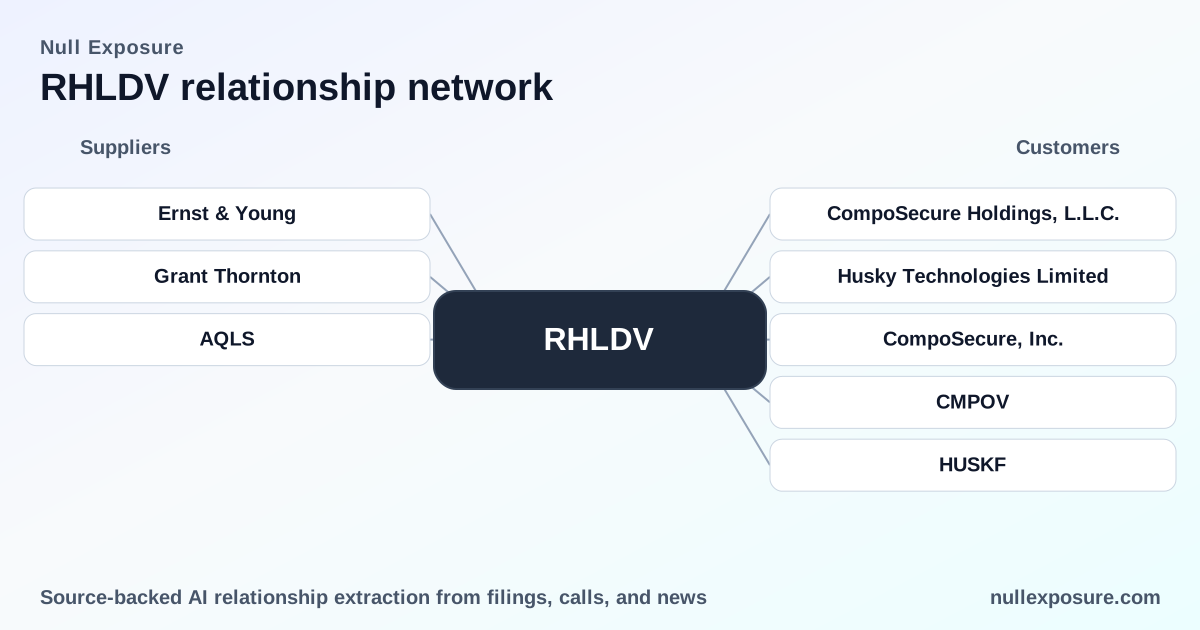
Ernst & Young — Resolute announced it is switching its auditor to Ernst & Young for the fiscal year ending Dec. 31, 2026, reflecting an explicit change in external assurance provider for future reporting periods; prior-year audit coverage remains with the previous firm. This transition is documented in a March 10, 2026 news item covering the company’s filings and market reaction. (Source: TS2 Tech, March 2026 — https://ts2.tech/en/why-resolute-holdings-management-rhld-stock-is-jumping-today-and-what-to-watch-next/)
-
Grant Thornton — Grant Thornton will continue to hold the audit engagement for the prior fiscal year even as Resolute names Ernst & Young as auditor for FY2026, indicating a phased handover of assurance responsibilities rather than an abrupt termination. The same March 2026 report captured the announcement of the auditor switch. (Source: TS2 Tech, March 2026 — https://ts2.tech/en/why-resolute-holdings-management-rhld-stock-is-jumping-today-and-what-to-watch-next/)
-
Arculus (inferred symbol AQLS) — Public company material and profile language identify an Arculus segment that produces and sells metal payment or nonpayment cards using Arculus technology, including authentication for digital asset cold storage and related services, positioning this partner or segment as a product-level revenue generator tied to payments and digital-asset custody hardware. This characterization is reflected in a TradingView company page and related segment descriptions first seen March 2026. (Source: TradingView profile, March 2026 — https://www.tradingview.com/symbols/NYSE-RHLD/)
What these relationships mean for investors: governance, concentration, and execution
-
Governance and market confidence are priorities. The decision to engage a Big Four auditor for FY2026 is a strong corporate governance signal: it elevates audit rigour and external reporting credibility, which investors value in companies executing acquisition-driven strategies. The phased retention of Grant Thornton for the prior year reduces near-term reporting disruption while preserving continuity for legacy audits.
-
Supplier concentration is low in public records, but supplier criticality is high. Only three distinct supplier mentions surfaced in monitored sources; two relate to audit and one to a product partner. That low public concentration should not be equated with low operational reliance — the auditors are critical for compliance and access to capital markets, and Arculus-related product capability is critical for any revenue generated by card or custody products.
-
Contracting posture and maturity signal institutionalization. Switching to Ernst & Young implies Resolute negotiates at an institutional level and is prepared to align with larger, more standardized assurance practices. The company’s willingness to preserve the prior auditor for an earlier period suggests a pragmatic contracting posture focused on staged transitions and continuity.
-
Product partnerships drive monetization at the segment level. The Arculus-related activity described in public profiles highlights a commercial channel where technology partners enable monetized product offerings (metal cards and custody solutions), which complement the asset-management side of the business.
Risk considerations investors should track
-
Audit transition risk: Any auditor change introduces short-term execution and disclosure risks; monitoring subsequent filings and auditor opinions for FY2026 will be essential to confirm the transition is functionally complete and that there are no material restatements.
-
Concentration on few high-impact suppliers: With public mentions concentrated in audit and a single product segment, supplier disruption or reputational issues at these firms would have outsized impact. Diligence should include contract terms, termination triggers, and contingency arrangements.
-
Product execution and commercialization: The Arculus segment's role in hardware and custody services exposes the company to product-development, manufacturing, and compliance execution risks that differ from investment-management risk; investors should track commercialization milestones and revenue attribution.
Constraints and company-level signals
No supplier constraints were captured in the available records for RHLDV. As a company-level signal, that absence indicates no publicly surfaced supplier disputes, flagged supply fragility, or contractual embargoes in the monitored sources during the reporting window. Use that absence as a starting point for diligence — it is not proof of absence of operational risk, but it does reduce the immediacy of headline supplier controversies in the public record.
Translate that signal into action by requesting:
- audit engagement letters and transition plans to evaluate assurance continuity;
- commercial contracts or term sheets with key product partners such as Arculus to assess revenue dependency and exclusivity.
How to act on these supplier signals
- Request the FY2026 auditor engagement letter and management representation to confirm the scope and timeline of the Ernst & Young engagement.
- Ask management for revenue breakdowns tied to the Arculus segment and coverage of manufacturing / fulfillment arrangements.
- Confirm contingency plans related to audit continuity and product-supplier substitution to stress-test downside scenarios.
For targeted supplier dossiers and to map these relationships across portfolios, visit https://nullexposure.com/ — the platform centralizes supplier intelligence and due-diligence artifacts for investment teams.
Bottom line
Resolute’s public supplier footprint is compact but strategically significant: a Big Four auditor for future reporting and a product-segment partner that supports productized revenue streams. Investors should prioritize audit transition documentation and commercial terms with product partners to validate both governance improvements and the durability of non-asset-management revenue lines. For systematic supplier screening that complements your investment thesis, start at https://nullexposure.com/.