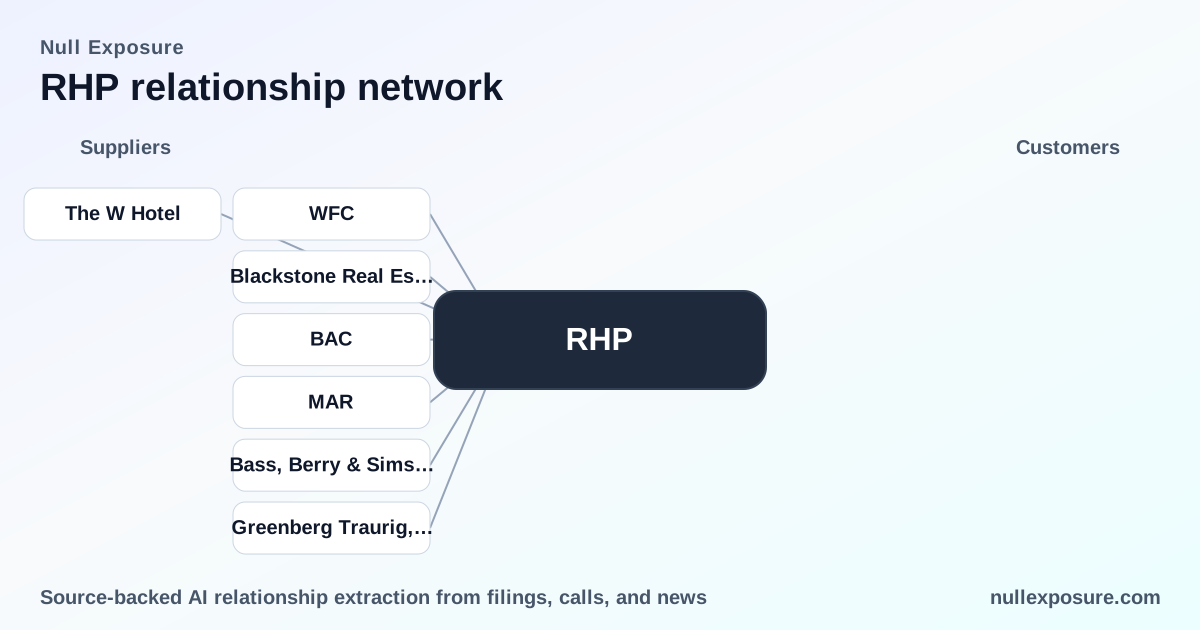
Ryman Hospitality Properties (RHP): supplier map and what it means for investors
Ryman Hospitality Properties is a focused hospitality REIT that owns large convention-oriented resorts and related assets and monetizes through net operating income from hotel operations, long-term management agreements and incremental real estate appreciation. RHP generates cash flow from room and meeting revenue while outsourcing day‑to‑day operations to third‑party managers and preserving capital flexibility through secured revolving and term credit facilities. This combination produces predictable base fees and owner cash flow plus upside via incentive fees and asset sales. For a direct view of supplier relationships and how they affect valuation and risk, visit https://nullexposure.com/.
How RHP runs the business and where suppliers matter
RHP owns marquee assets—Gaylord Hotels, JW Marriott Hill Country and select urban properties—and uses management contracts to shift operating execution to branded operators while retaining real estate economics. The company collects rents, management fee offsets and distributes trust-like cash flows as a REIT; it finances the asset base through a mix of unsecured notes and a revolving credit facility. Supplier relationships that matter are operational (hotel managers), capital (lenders and underwriters), and legal/financial advisors — these determine operating leverage, variable costs and financing flexibility.
Supplier list: every counterparty reported in the recent feeds
Below are the counterparties cited across news and filings, each with a plain‑English summary and a source.
Wells Fargo / Wells Fargo Bank (WFC)
Wells Fargo led a refinancing and expansion of RHP’s revolving credit facility, extending the revolver maturity from 2027 to 2030 and adding extension options, improving the company’s near-term liquidity profile. Source: GlobeNewswire press release and Yahoo Finance reporting on the revolver refinancing (Jan–Mar 2026) — https://www.globenewswire.com/ and https://finance.yahoo.com/.
Marriott / Marriott International (MAR)
Marriott International manages RHP’s hotel portfolio under long‑term management agreements that specify base fees (approximately 2% of gross revenues) and incentive fees tied to profitability, making Marriott the company’s primary operational counterparty. Source: SEC filing excerpts and multiple press releases including a TradingView summary of RHP’s 10‑K and GlobeNewswire investor materials (FY2026) — https://www.tradingview.com/ and https://www.globenewswire.com/.
JW Marriott
RHP intends to operate the San Antonio asset under the JW Marriott flag following acquisition, keeping brand operations with Marriott while owning the underlying real estate. Source: BizBash coverage of the definitive agreement to acquire JW Marriott San Antonio Hill Country Resort & Spa (Mar 2026) — https://www.bizbash.com/.
Blackstone Real Estate Income Trust (BREIT)
RHP agreed to purchase the JW Marriott San Antonio Hill Country Resort from BREIT for $800 million, representing an asset acquisition sourced from an institutional perpetual‑life vehicle and indicating RHP’s willingness to transact with large institutional sellers. Source: BizBash report on the $800 million purchase agreement (Mar 2026) — https://www.bizbash.com/.
BofA Securities (BAC)
BofA Securities served as exclusive financial advisor to RHP on the JW Marriott purchase and related strategic work, providing investment banking advisory capacity for a major acquisition. Source: Deal coverage in BizBash identifying BofA Securities as financial advisor (Mar 2026) — https://www.bizbash.com/.
Bass, Berry & Sims PLC
Bass, Berry & Sims acted as a legal advisor to RHP in the JW Marriott transaction, supporting transaction structuring and closing conditions. Source: BizBash legal advisory disclosure (Mar 2026) — https://www.bizbash.com/.
Greenberg Traurig, LLP
Greenberg Traurig acted as a legal advisor alongside Bass, Berry & Sims in the JW Marriott purchase, contributing external counsel on the acquisition. Source: BizBash transaction reporting (Mar 2026) — https://www.bizbash.com/.
The W Hotel
The W Austin is one of the previously acquired urban assets referenced in RHP reporting and press coverage, representing RHP’s selective foray into lifestyle/urban properties alongside its convention‑focused portfolio. Source: BizBash note referencing RHP’s 2021 W Austin acquisition (Mar 2026) — https://www.bizbash.com/.
What the contract and supplier constraints tell investors
RHP’s supplier constraints are directional and material to underwriting:
- Long‑term contracting posture: Management agreements include long terms (e.g., 65‑year amortization reference and agreements expiring in 2047 with renewal options), which lock operating relationships and stabilize operating continuity across economic cycles. Evidence: management‑agreement disclosures in the 10‑K and related investor presentations (FY2026).
- Usage‑based economics: Base fees (~2% of gross revenues) plus incentive fees (tiered share of pooled available cash flow) create a variable cost structure that scales with revenue recovery and amplifies upside when group demand and margins improve. Evidence: management fee descriptions in the 10‑K and investor materials (FY2026).
- Geographic concentration: Core assets are US‑centric and targeted at convention and large‑group markets, which concentrates demand risk by region and customer type. Evidence: portfolio descriptions in investor presentation and 10‑K (FY2026).
- Service‑provider model and spend concentration: Marriott functions as the primary service provider and accounted for tens of millions in base management fees (e.g., $48.0 million in 2024), implying high vendor spend and operational reliance on a single manager. Evidence: fee disclosure in RHP filings (2024).
- Active, mature relationships: Contracts are active and amortized, evidencing operational maturity and reduced near‑term execution risk but also long‑dated fee obligations. Evidence: management‑agreement terms and SOC review processes noted in filings (FY2026).
These are company‑level signals; where the filings explicitly name Marriott, those constraints are presented in context of that relationship.
For further, structured supplier intelligence and to model counterparty concentration, see https://nullexposure.com/.
Investment implications and risk checklist
- Operational concentration: Heavy dependence on Marriott for day‑to‑day hotel operations creates a single‑counterparty operational risk; changes in the management agreement economics would flow directly to margins.
- Financing flexibility: The Wells Fargo‑led revolver extension to 2030 reduces short‑term refinancing stress and supports near‑term capex and M&A optionality. Source: GlobeNewswire and Yahoo Finance (Jan–Mar 2026).
- M&A posture: The JW Marriott acquisition from BREIT for $800 million signals active portfolio rotation and a willingness to transact at institutional pricing — this affects pro forma leverage and asset mix. Source: BizBash (Mar 2026).
If you are modeling RHP, incorporate variable fee expense tied to revenue recovery, long‑dated management commitments, and the recently extended revolver as primary drivers of near‑term leverage and free cash flow.
For a supplier‑level dashboard and counterparty risk scoring, explore RHP’s supplier map at https://nullexposure.com/.
Bottom line and next commercial steps
Ryman Hospitality’s structure—owned real estate with outsourced operations, usage‑based management fees, and bank‑led financing—creates a predictable base with cyclical upside tied to group demand. Key relationships (Marriott operationally and Wells Fargo on liquidity) are the clearest levers for investors assessing operational risk and financing resilience.
If you evaluate REIT exposure or run diligence on operator and lender counterparty risk, start with the supplier map and constraints above and then request the detailed counterparty scoring and contract extracts on https://nullexposure.com/.