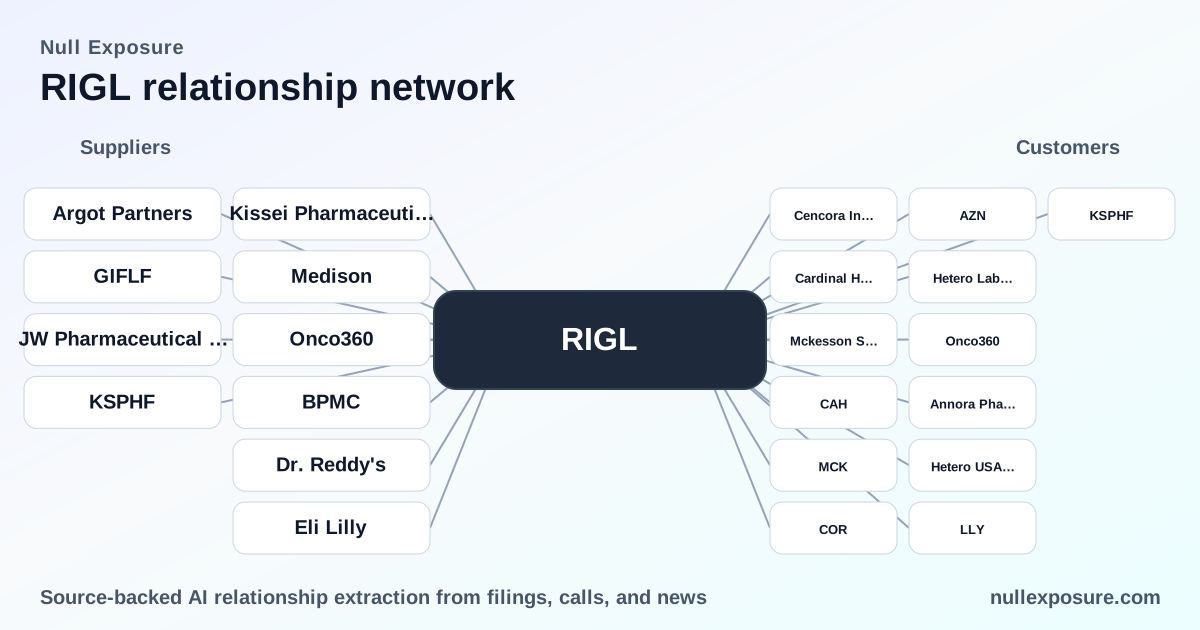
Rigel Pharmaceuticals (RIGL): Supplier and partner map investors must price into valuation
Rigel Pharmaceuticals discovers and develops small‑molecule therapies and monetizes through direct product sales, licensing and strategic collaborations that transfer regional commercial rights. Revenue drivers are a hybrid of owned commercial sales (TAVALISSE, GAVRETO, REZLIDHIA), milestone/royalty streams from licensing, and inventory purchases/sales tied to acquired rights. Investors should underwrite both commercialization upside and supplier concentration risk when valuing the equity. Learn more on strategic supplier exposure at https://nullexposure.com/.
How Rigel structures its supply and partner footprint — what that means for investors
Rigel operates with a lean internal manufacturing posture and a partner‑centric commercialization model. The company relies on third‑party contract manufacturers for active ingredients and finished goods, outsources distribution to third‑party logistics providers, and leverages regional commercial partners to access markets outside the U.S. That configuration accelerates go‑to‑market speed and limits capital intensity, but it also concentrates operational risk: manufacturing relationships are classified as critical, distribution is concentrated in two third‑party centers, and certain inputs are imported from China into APAC manufacturing flows.
Contracting posture is transactional with medium‑term commitments: the 10‑K discloses a manufacturing agreement entered in October 2024 that produces deliveries from 2026 through 2029 and a contractual obligation of roughly $24.1 million that could include cancellation fees. Rigel also executed inventory purchases and transfer arrangements (approximately $6.5 million of drug product inventories received from Blueprint in 2024 and a $15.0 million purchase price tied to the Gavreto transaction). These sums place several suppliers in the $1m–$100m spend band at the company level, signaling material procurement exposure that investors must track.
For governance and operational diligence, prioritize contract milestones, contingency manufacturing capacity, and the performance of limited‑distribution pharmacy partners for specialty oncology products. For an operational deep dive and supplier risk scoring, visit https://nullexposure.com/.
Every partner and supplier investors should know
Kissei Pharmaceutical Co., Ltd.
Rigel has a formal supply agreement with Kissei dated October 29, 2018, underpinning supply and regional commercialization activity for TAVALISSE/TAVLESSE. According to Rigel’s 2024 Form 10‑K, that supply agreement remains part of its commercial network (FY2024 10‑K).
Medison
Medison is a regional commercial partner that distributes TAVALISSE in Israel; management listed Medison among partners in the 2025 Q3 earnings call when discussing international availability (2025 Q3 earnings call).
Onco360
Onco360 was selected as a limited‑distribution specialty pharmacy partner to dispense TAVALISSE, GAVRETO and REZLIDHIA, consolidating specialty channel access for those products in the U.S. A March 10, 2026 Yahoo Finance release reported Onco360’s appointment and its role in Rigel’s controlled distribution strategy (Yahoo Finance, March 10, 2026).
Onco360 (implication)
This limited distribution appointment is a commercial control point: it centralizes patient access and reimbursement workflows but concentrates retail channel risk in a single specialty pharmacy partner (Yahoo Finance, March 10, 2026).
Blueprint Medicines
Rigel acquired commercial rights to Gavreto (pralsetinib) from Blueprint Medicines and recorded inventory transfers as part of the transaction; news coverage notes Gavreto joined Rigel’s portfolio after the 2024 deal (TradingView summary referencing Blueprint/2026 coverage). The company also paid a structured purchase price tied to the transaction, with payments disclosed in filings.
Dr. Reddy’s
Rigel entered into an exclusive license agreement with Dr. Reddy’s for all potential indications in Dr. Reddy’s territory, a deal referenced in the 2025 Q3 earnings call that expands regional commercialization through a licensing model (2025 Q3 earnings call).
Eli Lilly
Eli Lilly announced termination of a CNS disease program collaboration with Rigel; management disclosed in the 2025 Q3 earnings call that Lilly notified Rigel of the termination effective after a 60‑day notice (2025 Q3 earnings call).
Argot Partners
Argot Partners appears in Rigel’s investor relations and media contact listings; a FY2025 PR Newswire release distributed by the company identified Argot as media contact for a Piper Sandler conference presentation (PR Newswire, FY2025).
Grifols
Grifols is a commercialization partner that handles TAVALISSE availability in certain markets (Canada/Europe reference), and management named Grifols when summarizing international partners during the 2025 Q3 earnings call (2025 Q3 earnings call).
JW Pharmaceutical Corporation
JW Pharmaceutical Corporation is Kissei’s licensing partner that launched TAVALISSE in South Korea, as described by Rigel management in the 2025 Q3 earnings call when discussing partner launches and regulatory progress in APAC (2025 Q3 earnings call).
Kissei (earnings call mention)
In addition to the 10‑K supply agreement, management reiterated Kissei’s role as a commercial partner in the 2025 Q3 earnings call when listing the suite of international partners (2025 Q3 earnings call).
What the constraints tell investors about operational risk and maturity
The company‑level constraints from filings establish a clear operating profile: high dependency on contract manufacturers (critical), concentrated distribution operations, and APAC supply chain exposure due to imported inputs from China. Manufacturing relationships are active and material — Rigel discloses a multi‑year manufacturing contract with potential cancellation fees ($24.1M) and specific inventory purchases from Blueprint ($6.5M) and purchase obligations related to the Gavreto transaction (initial $10M payment plus up to $5M on anniversary). These are not hypothetical line items; they are executed commercial commitments that affect cash flow and counterparty risk.
Maturity is mixed: commercial products are in market, giving near‑term revenue visibility, but manufacturing and supply dependencies keep operational risk elevated. Contracting posture is pragmatic — fixed commitments with milestone‑driven payments — which transfers some commercialization risk to partners but leaves Rigel exposed to supplier performance failures. Monitor APAC manufacturing continuity and the replacement costs or lead times for critical third‑party producers.
How investors and operators should act
- For investors: stress test valuations for scenarios where a critical manufacturer experiences a disruption and model the cash impact of contractual obligations and inventory buys; track limited distribution partners like Onco360 for revenue cadence and net‑price realization.
- For operators: prioritize supplier redundancy, negotiate termination and cancellation‑fee protections, and build inventory buffers for core SKUs where commercial continuity is essential.
For a platform that maps supplier concentration and quantifies counterparty exposure for investment diligence, see https://nullexposure.com/.
Bottom line
Rigel’s commercial progress is real — multiple products and regional partners deliver revenue today — but the company’s outsourced manufacturing and concentrated distribution create material supplier risk that must be incorporated into any investment thesis. Investors should weigh commercialization upside against exposure to a small set of critical suppliers and legally binding purchase obligations that influence near‑term cash flow and operational flexibility. For continued updates on supplier relationships and structured exposure analysis, visit https://nullexposure.com/.