B. Riley Financial (RILY): Supplier relationships that move the credit and the stock
B. Riley Financial operates a diversified financial services platform that earns fees and financing spread income across investment banking, capital markets, lending, and advisory services, and it monetizes through underwriting and principal financing, advisory retainers, asset management fees, and interest spread on credit products. The firm supplements organic growth through targeted acquisitions and structured financings that rely on a broad network of broker-dealers, capital markets counterparties, and service providers. For investors and operators, the key question is whether those partner relationships are deep, concentrated, or mission-critical enough to affect funding costs, execution risk, or regulatory exposure.
If you want a concise map of RILY’s counterparties and what each relationship implies for operations and risk, start here: https://nullexposure.com/
How B. Riley sources capital and execution: networked underwriting and matched books
B. Riley’s capital markets model depends on two interlocking supplier sets: (1) syndicate and co-manager relationships that underwrite debt and equity offerings, and (2) clearing, securities lending and bank counterparties that support a matched-book trading and lending operation. That hybrid model creates revenue diversification but also operational dependency on multiple mid‑market broker-dealers and rating providers to maintain access to funding and to preserve capital-market credibility. Financial results—negative EPS and depressed margins—amplify the importance of reliable syndicate partners and independent ratings when the firm seeks financing.
Explore comparative counterparty profiles and deal histories at https://nullexposure.com/ before underwriting or operationalizing exposure.
The counterparties you must watch (plain-English summaries with sources)
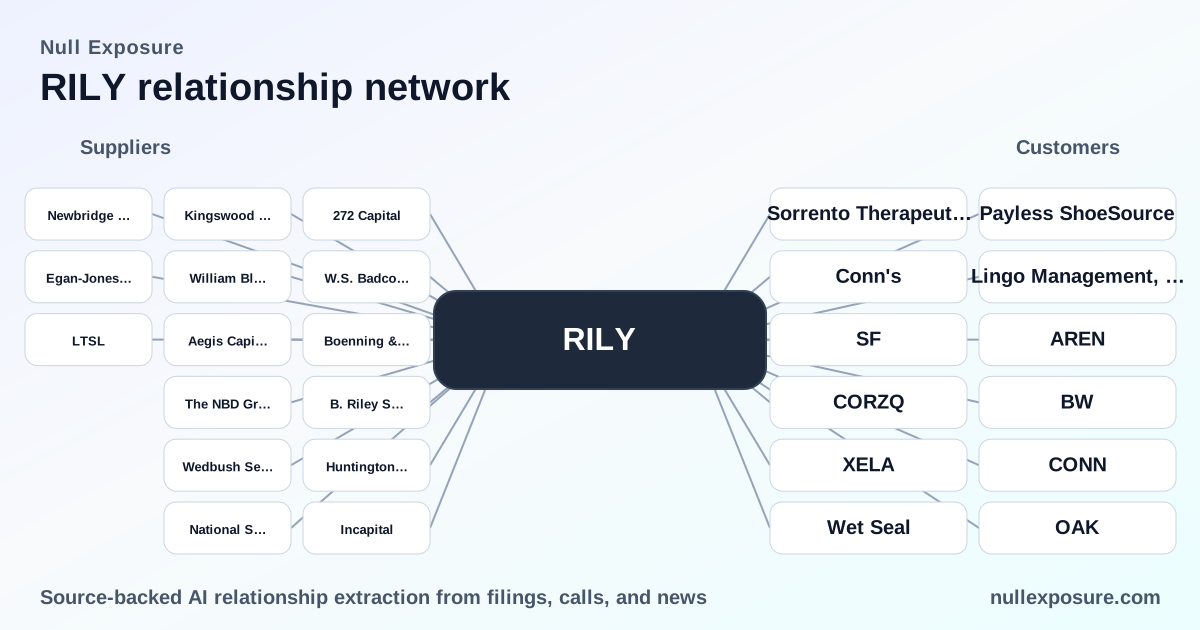
Below are every relationship referenced in the source materials, with a short explanation of the role each counterparty played.
-
272 Capital — A boutique investment advisory firm that B. Riley acquired to bolster its private fund and asset-management capabilities; together with existing funds and as sub‑advisor to B. Riley’s private fund, 272 Capital manages more than $270 million in assets. (Los Angeles Business Journal coverage, FY2021–2026 reporting window.)
-
W.S. Badcock — A regional furniture retailer whose receivables B. Riley purchased in two tranches following the chain’s acquisition, illustrating B. Riley’s practice of buying customer receivables to generate lending and servicing revenue. (InvestmentNews profile on business acquisitions, FY2024 discussion.)
-
Boenning & Scattergood — Named as a co‑manager on B. Riley’s $200 million senior note offering, functioning as a distribution partner to place debt with institutional clients. (PR Newswire press release announcing closing of $200 million senior notes, FY2021.)
-
B. Riley Securities — The firm’s in‑house broker‑dealer that acted as a book‑running manager on the same $200 million notes offering, demonstrating B. Riley’s vertical integration between origination and distribution. (PR Newswire press release, FY2021.)
-
Huntington Capital Markets — Served as a co‑manager on the 2021 senior note issuance, providing placement and syndication support for the transaction. (PR Newswire press release, FY2021.)
-
Incapital — Acted as a book‑running manager on the senior notes, contributing to retail and institutional distribution channels used by B. Riley to place debt. (PR Newswire press release, FY2021.)
-
Kingswood Capital Markets (division of Benchmark Investments) — Participated as a co‑manager on the notes issuance, reinforcing B. Riley’s reliance on mid‑tier capital markets firms for syndication. (PR Newswire press release, FY2021.)
-
William Blair — One of the book‑running managers for the senior notes, adding institutional distribution heft to the syndicate. (PR Newswire press release, FY2021.)
-
Aegis Capital Corp. — Listed among co‑managers for the offering, representing another channel for wholesale placement of the notes. (PR Newswire press release, FY2021.)
-
The NBD Group — Served as legal counsel to B. Riley in connection with the senior note closing, indicating external legal reliance for structured financings. (PR Newswire press release, FY2021.)
-
Wedbush Securities — Participated as a co‑manager on the note offering, another distribution channel in the syndicate. (PR Newswire press release, FY2021.)
-
National Securities Corporation — A book‑running manager on the offering, reinforcing the multi‑dealer approach to debt placement. (PR Newswire press release, FY2021.)
-
Newbridge Securities Corporation — Took part as a co‑manager on the syndicate, used by B. Riley to broaden placement reach. (PR Newswire press release, FY2021.)
-
Egan‑Jones Ratings Company — Provided an independent BBB+ rating for both B. Riley and the 2021 notes issuance, signaling a market‑facing credit opinion used to support investor demand. (PR Newswire press release, FY2021.)
-
Ladenburg Thalmann (LTSL) — Named as one of the book‑running managers for the offering, listed with a ticker in the disclosure, underscoring the breadth of the syndicate. (PR Newswire press release, FY2021.)
Each of these relationships is documented in press coverage and the company’s deal disclosures tied to the 2021 senior note closing and subsequent reporting. The mix of in‑house (B. Riley Securities) and external book‑runners demonstrates a syndication-first approach to financing.
What the supplier constraints signal about operations
Company-level constraint excerpts provide direct operational color without tying any one limitation to a specific vendor:
-
Geographic exposure (APAC): The company notes that third‑party contract manufacturers in Asia create geographic concentration risk, a signal that supply‑chain disruption or geopolitical stress could affect vendor costs or service continuity.
-
Manufacturer and manufacturing segment reliance: Excerpts referencing third‑party manufacturers supplying raw materials and manufacturing Targus and magicJack products indicate outsourced production and dependence on external factory capacity—a structural sourcing risk for product lines.
-
Service provider dependence: The company outsources critical data processing, trade processing, and maintains a broad group of banks and broker‑dealers to run a matched book. This signals operational criticality of third‑party processing and counterparty credit; prolonged vendor failure could directly impair trade settlement and financing flows.
-
Contracting posture and maturity: The language implies an established outsourcing posture (critical processes and multiple providers), not an ad‑hoc setup, which points to mature third‑party relationships but also to increased complexity and coordination risk as the business scales.
These constraints collectively indicate concentration in manufacturing geography and high criticality of service providers, which investors should treat as ongoing operational risk factors rather than one‑off issues.
What investors and operators should take away
-
Underwriting and syndicate depth matter. The 2021 notes placement used a broad roster of mid‑market book‑runners plus B. Riley’s own brokerage — a model that preserves distribution while diluting single‑counterparty risk. (PR Newswire, FY2021.)
-
Ratings and external validation are material. An independent BBB+ rating from Egan‑Jones supported the debt issuance; with thin margins and negative EPS, external credit opinions influence funding cost and access. (PR Newswire, FY2021.)
-
Outsourcing is strategic and exposes operational risk. The company’s reliance on APAC manufacturers and outsourced trade processing creates a combination of geographic and system dependencies that require active vendor management.
If you manage exposure to B. Riley or operate in its ecosystem, prioritize counterparty continuity plans, stress-test matched‑book operations under vendor outages, and validate the firm’s contingency arrangements for APAC manufacturing constraints. Learn more about practical counterpart risk discovery and monitoring at https://nullexposure.com/
Final read: action items for investors and partners
- Request recent counterparty confirmations and updated syndicate engagement letters when evaluating new financing from B. Riley.
- Insist on SLA details and business‑continuity evidence for any outsourced trade‑processing provider prior to entering matched‑book arrangements.
- Monitor credit opinions and syndicated placement partners as leading indicators of funding stability.
For a concise, supplier-focused risk brief tailored to your portfolio or counterparty monitoring program, visit https://nullexposure.com/ and request a focused report.