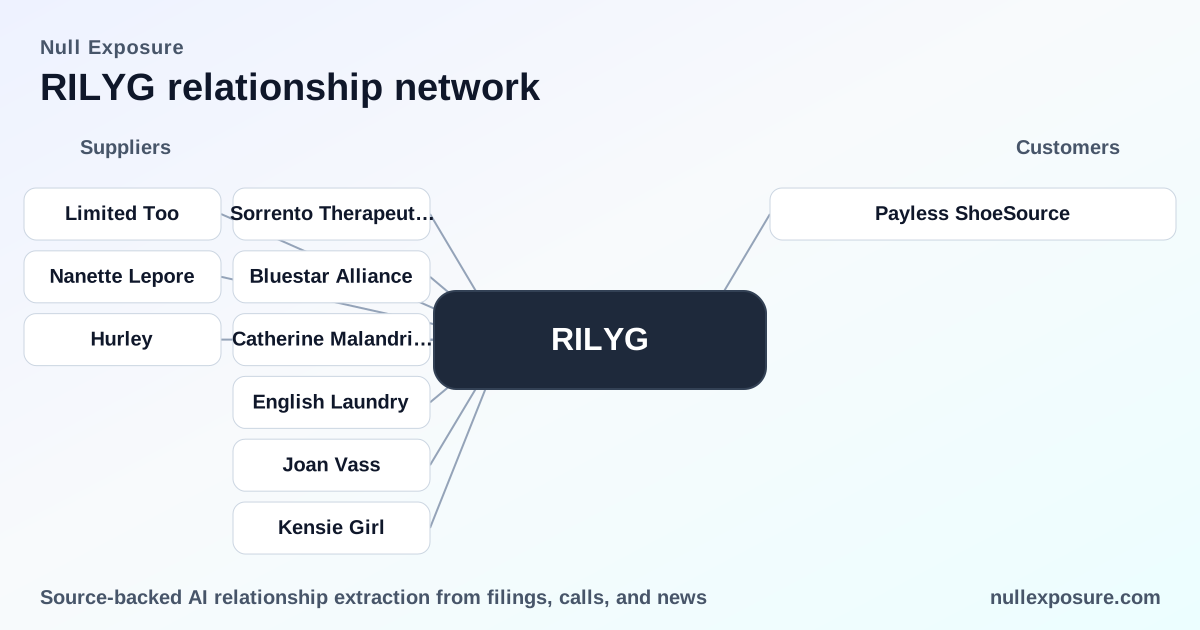
RILYG: Supplier and Counterparty Map for B. Riley Financial’s 5.00% Senior Notes (due 2026)
Thesis — RILYG is a fixed-income claim on B. Riley Financial that sits behind the firm’s operating playbook: B. Riley underwrites, lends to, restructures and acquires distressed assets and intellectual property, then monetizes those positions through asset sales, restructuring fees and ongoing operating cash flows. For investors in these notes, credit risk is driven less by day-to-day retail operations and more by the firm’s counterparty exposures, litigation and the performance of acquired assets. Learn more about counterparty intelligence at https://nullexposure.com/.
Why supplier and counterparty relationships matter for noteholders
B. Riley’s business model blends lending and asset ownership. That hybrid model creates two sources of counterparty vulnerability: lenders and buyers of acquired assets, and counterparties to its operating businesses. Supplier, debtor and portfolio-acquisition counterparties are credit-risk amplifiers — an adverse bankruptcy claim, asset impairment or manufacturing disruption can cascade into lower recoveries for noteholders.
The complete list of relationships identified in our review
Below are every relationship surfaced in the records for RILYG. Each entry is a concise, plain-English synopsis with the supporting source noted.
Sorrento Therapeutics, Inc.
B. Riley’s subsidiary BRCC received a bankruptcy demand alleging approximately $32,166 in payments under a September 30, 2022 bridge loan are avoidable preferences in Sorrento’s Chapter 11 case, creating a contested receivable or contingent liability for the creditor group. According to B. Riley’s 2024 Form 10‑K (FY2024), the demand was filed in the Southern District of Texas.
Bluestar Alliance
B. Riley purchased a portfolio of six retail brands from Bluestar Alliance for $116.5 million, signaling the firm’s strategy of acquiring brand IP and monetizing it through licensing, liquidation or relaunch. A 2019 report in the Los Angeles Business Journal covered the transaction (FY2019).
Catherine Malandrino
B. Riley acquired the assets and intellectual property rights of the Catherine Malandrino fashion brand as part of its Bluestar portfolio purchase, indicating exposure to brand-revival execution risk and licensing revenue volatility. The acquisition was reported by the Los Angeles Business Journal in 2019.
English Laundry
The English Laundry brand’s assets and IP were part of the same Bluestar Alliance portfolio acquired by B. Riley, adding another fashion-label exposure that requires brand management and licensing execution to generate value. This was documented in the LA Business Journal (2019).
Joan Vass
Joan Vass was purchased by B. Riley within the Bluestar portfolio, creating a small-brand exposure that contributes incremental licensing upside but also requires active commercialization to avoid impairment. Source: Los Angeles Business Journal, 2019.
Kensie Girl
Kensie Girl’s assets and IP were included in B. Riley’s purchase from Bluestar, reflecting the firm’s appetite for mid‑market retail IP that can be re-monetized outside legacy corporate structures. Reported by the LA Business Journal (2019).
Limited Too
Limited Too was acquired among the Bluestar portfolio brands; the asset adds to seasonal retail risk and dependence on successful relaunch or licensing deals for recovery. Source: Los Angeles Business Journal, 2019.
Nanette Lepore
Nanette Lepore’s intellectual property was purchased from Bluestar by B. Riley, adding another boutique-label exposure that requires brand stewardship to avoid value erosion. Covered in the Los Angeles Business Journal, 2019.
Hurley
B. Riley indicated intent to buy a significant share of the Hurley surf-wear brand from Bluestar Alliance (which was acquiring Hurley from Nike), but the firm declined to specify the amount, signaling optionality and potential undisclosed contingent exposure. This detail was reported in the Los Angeles Business Journal (2019).
What the company-level constraints tell investors about operations and concentration
The documents include several constraint signals that should be read as company-level operating characteristics rather than linked to any single counterparty.
- Long-term contracting posture: The firm funds operations and acquisitions with senior notes and credit facilities at fixed interest rates, creating predictable but enduring interest-service obligations that increase sensitivity to asset performance over the note tenor.
- APAC manufacturing concentration: Records note production by third‑party manufacturers in Taiwan, China, Thailand, Vietnam, Cambodia, India, South Korea and the Philippines. Geographic concentration in APAC raises supply‑chain and geopolitical exposure for any operating businesses that depend on physical goods.
- Critical dependence on manufacturers: The company states that manufacturers supply substantially all raw materials and facilities required to produce products, making those relationships operationally critical; failure of a single major manufacturer could disrupt revenue tied to product lines.
- Manufacturer role and hardware segment exposure: References to contract manufacturers and “hardware” product segments suggest operational complexity and vendor oversight requirements, especially where product specifications and compliance certifications are required.
These constraints collectively describe a firm that combines long-term financial obligations with operational exposures in global manufacturing and brand management — a profile that amplifies the value of robust counterparty monitoring.
Investment implications and a concise risk checklist
- Credit-serviceability hinges on asset monetization: The note’s safety depends on B. Riley’s ability to realize value from brand acquisitions and collect disputed loan receivables (e.g., Sorrento). Litigation and bankruptcy exposure reduce immediate recoveries.
- Operational counterparties are concentrated and critical: APAC manufacturing concentration is a second-order risk for any product lines in the portfolio; management’s ability to enforce specs and compliance with contract manufacturers is essential.
- Acquisition strategy introduces idiosyncratic execution risk: Purchasing multiple small-to-mid market brands creates optionality but produces volatile cash flows and potential impairments if relaunches fail.
Bold checklist for investors:
- Monitor litigation and bankruptcy developments (Sorrento).
- Track performance and impairment updates for Bluestar-derived brands.
- Assess supply‑chain resilience for any hardware or manufactured product lines.
For a deeper counterparty-focused view of B. Riley and similar issuers, visit https://nullexposure.com/ and see targeted supplier intelligence.
Actionable next steps for holders and analysts
- Request the issuer’s latest recovery and impairment schedules for the Bluestar portfolio and the contingency reserve for litigation claims tied to Sorrento.
- Require quarterly disclosures on manufacturing counterparties, geographic concentration and supplier attestation/compliance to reduce operational tail risk.
- Re-evaluate position sizing against the note’s remaining tenor given fixed-rate senior obligations and the firm’s acquisition-driven balance sheet.
For firm-level counterparty mapping and to subscribe for ongoing updates on RILYG exposures, go to https://nullexposure.com/.
Final takeaway: RILYG investors are effectively lending against a specialist acquirer and lender with concentrated operational and brand-management exposures; credit outcomes depend on legal recoveries and the successful commercialization of acquired assets, not on a steady operating-margin story.