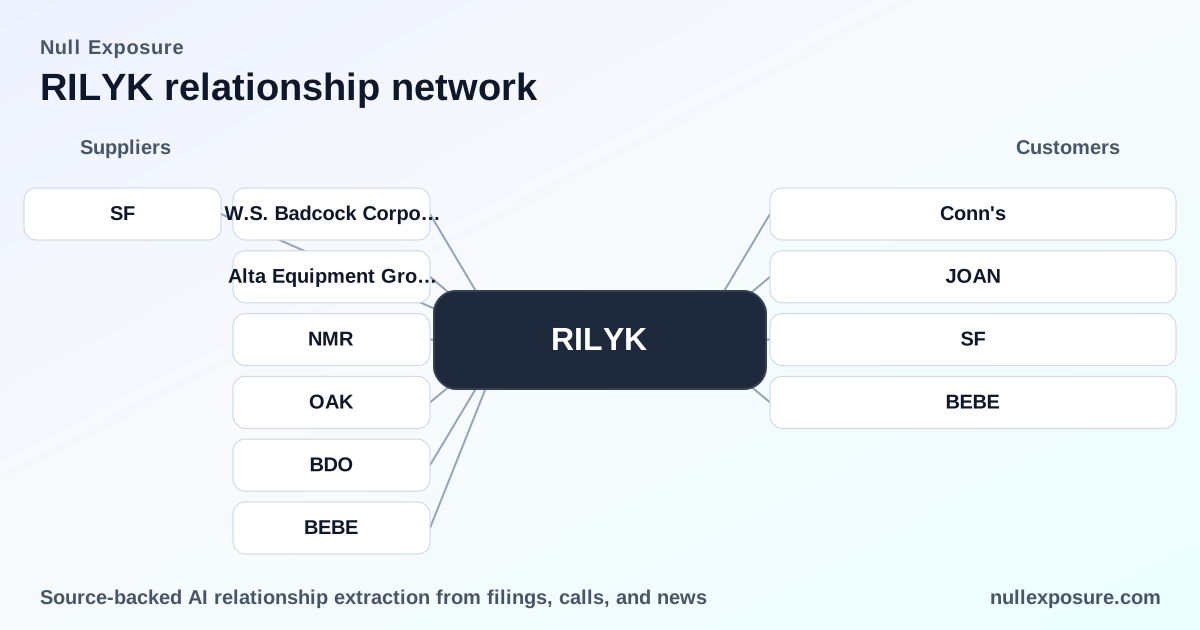
RILYK (B. Riley Financial Inc. 5.50% Senior Notes Due 2026): Supplier relationships and what they signal for investors
B. Riley Financial operates as a diversified financial-services platform that monetizes through investment banking, advisory fees, asset management, and customized financing solutions — the RILYK instrument is a 5.50% senior note due 2026 issued against that corporate platform. For creditors and counterparties, the supplier and partnership map is a direct window into operational dependencies, capital allocation decisions, and where counterparty risk concentrates across businesses such as merchant finance, retail turnarounds, and auction services. Visit https://nullexposure.com/ for a consolidated view of supplier intelligence across fixed-income issuers.
The headline operating thesis for counterparties and note investors
B. Riley runs a multi-pronged service business that leverages both capital provision (loans, underwritings, direct investments) and third-party operational relationships (receivables finance, joint ventures, and outsourced service providers) to generate fee and interest income. Key monetization levers are advisory mandates, recurring asset-management fees, and returns on merchant lending and investment positions; the 5.50% senior notes are funded obligations layered on top of those cash flows.
What the supplier footprint signals about the business model
The supplier data and constraints point to a platform that is transactional, externally leveraged, and operationally distributed:
- Contracting posture: The firm routinely uses master purchase agreements and external credit facilities to move receivables and working capital off the balance sheet, indicating an active use of third-party arrangements to manage liquidity and risk.
- Concentration and criticality: Company-level signals show dependence on external manufacturers and service providers for certain operating lines; those suppliers are critical because interruptions would materially impact revenue-producing operations.
- Role diversity and maturity: Relationships range from traditional service providers (auditors, banks) to strategic joint ventures and equity dispositions, reflecting a mature company managing both near-term liquidity and longer-term strategic repositioning.
These are company-level signals drawn from regulatory disclosures and press reporting; they are not attributed to any single listed relationship unless explicitly named in the underlying excerpt.
Detailed relationships investors should know
Below are the supplier and partner relationships identified in filings, calls, and press reporting, with concise descriptions and source context.
-
W.S. Badcock Corporation — B. Riley entered into a Master Receivables Purchase Agreement with W.S. Badcock Corporation on December 20, 2021, demonstrating the firm's use of receivables financing to monetize retail receivables. According to the company's 2024 Form 10‑K, this agreement remains a disclosed receivables arrangement (10‑K, FY2024).
-
Alta Equipment Group, Inc. — B. Riley sold its entire equity investment in Alta Equipment Group during the year ended December 31, 2024, signaling a portfolio realization event consistent with active investment-cycle management (10‑K, FY2024).
-
Nomura (NMR) — Nomura provided a working-capital facility that B. Riley used to retire an outstanding senior security credit facility; this highlights reliance on third-party credit lines for working-capital optimization (Q4 2024 earnings call, 2024Q4).
-
Oaktree Capital Management (OAK) — B. Riley established a joint venture with Oaktree for Great American Group, indicating strategic alliance use to scale auction/asset‑recovery operations while sharing capital and execution risk (Q4 2024 earnings call, 2024Q4).
-
BDO — B. Riley transitioned to BDO as its auditor mid‑year, executing the handover with external staff augmentation to preserve accounting continuity; this was recapped in a company press summary reported on Yahoo Finance in early 2026 (news report, FY2025).
-
Bebe Stores, Inc. (BEBE) — In a transaction reported in 2023, Bebe financed part of a deal through cash, a secured loan from Milfam, and sold 1.5 million common shares to B. Riley at $5 per share — reflecting B. Riley’s role as an equity purchaser in retail restructurings (Sourcing Journal, FY2023).
-
Stifel (SF) — On October 31, 2024, B. Riley signed a definitive agreement to sell a portion of its W‑2 Wealth Management business to Stifel, illustrating active divestiture of non-core wealth assets to sharpen strategic focus (10‑K, FY2024).
What these relationships imply for risk and opportunity
Together these relationships form a coherent picture: B. Riley executes a capital-intensive operating strategy that shifts economic exposure through sales, JV structures, and external financing. Key implications:
- Operational leverage and counterparty concentration: The receivables purchase with Badcock and the use of external facilities with Nomura show active balance-sheet engineering; this creates exposure to counterparty performance and wholesale funding availability.
- Strategic capital recycling: The sale of Alta equity and partial wealth-management divestiture to Stifel show disciplined capital redeployment from non-core to higher-return segments.
- Risk transfer through partnerships: The Oaktree JV for Great American Group transfers execution risk while preserving upside; this reduces direct capital burden but embeds joint-venture counterparty risk.
- Governance and financial reporting continuity: The mid‑year auditor transition to BDO was executed with external support, which removes an accounting continuity risk vector and stabilizes financial reporting practices.
Visit https://nullexposure.com/ to benchmark these supplier patterns against peer platforms and to track counterparty concentration trends.
How this matters to RILYK note investors
For holders of the 5.50% senior notes due 2026, the supplier and partner map translates into three practical investment considerations:
- Liquidity pathway: Active use of facilities and receivables monetization supports near‑term liquidity management but increases dependence on external credit markets and counterparties such as Nomura.
- Credit remediation and asset quality: Disposals and JVs reduce balance-sheet concentration but create realized-gain and operational-integration risks that affect free cash flow available for note servicing.
- Operational resilience: Critical supplier roles cited at a company level imply that any material interruption in outsourced services would have immediate earnings consequences; note investors should monitor operational-disruption disclosures closely.
Final takeaways and next steps
B. Riley runs an externally integrated operating model that is capital‑efficient but counterparty‑sensitive. The company offsets balance‑sheet strain with strategic disposals, JV formation, and receivables financing, while auditor transition and M&A activity show active corporate management.
For ongoing monitoring and comparative supplier intelligence, review consolidated supplier profiles and counterparty concentration analytics at https://nullexposure.com/. If you want a tailored counterparty risk brief or a comparative supplier heat map for fixed‑income exposures, start with the home page: https://nullexposure.com/.