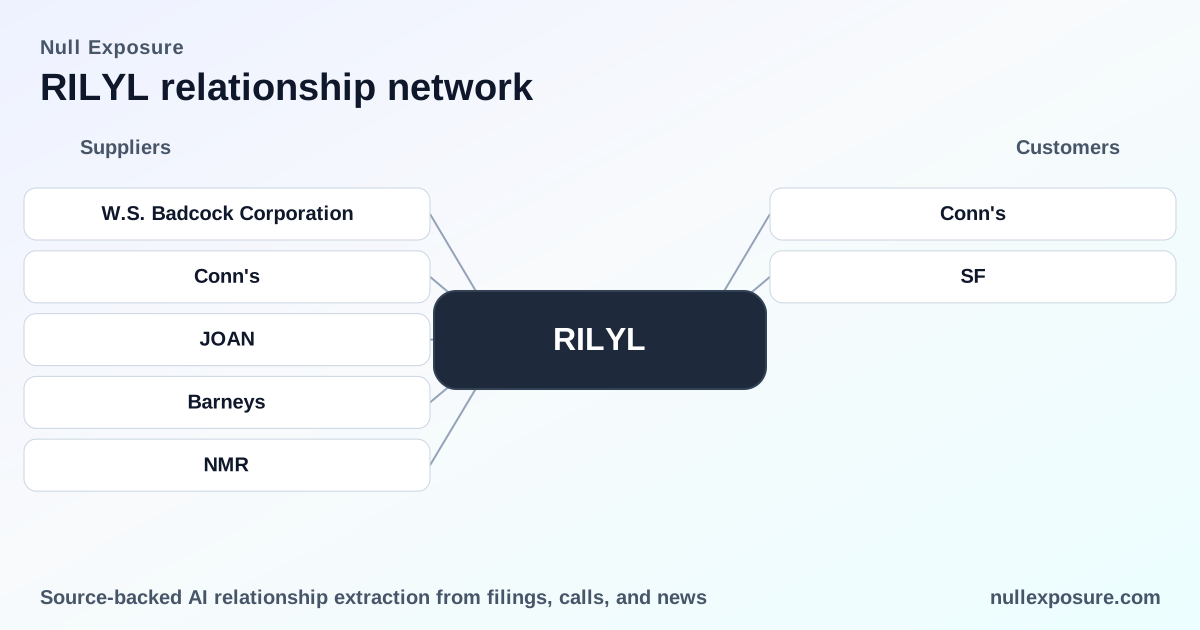
B. Riley Financial Inc (RILYL) — Supplier relationship and operational briefing
B. Riley Financial operates as a diversified financial services conglomerate that monetizes through advisory, asset acquisition and disposition, lending, and specialty finance activities, including receivables purchasing and retail liquidation mandates executed through subsidiaries. The firm's revenue mix reflects transactional income from asset dispositions and ongoing returns from credit and investment positions established around distressed or corporate restructuring events. For investors and operators assessing counterparty risk, the company's supplier and counterparty footprint is an important lens into how capital, operational execution, and reputational exposure are coordinated. Learn more about the underlying supplier intelligence at https://nullexposure.com/.
Quick read on contracting posture, concentration and criticality
B. Riley’s public disclosures and subsidiary activity produce a clear set of company-level signals about how it sources external services and manages operational risk. Third-party relationships are both operationally important and geographically diverse. Filings indicate heavy reliance on external service providers for critical processing functions and, in some businesses, outsources production activities across Asia. This combination creates a mix of important service-provider dependencies and global supply-chain exposure.
- Contracting posture: filings reference master receivables purchase agreements and dedicated credit facilities, reflecting formal, contract-driven supplier engagements rather than ad hoc vendor relationships.
- Concentration and criticality: company-level language describes suppliers that “supply substantially all of the raw materials” for certain operations and third-party providers of core data processing; that wording signals high criticality for select vendors.
- Maturity and controls: the company references reliance on vendor SOC 1 Type 2 reports for hosted IT solutions, which is a signal of deployed control frameworks and an ability to manage vendor governance at scale.
- Geography and disruption risk: evidence points to APAC manufacturing exposure and global supplier footprints, which translates into policy and operational vulnerability to regional disruptions.
These operating-model signals matter because they affect uptime of asset processing, the enforceability of receivables arrangements, and the speed at which the company can monetize distressed retail assets.
What this means for procurement and risk management
Institutional counterparties should treat B. Riley’s supplier posture as contract-oriented but operationally concentrated in specific service streams. The presence of SOC-validated providers is positive for control maturity, but the combination of critical external manufacturers and global supplier exposure requires monitoring of geopolitical, labor, and logistics variables. Pay attention to spend bands that indicate both smaller revolving balances and mid-size term exposures; these reveal a mix of tactical, transaction-level counterparty exposures and occasionally material credit lines referenced in filings.
For deeper supplier visibility, visit https://nullexposure.com/ for a unified view of counterparties and documented excerpts.
Supplier relationships you should evaluate (each relationship covered)
W.S. Badcock Corporation
B. Riley executed Master Receivables Purchase Agreements with W.S. Badcock Corporation via subsidiaries — the first agreement dated December 20, 2021, and a subsequent agreement executed by B. Riley Receivables II on September 23, 2022 — indicating structured receivables financing tied to the retailer. This arrangement demonstrates asset-backed funding relationships used by B. Riley to acquire and monetize retail receivables. According to the company’s FY2024 10‑K, these agreements are formalized through designated receivables entities.
Conn's
B. Riley carries a small loan receivable exposure to Conn’s, with accrued interest on a $93,000 balance reported as current as of June 30, 2024; this is a modest counterparty credit position within the broader portfolio. The FY2024 10‑K specifically notes the $93,000 Conn’s loan receivable and its status.
JOANN (JOAN)
B. Riley disclosed a partnership and active role in the liquidation process for JOANN, citing a successful competitive bankruptcy bid to manage the liquidation of over 800 JOANN fabric and craft stores — an example of the firm’s execution in retail restructuring and asset disposition. Management referenced this transaction on the company’s 2024 Q4 earnings call, describing use of capital to fund the investment loan associated with the JOANN liquidation.
Barneys
B. Riley participated on the buyer side in the 2019 Barneys bankruptcy asset transaction, which resulted in assets being sold to Authentic Brands Group and B. Riley Financial; that engagement underscores the company’s historical role in retail asset acquisition and brand-related restructuring. A 2021 industry report in National Jeweler recounts B. Riley’s involvement in the Barneys asset sale following the 2019 bankruptcy.
Nomura
B. Riley used a financing facility with Nomura in a capital-management maneuver: management stated that they used that facility to retire a senior security credit facility with Nomura and to provide working capital and to fund the JOANN investment loan. The detail comes from remarks on the 2024 Q4 earnings call and illustrates how B. Riley leverages bank facilities to optimize capital structure around special situations.
Constraints and what they reveal about the business model
Company-level excerpts provide instructive constraints that shape supplier risk and procurement strategy. Filings reference APAC-focused production and global supplier exposure, which is a signal of cross-border operational dependencies and potential exposure to regional labor and trade disruptions. The company also highlights outsourced, critical data processing operations and reliance on third-party SOC 1 Type 2–audited providers, indicating governed, control-aware service relationships rather than informal vendor ecosystems. Spend-band excerpts referencing both sub‑$100k revolvers and mid‑hundred‑thousand dollar term loan balances portray a portfolio of small, transaction-level exposures alongside episodic, larger term commitments.
These constraints should shape counterparty diligence: prioritize continuity-of-service clauses, control evidence (SOC reports), and dispute/termination provisions for critical vendors.
For a consolidated supplier risk dossier and to monitor changes over time, see https://nullexposure.com/.
Investor action points
- Verify counterparty controls: request SOC reports or equivalent for any critical service providers involved in data processing or asset custodial services.
- Monitor receivables agreements: receivables purchase agreements are central to how B. Riley monetizes retail assets; track amendment history and subordination terms in the relevant entities.
- Stress-test geography risks: map any APAC supplier exposure cited at the company level against scenario plans for logistics, currency, and labor disruptions.
For investor-grade supplier research and to follow updates to these relationships, consult https://nullexposure.com/.
B. Riley’s playbook is clear: it executes structured, contract-led engagements to acquire and monetize retail and receivables assets while leveraging bank facilities for working capital. The governance signals in filings — SOC reliance and formal receivables vehicles — indicate operational sophistication, but the combination of critical external suppliers and global exposure requires active monitoring by institutional counterparties.