B. Riley Financial (RILYN) — supplier relationship briefing for investors
B. Riley Financial operates as a diversified capital markets and advisory platform that monetizes through transaction and recurring fee income: investment banking and advisory fees, brokerage and trading spreads, asset management fees, and financing interest and carried returns from capital investments. The firm's supplier footprint in regulatory disclosures is narrow in this supplier-focused review, but the items disclosed—receivables purchase agreements and credit facilities—carry direct implications for liquidity, counterparty exposure and the firm's reliance on third‑party service providers. For a concise view of supplier relationships and contractual signals, see the full portal: https://nullexposure.com/.
Why supplier relationships matter for a financial services consolidator
B. Riley’s core business depends on a mesh of third-party counterparties rather than large inventories or manufacturing supply chains. Counterparty contracts that affect receivables funding, matched-book brokerage lines, and lending facilities are operationally critical because they influence funding cost, balance sheet flexibility and firm-level credit exposure. The supplier disclosures in filings should be read as components of capital structure and liquidity management, not just procurement.
Visit the homepage for more supplier intelligence: https://nullexposure.com/.
What the disclosed supplier link is in simple terms
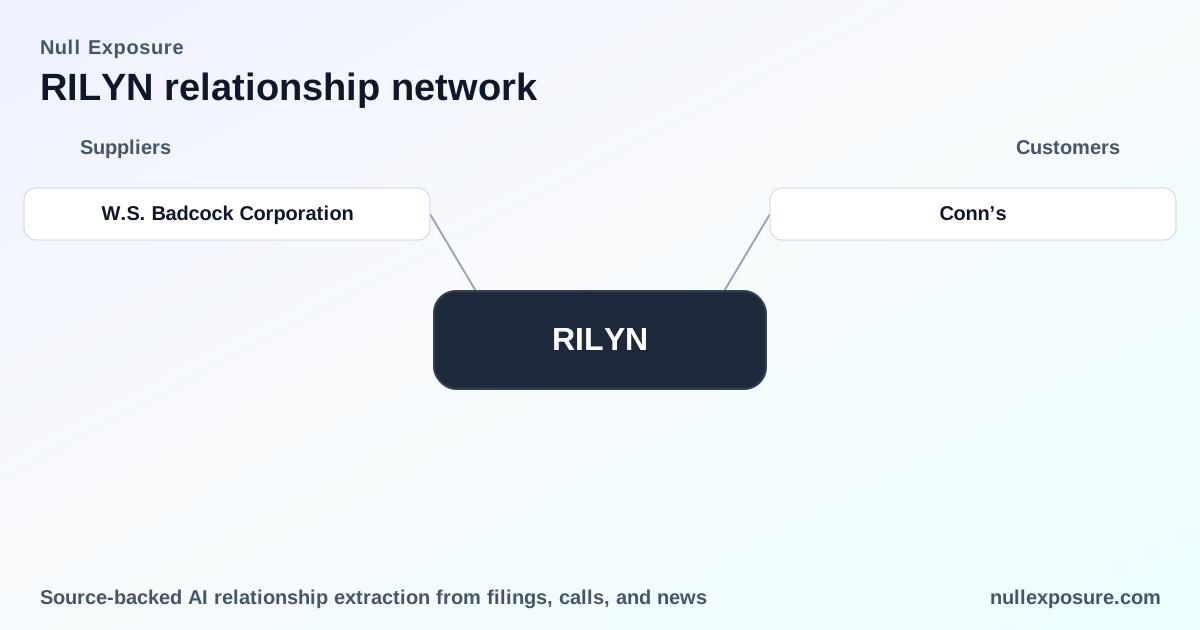
A single supplier relationship appears in the supplier-focused disclosure set: W.S. Badcock Corporation. According to the company’s FY2024 10‑K, RILYN entered into a Master Receivables Purchase Agreement (Badcock Receivables I) with W.S. Badcock Corporation on December 20, 2021; the filing notes W.S. Badcock was an indirect subsidiary of FRG at signing and became a subsidiary of Freedom VCM on August 21, 2023. This structure functions as a receivables financing arrangement that shifts payment timing and credit exposure tied to Badcock receivables. (FY2024 10‑K filing.)
Relationship list — one short entry per disclosed relationship
- W.S. Badcock Corporation — RILYN executed a Master Receivables Purchase Agreement (Badcock Receivables I) with W.S. Badcock Corporation on December 20, 2021, with subsequent ownership crossover noted when Badcock moved under Freedom VCM on August 21, 2023; the FY2024 10‑K treats this as a receivables financing arrangement. (FY2024 10‑K filing, rilyn-2024-12-31.)
What the disclosed constraints reveal about RILYN’s operating posture
The set of constraint excerpts extracted from disclosures signals several company-level characteristics that matter to investors evaluating supplier and counterparty risk:
- Long-term funding posture: The company disclosed a new credit agreement executed on February 26, 2025, with funds affiliated with Oaktree Capital Management that provided a three‑year $125 million secured term loan plus a four‑month $35 million delayed draw facility. This indicates multi-year secured financing relationships that anchor liquidity and influence covenant-driven flexibility. (Disclosure of new credit agreement, Feb 26, 2025.)
- APAC production exposure cited in the corpus: One disclosure notes that production for certain operations is performed by third‑party contract manufacturers in Taiwan, China, Thailand, Vietnam, Cambodia, India, South Korea and the Philippines. Present in the disclosure set, this is a company-level signal of geographic concentration of third‑party operational activity in APAC, which increases exposure to regional supply‑chain and geopolitical risk even for firms with financial-service centric business lines. (Production/manufacturing excerpt.)
- Critical supplier dependence: The language “our manufacturers supply substantially all of the raw materials and provide all facilities and labor required to manufacture our products” signals high criticality of certain third‑party manufacturers to the business model where those lines exist; replacement cost and switching risk are material if those suppliers are disrupted. (Manufacturer dependency excerpt.)
- Dual supplier roles: Excerpts also describe third parties functioning as both manufacturers and service providers and disclose reliance on a broad group of banks and broker‑dealers to operate a matched book for securities borrowing and lending. This highlights operational interdependence with financial intermediaries, where counterparties are essential to trading, hedging and liquidity management. (Service provider / matched-book excerpt.)
Taken together, these constraints suggest a company operating with secured, multi-year financing commitments, concentrated operational exposure in certain geographies and critical dependencies on specialized third‑party providers—all factors that determine counterparty risk and recovery dynamics in stress scenarios.
Concentration, criticality and what investors should prioritize
The supplier disclosure set is concentrated—only the Badcock receivables agreement is explicitly reported in the supplier results returned. Concentration is a signal, not a conclusion: a single documented supplier relationship exposes the firm to idiosyncratic credit and contractual risk tied to that counterparty’s receivables and ownership transitions. For market participants assessing exposure, focus on:
- The terms and recourse in the receivables purchase agreement, including repurchase, credit protections, and recourse events.
- How the receivables financing interacts with broader secured financing (the Oaktree facility) and whether cross-collateralization or intercreditor arrangements exist.
- The matched-book and broker-dealer relationships that enable securities lending—these are operational suppliers whose failure or withdrawal can compress liquidity rapidly.
A practical next step: review the full 10‑K and credit agreement exhibits for covenant thresholds and intercreditor language, available via regulatory filings and the supplier intelligence hub: https://nullexposure.com/.
Final takeaways and recommended actions for investors
- Receivables financing is the primary supplier exposure in the current disclosure set; the Badcock Receivables I agreement is the tangible manifestation of counterparty dependence. (FY2024 10‑K.)
- RILYN’s liquidity posture is secured by multi-year facilities (Oaktree‑backed term loan structure disclosed Feb 26, 2025), which reduces short-term refinancing risk but concentrates secured creditor rights. Treat the credit agreements as operational suppliers of capital. (Credit agreement disclosure.)
- Third‑party manufacturing and service exposure in APAC and matched‑book bank relationships are company-level risk signals that investors should monitor across related filings, even if those suppliers are not traditional procurement vendors. (Production and service provider excerpts in disclosures.)
For deeper supplier mapping and contract-level summaries, review the RILYN supplier dossier at https://nullexposure.com/. If you need a targeted counterparty risk memo or a covenant analysis for RILYN’s credit facilities, the portal resources can be used to generate tailored due-diligence outputs: https://nullexposure.com/.
This briefing focuses on disclosed supplier relationships and contract-level signals that materially affect liquidity and counterparty exposure; use the cited 10‑K and the firm’s credit agreement disclosures as the primary documents for any investment decision.