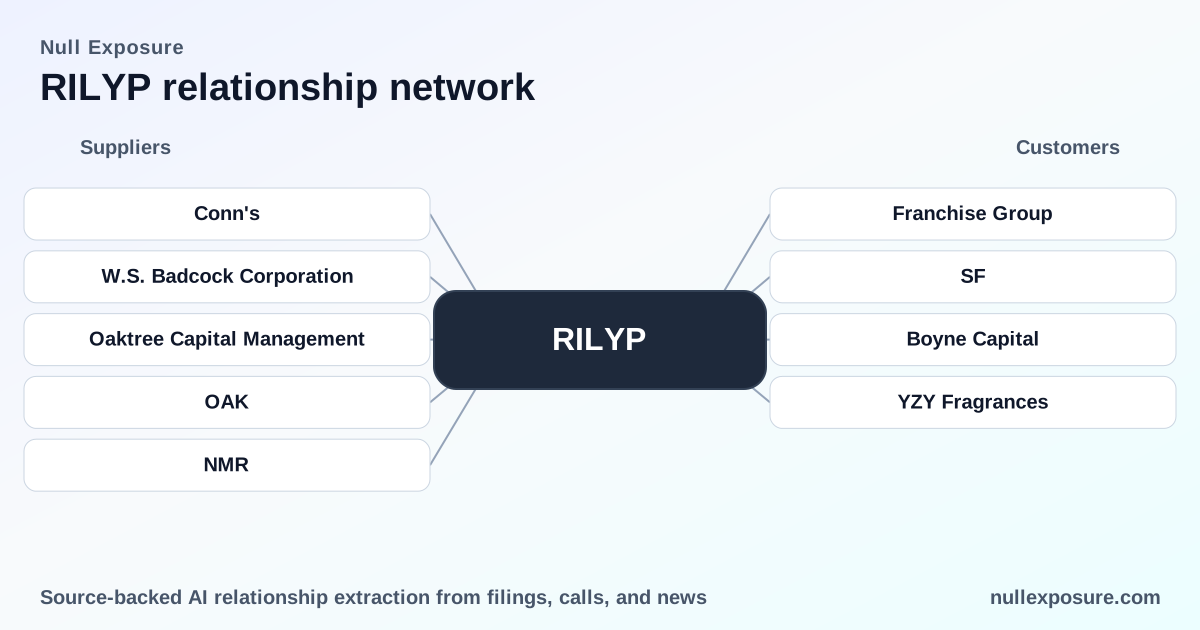
B. Riley Financial (RILYP) — Supplier relationships and what they signal for investors
B. Riley Financial operates as a diversified financial services conglomerate that monetizes through advisory, capital markets, merchant banking, and credit products; in the preferred-stock context (RILYP) investors are buying a fixed-income-like claim on a company that funds itself through a mix of secured lending, receivables arrangements, and syndicated financing. The company leverages balance-sheet lending and structured receivables purchases while maintaining third‑party servicing and capital partners to scale those products. For an investor or operator evaluating supplier exposure, the critical questions are which counterparties service receivables, who provides capital and credit lines, and what operational outsourcing creates concentration or single-point-of-failure risk. Learn more at https://nullexposure.com/.
Quick orientation: how supplier relationships feed the business model
B. Riley’s operating model depends on two pillars: capital partners who underwrite and provide liquidity (term loans, credit facilities) and service/vendor relationships that manage receivables origination and servicing. The combination lets B. Riley originate loans, sell or securitize receivables, and retain servicing economics without owning all operating infrastructure. That structure creates operational leverage but also counterparty concentration and refinancing sensitivity.
If you want to map detailed supplier exposures and counterparty clauses, start here: https://nullexposure.com/.
The counterparties named in public disclosures — plain-English summaries
Conn’s
B. Riley reports a loan receivable with a principal amount of $93,000 outstanding from Conn’s, plus two smaller receivable instruments that are serviced by Conn’s. According to the FY2024 Form 10‑K, Conn’s is a servicer/counterparty on specific receivable assets on B. Riley’s balance sheet. (Source: B. Riley FY2024 10‑K)
W.S. Badcock Corporation
B. Riley entered a Master Receivables Purchase Agreement entitled “Badcock Receivables I” with W.S. Badcock Corporation on December 20, 2021, under which B. Riley purchased receivables originated by Badcock. The FY2024 10‑K references this agreement as a structured receivables purchase tied to the company’s merchant lending efforts. (Source: B. Riley FY2024 10‑K)
Oaktree Capital Management / Oaktree Capital Management, L.P.
B. Riley completed a credit agreement with Oaktree that provided a $125.0 million secured term loan facility, and later public reports describe partnering with Oaktree on an additional loan facility and negotiating bond exchanges with institutional investors. These references—reported across the FY2025/FY2026 timeline—show Oaktree functioning as a capital provider and lender supporting B. Riley’s financing needs. (Source: company SEC reporting summarized in TradingView (SEC 10‑K highlight) and a March 2026 LA Business Journal article)
Nomura Holdings
B. Riley was involved in arranging financing for a management buyout of Franchise Group that included a Nomura‑provided financing commitment of roughly $2.8 billion, a transaction discussed in the context of subsequent shareholder litigation. This indicates Nomura’s role as a large external financing partner on major M&A transactions in which B. Riley participated. (Source: InvestmentNews reporting on litigation and transaction financing, FY2026 coverage)
What the constraints tell investors about operating posture
The public constraint excerpts build a consistent operational picture. Treat these as company‑level signals rather than being tied to a single supplier unless the excerpt names a counterparty.
-
Long‑term contracting posture: The company recognizes operating leases with terms greater than 12 months, signaling a preference for multi‑year commitments where property and capacity are relevant. This implies a degree of fixed-cost leverage and potential lease liability on the balance sheet. (Evidence: lease accounting excerpt)
-
Manufacturing and geographic exposure to APAC: Excerpts note third‑party production in Taiwan, China, Thailand, Vietnam, Cambodia, India, South Korea and the Philippines—this is a clear indication of APAC operational dependence and potential supply‑chain concentration risk. While that language is generic and not specific to B. Riley’s financial services lines, it is a company‑level signal that the firm or its subsidiaries rely on APAC manufacturing/service partners. (Evidence: geography excerpt)
-
High criticality of outsourced manufacturers/providers: The constraints stress that third‑party manufacturers supply substantially all raw materials and capacity, and their termination would disrupt production—this signals critical supplier dependence when it applies and suggests limited redundancy in some operational lines. (Evidence: materiality excerpt)
-
Active use of third‑party service providers for core processes: The company leverages third‑party hosted IT solutions for processing customer sales and billing (SOC 1 Type 2 reliance), which points to reliance on serviced platforms for revenue processing and controls. This is an operational concentration that reduces in‑house overhead but creates vendor‑risk if a provider fails or changes control. (Evidence: SOC 1 Type 2 excerpt)
-
Relationship maturity and stage: Excerpts describing production performed by third‑party contract manufacturers and reliance on third‑party service organizations indicate active, mature outsourcing relationships rather than pilot arrangements. (Evidence: relationship_stage and relationship_role excerpts)
Investment implications — what investors and operators should watch
-
Counterparty concentration vs. diversification: B. Riley’s model uses named capital partners (Oaktree, Nomura) for large facilities and captive receivables arrangements with retail partners (Conn’s, Badcock). Concentration among a few capital providers is a financing risk if markets stress.
-
Operational outsourcing reduces fixed cost but increases single‑point risk: Dependence on third‑party servicers (for billing, loan servicing) and manufacturing/service partners in APAC creates systemic operational exposures that require strong contracts and continuity plans. Service continuity and SOC attestation are material to credit and operational stability.
-
Legal and reputational overlay from large transactions: The Nomura‑backed buyout tied to Franchise Group and subsequent shareholder litigation illustrates how financing arrangements can generate litigation and reputational risk that affect sponsor cash flows and distract management.
-
Liquidity and covenant monitoring: The Oaktree secured term loan ($125m) and later loan facility activity underscore the need to monitor covenant headroom and refinancing timelines; capital partner relationships underpin near‑term liquidity.
If you need a transaction‑level supplier map or clause‑level risk assessment, start your due diligence at https://nullexposure.com/.
Final assessment and action items
B. Riley’s supplier relationships combine receivables servicers and retail originators (Conn’s, Badcock) with institutional capital providers (Oaktree, Nomura)—a business model that scales credit origination while transferring parts of capital risk to partners. For investors, the two most important monitoring items are (1) the stability and terms of financing facilities with capital providers and (2) the robustness of vendor servicing controls and business‑continuity arrangements.
To explore detailed counterparty disclosures, document timelines, and clause‑level evidence, visit https://nullexposure.com/. For portfolio managers and operating partners focused on counterparty concentration and vendor‑risk, NullExposure’s supplier mapping tools will speed definitive diligence: https://nullexposure.com/.