RILYT supplier relationships: what investors should know
B. Riley Financial issues the RILYT instrument as part of a diversified financial services franchise that monetizes through investment banking, asset management, principal investing and advisory fees. The 6.00% Senior Notes due 2028 fund working capital and strategic activity across the platform; supplier and counterparty disclosures in public filings therefore matter because they reveal contingent exposures that can affect cash flow, collateral arrangements and reputational risk. This note examines the supplier and counterparty references tied to RILYT, summarizes every disclosed relationship in the record set, and draws operational implications for investors and operators. For primary-source supplier intelligence, visit https://nullexposure.com/.
Quick read: the two counterparties on record
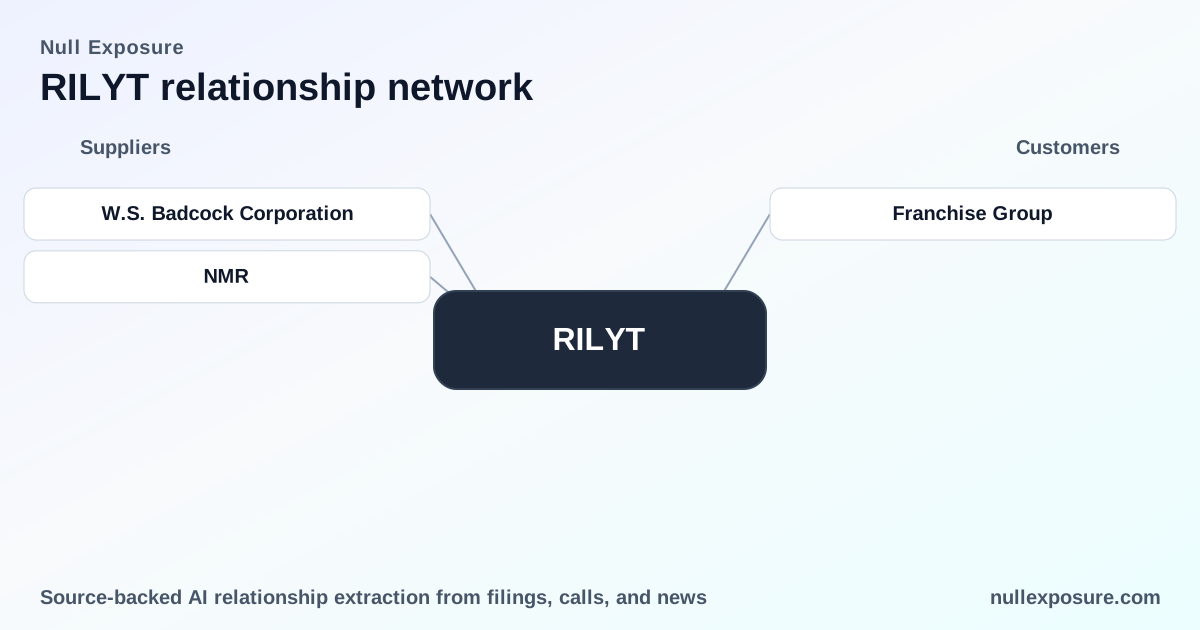
Two counterparties are present in the supplied results: W.S. Badcock Corporation (documented in a 10‑K filing) and Nomura Holdings (reported in news coverage). Each relationship touches different parts of B. Riley’s deal flow—receivables financing on one hand and large‑ticket M&A financing on the other—so investors should treat these as distinct vectors of exposure.
W.S. Badcock Corporation — receivables financing arrangement
B. Riley disclosed a Master Receivables Purchase Agreement (termed “Badcock Receivables I”) executed on December 20, 2021 with W.S. Badcock Corporation, originally described as an indirect subsidiary of FRG and later affected by a transaction in August 2023. According to the company’s FY2024 10‑K filing, this is an explicit receivables purchase relationship that transfers credit and servicing dynamics to B. Riley’s balance sheet management. (Source: B. Riley FY2024 10‑K filing.)
Nomura Holdings — financing partner in a large buyout
A 2026 news report documents B. Riley’s role structuring financing for the $2.8 billion management buyout of Franchise Group, with Nomura Holdings providing key financing to complete the transaction that allowed management to acquire the remaining stake. This relationship demonstrates B. Riley’s capacity to syndicate or arrange large‑scale financing with global banks. (Source: InvestmentNews coverage, March 2026.)
What the disclosures imply about operating posture and counterparty risk
B. Riley’s disclosures and the extracted constraints provide company‑level signals about contracting posture, concentration, criticality, and operational maturity that investors should incorporate into credit and counterparty analysis.
- Contracting posture: The presence of a named receivables purchase agreement shows the firm uses structured commercial arrangements to move credit exposures off or onto its balance sheet depending on capital strategy; the Nomura financing demonstrates willingness to arrange syndicated or external financing for sponsor‑led deals. Both signal active balance‑sheet and deal‑sourcing management rather than passive lending.
- Concentration and counterparty mix: The disclosed counterparties span a retail operator (W.S. Badcock) and a global investment bank (Nomura), indicating diversified counterparty types rather than single‑counterparty concentration in the supplied results; however, the dataset is small and does not prove broad diversification across the platform.
- Criticality and operational dependence (company signal): Filings include language that production is performed by third‑party contract manufacturers across Asia and that such arrangements are critical — termination or capacity failure would prevent manufacturing until replacements were sourced. While that excerpt reads as manufacturing exposure, treat it as a company‑level constraint flagged in the records: the company acknowledges single‑point‑of‑failure risk where third‑party suppliers control essential capacity.
- Maturity of relationships and professionalization: The filing references the use of established professional service providers — e.g., a retained compensation consultant reporting solely to the Compensation Committee — and standard clearing arrangements with broker‑dealers. These items point to institutionalized governance and third‑party engagement practices that investors value, but they also formalize dependency on external expertise.
Detailed constraint signals from filings (company-level)
The filing excerpts supplied reveal several operational constraints that are relevant to supplier risk and resilience planning:
- Production and manufacturing are performed by third‑party contract manufacturers in Taiwan, China, Thailand, Vietnam, Cambodia, India, South Korea and the Philippines, which exposes operations to Asia‑centric supply‑chain risk and geopolitical concentration.
- The filing explicitly classifies these manufacturing arrangements as critical: termination or failure to provide capacity or quality would halt production until replacements are found.
- The company relies on third parties to supply raw materials and provide labor and facilities — i.e., the vendors are acting as manufacturers rather than mere component suppliers.
- The company uses third‑party service providers for clearing broker functions and for executive compensation consulting (Mercer LLC in FY2024), demonstrating reliance on specialized service firms for operational execution and governance.
These constraints should be used as company‑level signals when evaluating counterparty credit and operational continuity for RILYT holders.
What investors should watch next
- Collateral and waterfall exposure: For noteholders of the RILYT issue, confirm whether receivables purchase agreements such as the Badcock arrangement create priority claims or influence available collateral in stressed scenarios. The 10‑K language is definitive on the existence of the arrangement; review transaction schedules for priority and recourse terms.
- Syndication and reputational lines: The Nomura‑backed buyout underscores B. Riley’s ability to organize large financings, but also creates relationship exposure to the financing banks; monitor rolling commitments and bank covenants that could amplify funding stress.
- Supply‑chain vs. platform mismatch: The extracted manufacturing constraints are material and critical; investors should reconcile whether these excerpts reflect a business unit within the broader platform or a separate reporting entity before drawing conclusions on operational risk for financial assets.
For a deeper read and primary‑source access to these filings and media coverage, explore the full supplier profile at https://nullexposure.com/.
Bottom line for portfolio and operations teams
B. Riley’s disclosed supplier and counterparty universe in the supplied records is small but meaningful: a structured receivables purchase program with a retail operator and a financing relationship with a global bank. Filings throw a spotlight on company‑level dependencies—particularly third‑party manufacturing and service providers—that create critical operational exposure and require targeted diligence by credit and operational risk teams. Institutional investors should reconcile these signals with transaction‑level documentation to understand priority, recourse and contagion channels.
If you need a concise, document‑level review of the arrangements and how they interact with debt‑service and covenant mechanics, begin with the supplier dossier on Null Exposure: https://nullexposure.com/. For tailored questions or to commission a focused counterparty risk memo, visit https://nullexposure.com/ and request a supplier deep‑dive.